

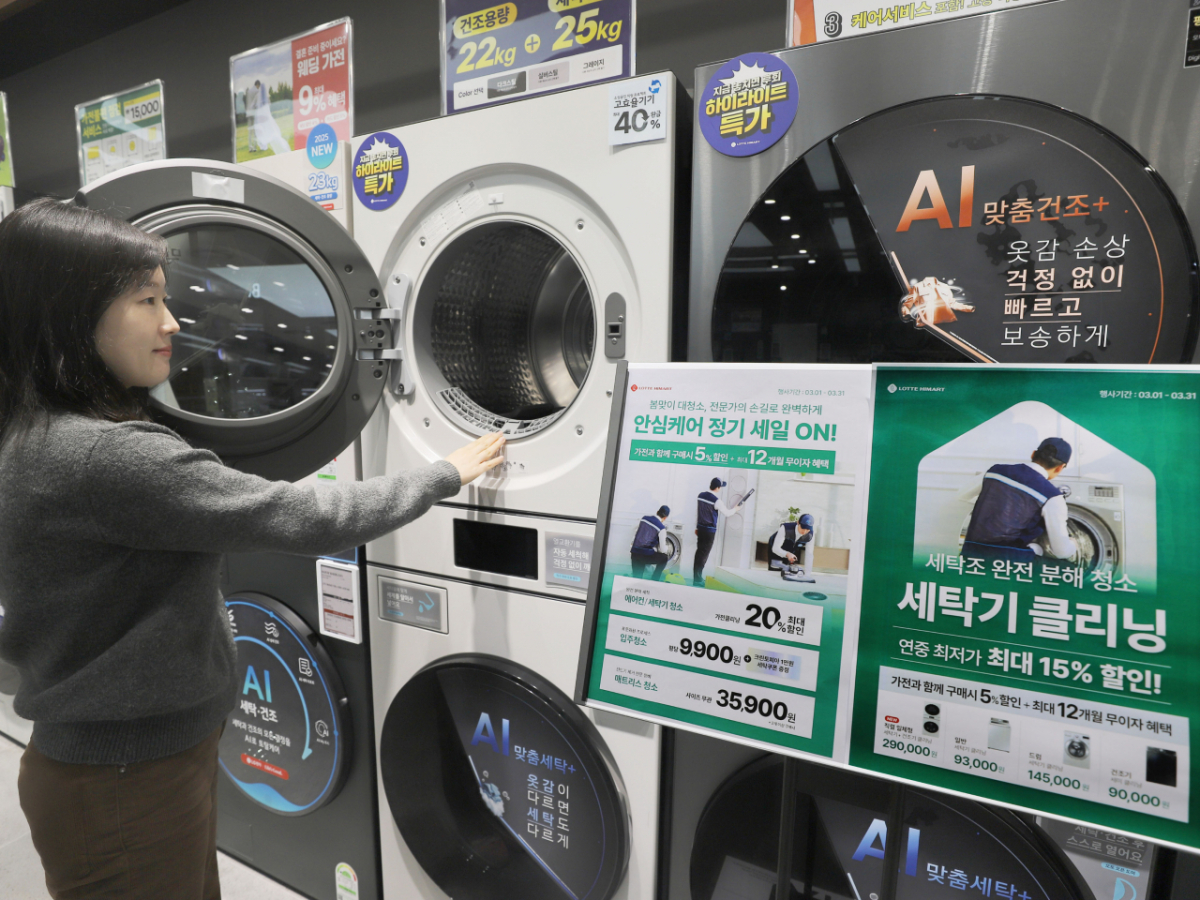
Domestic home appliance hypermarkets are seeking survival strategies beyond their traditional business models that relied heavily on home appliance sales. This shift comes amid slowing demand for replacing large appliances, alongside the expansion of e-commerce in home appliance sales and an increase in direct sales by manufacturers.
According to industry sources on the 8th, Lotte H-E-Mart's net sales for the first half of this year amounted to 1.089 trillion won, a 3.1% decrease compared to the same period last year. Operating losses reached 13.9 billion won, widening the deficit. E&S Retail, which operates Electronic Land, recorded an operating loss of 20.4 billion won last year, also seeing its deficit expand. Sales fell slightly to 521.4 billion won compared to the previous year.
The primary reason for the difficulties faced by the home appliance hypermarket industry is the decline in demand for large appliances themselves. Analysts note that while the pandemic prompted increased time spent at home, leading to a surge in replacement demand for large appliances, the repurchase cycle has not yet returned. The typical replacement cycle for large appliances is usually 8 to 10 years.
The growth of e-commerce also contributed to shrinking the market position of hypermarkets. There has been an increase in cases where manufacturers meet consumers directly through their own online stores or flagship stores. In response, Lotte H-E-Mart is expanding its business scope to become "a place responsible for everything from home appliance purchases to management." A representative example is " Care (Care)." This service allows customers to resolve all post-purchase needs—including home appliance insurance and repairs, cleaning, and home interior services—at Lotte H-E-Mart. Representative offerings include appliance cleaning, where professional technicians visit customers' homes to disassemble, clean, and sterilize appliances, as well as non-invasive installation services. Unlike manufacturers that typically offer quality guarantees for only 1 to 2 years, some services now provide coverage of up to 5 years depending on the product.
Care is already delivering tangible results. Over the past three years, sales have grown at an annual average rate of 56%, with first-half sales this year reaching 37.3 billion won, a 44% increase compared to the same period last year. The bundled purchase rate—the proportion of customers who buy both appliances and services—rose from 15% in 2023 to 52.5% in the first half of this year.
To compensate for the long replacement cycle of large appliances, hypermarkets are also focusing on mobile and IT products, which have relatively higher purchase frequency. Items such as smartphones, earphones, and peripherals have shorter replacement cycles and require more frequent store visits than refrigerators or washing machines. In February, the Jamsil store was reorganized to include Takan Shop, Korea's largest keyboard specialty store, and a custom PC section where customers can assemble their own PCs. Mobile and IT sales increased by 15.3% in the first quarter and 13.7% in the second quarter.
Store layouts are also being transformed into spaces for experiencing hobbies. A representative example is a dedicated area for camera enthusiasts. By operating hobbyist galleries and educational programs, hypermarkets are expanding customer touchpoints centered around hobbies and communities. The goal is to leverage these increased touchpoints to drive purchases of other home appliances.
Electronic Land is accelerating changes aimed at attracting younger customers. It is expanding digital-focused stores targeting the 2030 demographic, who show strong interest in desk setups, computers, and gaming devices. In particular, the Yongsan store has established a dedicated IP (intellectual property) zone to showcase pop-up content and other related offerings.
Industry observers believe that the competitive landscape for hypermarkets will no longer remain limited to "which store offers more home appliances" as in the past. With the replacement cycle for large appliances lengthening and online shopping becoming routine, survival now depends on how diversely stores can create reasons for customers to visit—through services, IT products, and hobby-related content. An industry executive stated, "For hypermarkets, creating touchpoints with customers has become crucial. Strategies aimed at increasing store visit frequency through services, small appliances, IT products, and experiential content—and converting these visits into purchases—are expected to be strengthened."

 in LIVING
