

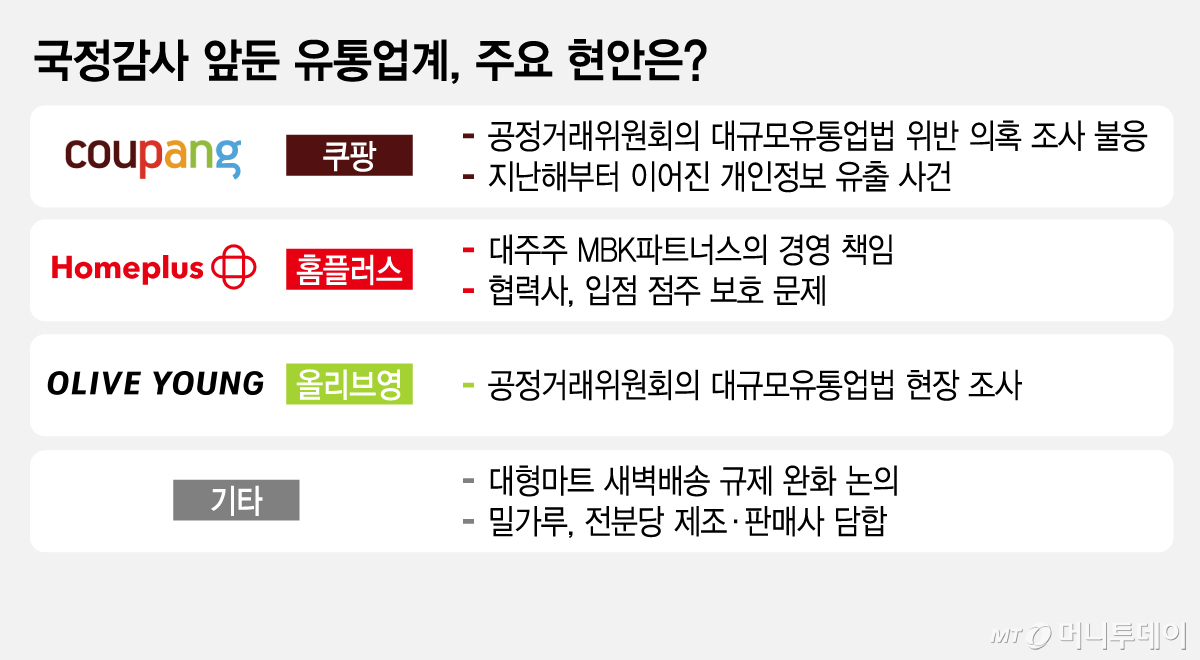
Tension is rising in the retail and food industries ahead of next month’s national assembly review. This follows a series of major issues this year, including the clash between Coupang and the Fair Trade Commission over on-site inspections, the Homeplus crisis, collusion on food raw material prices, and industrial accidents. Recently, the Korea Fair Trade Commission has conducted successive investigations into Daiso and Olive Young, increasing the number of matters to be addressed at the National Assembly.
According to the retail industry on the 17th, key issues in the retail and food sectors are expected to be discussed primarily through the Ministry of Trade, Industry and Energy and Small and Medium Venture Committee and the Political Affairs Committee. The Ministry of Trade, Industry and Energy handles policies and regulations across industries including the retail sector and large-scale department stores, while the Political Affairs Committee oversees the Fair Trade Commission as a relevant institutional investor. Consequently, fair trade-related issues for retail companies are likely to become major targets of questioning. This year’s national assembly review will be held from the 6th to the 27th next month.
The Ministry of Trade, Industry and Energy and the Political Affairs Committee submitted their lists of witnesses on the 16th, the day before. The Ministry of Trade, Industry and Energy is preparing for witness selection on the 21st, while the Political Affairs Committee has not yet finalized specific selection dates. Final witnesses will be selected through negotiations between ruling and opposition party secretaries based on the lists submitted by each standing committee. The industry is closely watching which companies and executives will appear as witnesses.
One of the most watched issues in the retail sector is the clash between Coupang and the Korea Fair Trade Commission over investigations. Last month, the Korea Fair Trade Commission launched an on-site inspection of Coupang regarding allegations of violating the Large-Scale Retail Industry Act, but Coupang refused to cooperate, citing lack of proper prior notice. Subsequently, Coupang filed a lawsuit to cancel the investigative penalty and requested a suspension of enforcement, leading to ongoing disputes over the investigation procedures and the authority of the Korea Fair Trade Commission.
Issues such as personal information leaks and safety problems at logistics centers may also be raised as national assembly review topics related to Coupang. On the 11th, Coupang rejected the Consumer Dispute Adjustment Committee of the Korea Consumer Agency’s mediation proposal to compensate affected customers with 100,000 won per person, raising the possibility that discussions on victim compensation and consumer protection will continue during the national assembly review.
The Homeplus crisis is also a major issue. The Seoul Bankruptcy Court approved Homeplus’ reorganization plan on the 2nd, averting immediate liquidation risks, but challenges remain regarding debt repayment and business normalization. Issues such as the controlling shareholder MBK Partners’ management responsibility and protection of suppliers and store tenants, which were intensively discussed during last year’s national assembly review, may resurface as contentious points.
Investigations by the Korea Fair Trade Commission into retail companies continue until just before the national assembly review. This month, the Korea Fair Trade Commission visited Olive Young’s headquarters to conduct on-site inspections related to the Large-Scale Retail Industry Act. Earlier, it also conducted on-site investigations at Daiso. Attention is focused on whether trading practices between large-scale retail channels and their suppliers, as well as fair trade issues arising in transactions with store tenants, will be addressed at the National Assembly.
In the food industry, price collusion on raw materials and industrial accidents are key issues. This year, the Korea Fair Trade Commission uncovered price and volume collusion among seven flour manufacturing and sales companies (Daehan Jibun, CJ CheilJedang, Sajo Dongwon, Samyang Foods, Daesun Jibun, Samhwa Jibun, and Hantap), imposing total administrative fines of 671 billion won. It also imposed fines totaling 747.6 billion won on four starch and starch sugar manufacturers (Daesang, Sajo CPK, Samyang Foods, and CJ CheilJedang). Including the sugar collusion case, the total amount of administrative fines for food raw material collusion this year has exceeded 1.8 trillion won, raising the possibility that impacts on processed food prices and consumer burdens will be discussed during the national assembly review.
Industrial accidents are also a concern for the food industry. This year, worker deaths and safety incidents have occurred successively at food manufacturing sites including Maeil Dairy, OurHome, and Samlip, making accident causes, safety management responsibilities, and measures to prevent recurrence likely targets of questioning.
Other major issues include marketing controversies involving Starbucks Korea and regulatory reforms on early morning delivery by large-scale department stores. Following a controversy over wording in its tumbling promotion last May, Starbucks has undertaken executive changes and internal process restructuring. Meanwhile, discussions are underway to relax operating hour regulations for early morning delivery by large-scale department stores in response to changes in the online retail market.

 in LIVING
