

⑦Excessive and Unjustified Punishments: The Structural Background
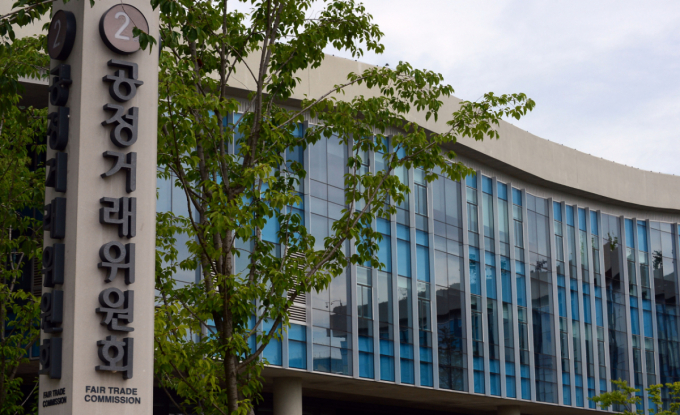
"If the Board of Audit and Inspection or the National Assembly points out 'favoritism,' the person in charge will be completely ruined."
This is the structural background behind the recent trend of "strict administrative punishment" by the Korea Fair Trade Commission, as pointed out by a former official from the Fair Trade Commission. It has been noted that the imposition of massive fines before the judiciary's final ruling is rooted in the "self-preservationism" within the civil service community. With President Lee Jae-myung's additional call for "strict response" to corporate unfair practices, it is analyzed that the Korea Fair Trade Commission's stance on strict punishment has been further strengthened.
The official said, "If a company is suspected of receiving special treatment, the responsible civil servant could face disciplinary action such as an audit or inspection by the Board of Audit and Inspection," adding that "the safest course for personal stability is to impose sanctions as strictly as possible."
This risk-averse tendency of the bureaucratic society manifests under the guise of "severe sanctions." Even if a court rules against the authorities several years after imposing massive fines, it is extremely rare for the responsible civil servants to face personnel disadvantages or bear responsibility.
Another official from the Korea Fair Trade Commission pointed out that "in the past, the severity of sanctions was decided carefully after comprehensively considering the economic repercussions of sanctions, their impact on the industrial ecosystem, and past precedents," but added that "currently, there is an excessive tendency to impose harsh punishments first and then say 'take it to court'."
Officials at the Korea Fair Trade Commission are indeed sensitive to the term "favoritism." When it was pointed out that the Korea Fair Trade Commission had reduced a fine of 99 billion won in the sugar price-fixing case, they explained that the fine was imposed in accordance with relevant regulations such as the Fine Imposition Notice. Regarding claims that Korean Air's penalty payment was reduced by 94%, they clarified that the Penalty Payment Notice includes an exception provision allowing for the imposition of a penalty payment different from the standard to ensure specific validity for each case.
Analyses suggest that the strengthened investigative functions and expanded organization and personnel, promoted since President Lee took office, have also reinforced the Korea Fair Trade Commission's strict punitive stance. In fact, the investigation bureau of the Korea Fair Trade Commission, once known as the "grim reaper of business," is set to revive after 21 years as the "Key Investigation Planning Team."
The penalty system has also been significantly strengthened. Notably, the minimum penalty rate was raised. For instance, in cases of collusion, the lower limit of the penalty assessment rate was increased from the previous 0.5% to 10%, a maximum increase of 20 times. The penalty assessment rate for serious collusion, previously set at 3%, was raised to 15%. For cases of private gain acquisition (improper support and improper benefit provision to special related parties), the penalty assessment rate was increased from the previous lower limit of 20% to 100%.
Although the intent is to strengthen enforcement against legal violations, it also effectively blocks the possibility of leniency from the Korea Fair Trade Commission. Nevertheless, the political sphere continues to view the Korea Fair Trade Commission with suspicion, questioning whether it is imposing penalties in a manner that favors companies.
Even President Lee is wary of the Korea Fair Trade Commission showing favoritism to companies. The abolition of exclusive prosecution rights is a prime example. Exclusive prosecution rights are a system under which public prosecutions can be filed only after the Korea Fair Trade Commission files a complaint in cases related to six of the 13th laws under the commission's jurisdiction that carry criminal penalties. At a State Council meeting last March, President Lee said, "Could it not be that the Korea Fair Trade Commission drags out investigations and then covers up allegations as unfounded?" He added, "Ultimately, because the Korea Fair Trade Commission monopolizes authority, it has even gained the power to show favoritism."
Ultimately, it is pointed out that a vicious structural cycle continues in which the Korea Fair Trade Commission, under suspicion of 'special treatment' from the political sphere, has no choice but to adopt a strict punitive stance on its own to avoid risks of audit or disciplinary action.
There is also an analysis that the "Regulations on Managing External Contact" have turned the Korea Fair Trade Commission into a "Gala Rafah Gos." While the intent was to encourage reporting and meetings with officials from the Korea Fair Trade Commission or industry practitioners, the mere fact of having met could raise suspicions from the National Assembly or the Board of Audit and Inspection. Consequently, an atmosphere has formed where all contact is avoided altogether. This is the background behind criticisms that the Korea Fair Trade Commission remains isolated from the market and fails to grasp the flow of the rapidly changing industrial ecosystem in a timely manner.
Another official from the Korea Fair Trade Commission stated, "The pace of market change is accelerating, yet the Korea Fair Trade Commission appears to be judging the current market based on past standards, constrained by history." They added, "If the approach remains too rigid and static, it could disrupt the market and infringe upon consumer interests, suggesting that greater flexibility is needed."
⑧The Reality of Korea's Strict Administrative Punishment Compared to Global Standards

Facebook (now Meta) promised the U.S. Federal Trade Commission (FTC) in 2012 that it would obtain explicit consent when sharing user information with third parties, under a "consent order." Nevertheless, it faced allegations in 2018 of transferring information on approximately 87 million users to Cambridge Analytica, a British political consulting firm. The FTC immediately launched an investigation.
In July 2019, after months of negotiations with the Federal Trade Commission (FTC), Facebook agreed to pay a $5 billion fine (approximately 6.7 trillion won) rather than litigate in court. While this was the largest monetary penalty imposed on a big tech company by the FTC at the time, the process itself was equally notable. The FTC did not unilaterally impose the fine; instead, it brought the company to the negotiating table through investigations and litigation.
While anyone who breaks the law must be held accountable, it is equally important to have mechanisms that verify the validity and appropriateness of sanctions as rigorously as the sanctions themselves. This is why major countries such as the United States, Europe, and Japan place significant weight on judicial review or consensus procedures alongside the authority of administrative bodies leading sanctions.
The FTC, a representative regulatory institutional investor in the United States, has the authority to investigate unfair corporate practices and issue cease-and-desist orders, but its power to impose monetary penalties for violations of competition law is limited by the Bank of Korea. Consequently, cases in which the FTC secures monetary penalties are primarily resolved not through direct FTC sanctions, but through agreements with companies that receive court approval or are settled via civil litigation agreements.
![[Strict Administration and Global Standards] Corporate Sanctions: "Checks" Are as Important as "Authority"/Graphic=Yoon Seon-jeong](https://thumb.mt.co.kr/cdn-cgi/image/f=avif/21/2026/09/2026091718462740756_3.jpg)
Japan, like South Korea, allows the Fair Trade Commission (JFTC) to directly investigate unfair corporate practices and impose administrative fines. Prior to 2015, if a company contested a JFTC ruling, the case would immediately proceed to the Tokyo High Court, which serves as the second-instance court. In effect, JFTC rulings functioned similarly to first-instance judgments.
However, the government amended the law after criticism that the administrative institutional investor was effectively acting as a first-instance court, raising concerns about fairness and neutrality. This change transferred the initial adjudication authority to the Tokyo District Court, which serves as the first-instance court. For companies, this shift moved the system from a de facto two-tier structure to a three-tier one, allowing them to seek judicial review at an additional level.
In the case of the European Union (EU), the structure is similar to that of Korea in that the European Commission imposes fines directly on companies, and if a company appeals, the case goes to the EU Court, effectively creating a two-tier system. However, the EU Court has full jurisdiction over competition law fines, meaning it can reduce or increase the fines imposed by the European Commission. This signifies that the judiciary can independently assess and modify the appropriate amount of the fine.
In 2009, the European Commission imposed a fine of €1.06 billion (approximately 1.5855 trillion won) on Intel for allegedly using illegal sales strategies to drive out competitor AMD. Intel sued before the EU Court, which in 2022 ruled that the Commission had failed to properly prove Intel's wrongdoing and sided with Intel.
However, the court acknowledged that some of Intel's activities involved illegal elements, and the European Commission imposed a fine of €376.36 million for certain violations. Intel again refused to accept this and filed a lawsuit; the General Court of the EU reduced the fine by approximately 37% in December 2025 to €237.11 million. Intel appealed to the European Court of Justice, the highest court in the EU, last February.
How to resolve the controversy over fairness
The controversy over fairness surrounding the Fair Trade Commission stems from a structural problem within the Korea Fair Trade Commission, which holds both investigative and adjudicative functions. Critics argue that because the Korea Fair Trade Commission handles both investigations and trials, it resembles a tilted playing field where the judge also plays as a player. Consequently, there are calls to establish an independent third-party institutional investor to ensure judgments can be made by an impartial body.
According to the government and industry sources on the 16th, this year's Korea Fair Trade Commission has been criticized for squeezing companies through "strict administrative punishment" that goes beyond establishing market order, amid its comprehensive investigations and increased fine levels. Fines in the hundreds of billions of won, such as the sugar cartel (408.3 billion won) and flour cartel (671 billion won), have become a "new normal."
Critics inside and outside the industry have raised concerns that the structure itself, which involves internal investigations followed by adjudication, is unreasonable. Lee Hwang, a law professor at Korea University, stated, "The Korea Fair Trade Commission has a dual nature." He added, "The academic view is that the quasi-judicial institutional investor nature is essential to the Korea Fair Trade Commission. While the separation of investigation and adjudication functions aligns with the principles of due process, it is true that the Korea Fair Trade Commission has not been diligent in its efforts over a long period."
On the other hand, the Korea Fair Trade Commission maintains that it has ensured fairness through a strict separation of investigation and adjudication functions. In 2023, the commission prohibited personnel transfers between its investigation and adjudication divisions, requiring all matters to pass through policy departments first. This effectively uses policy departments as a buffer zone between investigation and adjudication units. The commission also completely separated workspaces to eliminate any possibility of contact.
A Korea Fair Trade Commission official stated, "The space for the department responsible for judging and investigation is itself separated," adding that "there is a strong atmosphere where information sharing is prevented through a powerful 'firewall,' and even internal contact is considered burdensome." Another official dismissed concerns about the structure of the Korea Fair Trade Commission, saying, "Since judgment decisions are made by committee consensus, there are often heated debates during plenary meetings, and results do not always turn out as intended."
However, it still seems difficult to quell concerns over fairness as long as investigations and adjudications remain under the same roof. The fact that the head of the Korea Fair Trade Commission, who can order investigations, also participates in the adjudication process fuels doubts about a structural problem that leaves matters to the conscience of the commission's head, lending weight to such opinions.
Proposals are also emerging for an independent institutional investor similar to the Tax Tribunal, which operates separately from the National Tax Service and other bodies. The Hongdae-style Law School Council Lee (President) stated, "We strongly support establishing a third-party judgment procedure like the Tax Tribunal," adding, "It is desirable that the adjudicator not be involved in the investigation phase, leaving it to the chairman's conscience; however, if doubts remain unresolved, structural separation is the correct approach."
However, there are also many counterarguments that this is not realistic in practice. A former commissioner of the Korea Fair Trade Commission stated, "If the adjudication function is entirely outsourced to external parties, it will take even longer than now, and there is a risk that people with low understanding of competition law will conduct adjudications." He further explained, "It is more reasonable to maintain independence by strictly separating investigation and adjudication functions within the organization."
A proposal to improve the current two-tier system for administrative fair trade cases to a three-tier system is also being discussed. Administrative fair trade cases currently follow a two-tier process, moving from Seoul High Court to the Supreme Court. The Korea Fair Trade Commission's rulings impose direct sanctions on businesses, such as corrective orders and surcharges. In effect, the Korea Fair Trade Commission functions as the first instance court. While small-amount cases allow for three rounds of trials, there is criticism that in situations involving hundreds of billions of won changing hands, companies actually have fewer opportunities to seek legal judgment.
⑩ Measures to prevent excessive administrative sanctions
![[Sejong=NEWSIS] Reporter Kang Jong-min = The full meeting hall of the Fair Trade Commission at the Sejong Government Complex. June 12, 2024. ppkjm@newsis.com](https://thumb.mt.co.kr/cdn-cgi/image/f=avif/21/2026/09/2026091718462740756_5.jpg)
As administrative sanctions imposed by the government on companies are repeatedly overturned by courts, calls for institutional improvements to prevent unreasonable administrative actions by regulatory bodies are gaining momentum. Proposals include considering the introduction of a "sanction name system" or a "defeat liability system" to enhance accountability among public officials. There are also indications that fundamental measures should be explored, such as shifting to a "negative regulation" environment and strengthening procedural controls through amendments to the "Administrative Investigation Basic Act."
According to data submitted by the Public Procurement Service on the 16th, Park Soo-young, a People Power Party member of the National Assembly's Financial and Economic Planning Committee, revealed that the administrative litigation loss rate of the Public Procurement Service as of last month stood at 26.8%, the highest since 2020. Of the 866th administrative lawsuits filed against the Public Procurement Service from 2020 through August this year, 594 were requests to cancel restrictions on bidding participation qualifications. Restrictions on bidding participation qualifications are among the most severe administrative penalties imposed by the Public Procurement Service, as they directly impact a company's sales revenue.
The problem is that administrative penalties are frequently overturned by courts after the fact. Of the 78th cases in which the Public Procurement Service ultimately lost since 2020, 73 involved either abuse of discretion or circumstances where the grounds for the penalty were not recognized. A representative example is when a penalty was imposed on an entire contract despite only some parts of the agreement with a company being problematic.
According to an analysis of Fair Trade Commission data by Democratic Party of Korea lawmaker Heo Young in the previous year, the Korea Fair Trade Commission refunded 624.7 billion won in fines imposed between 2017 and August 2025 to companies. Of the refunded amount, 93.2 percent was due to losses in administrative lawsuits or voluntary revocation (a penalty reduction measure taken by the Korea Fair Trade Commission itself).
In the business community, while sanctions against the market are seen as inevitable, regulations that exceed a reasonable scope must be improved. The argument is that repeated regulation forces companies to incur significant costs in legal responses and dampens investment aimed at strengthening competitiveness. From the perspective of government ministries, decisions made without careful review can also lead to waste of tax revenue. When fines are refunded to companies, refund bonuses are provided alongside them.
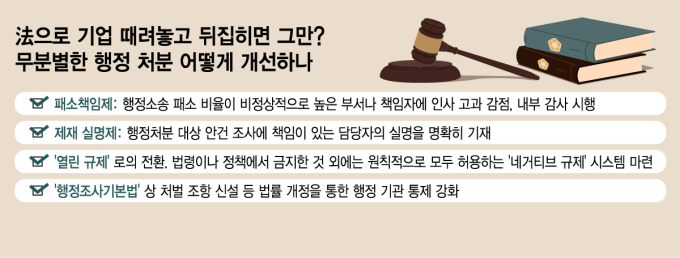
Alternatives such as the introduction of a defeat accountability system and a sanction naming system are being discussed. The system would impose point deductions in personnel evaluations or audits on departments or individuals with abnormally high administrative litigation loss rates. In a phone interview with Money Today's the300, Professor Chang-nam An of Gangnam University's Department of Economics and Taxation stated, "A system that can impose penalties on personnel evaluations when civil servants make improper rulings for specific purposes should be introduced," adding, "It is worth considering the introduction of a sanction naming system." The sanction naming system is designed to clearly record the names of those responsible for investigations and deliberations on major sanction matters.
A People Power Party member who worked in the corporate sector, Han (Rep.), stated that while "good regulations" are necessary, "excessive regulation is the fundamental problem hindering South Korea's business environment," and added that the regulatory framework should be shifted to a negative system where "everything is permitted except what is explicitly prohibited."
A lawyer at a major law firm stated, "In the case of administrative penalties, the relevant institutional investor performs the roles of police, prosecutor, and judge regarding the subject of investigation, leading to excessive sanctions in many instances," adding that "as the functions of the Prosecution Service weaken, control over administrative sanctioning by institutional investors must be reasonably strengthened."
Especially, it was suggested that "the Administrative Investigation Basic Act lacks provisions to penalize violations of investigation procedures, making it virtually impossible to limit the scope even if it becomes excessively broad," and that "the National Assembly needs to carefully amend the investigation procedures under the Administrative Investigation Basic Act."

 in INDUSTRY


