

The government's announcement of a major overhaul of real estate taxation is imminent. Following last week's large-scale real estate symposium chaired by President Lee Jae-myung, a seminar was held on the 27th under the auspices of Han Seong-suk (Prime Minister). The event sought public opinion on strengthening taxes on ultra-high-value homes, revising loan regulations, and supply policies. Although the government claims it is listening to public sentiment, underlying public dissatisfaction with real estate remains acute. This is due to the triple surge in housing prices, monthly rents, and deposit rents, exemplified by average Seoul apartment rents exceeding 700 million won. Compounding this issue is President Lee Jae-myung's recent sale of his home in Su-nae-dong, Bundang, which utilized a "seller loan" arrangement involving a mortgage of approximately 1.7 billion won, further eroding public trust.
A Korea Gallup survey released on the 24th revealed that positive evaluations of the government's real estate policy dropped from 51% in March to 26%, a decline of 25 percentage points. Similarly, an opinion poll by Real Meter on the 27th showed that approval ratings for the president's performance fell to 46.3%, while disapproval rose to 49.5%, indicating growing public skepticism. In a situation where genuine homebuyers are suffering due to the inability to secure loans, there is significant resentment toward the president circumventing regulations to avoid missing out on capital gains from property sales. Currently, for homes valued over 2.5 billion won, mortgage loans are capped at a maximum of 200 million won.
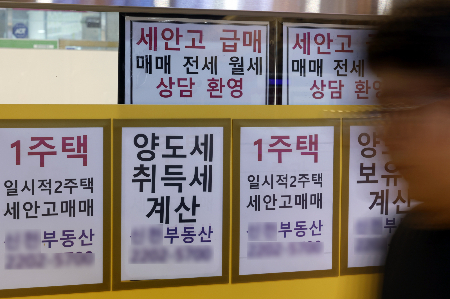
Jeong Bu-neun (President) explains that the real estate transaction followed conventional methods and that the title transfer was conducted with consideration for the buyer's circumstances. However, seller loans, previously conducted discreetly, have now surfaced publicly. Properties offering such arrangements—where sellers lend money to cover shortfalls—are flooding markets nationwide, including Seoul's Gangnam, Seocho, and Songpa districts; Busan's Haeundae District; and Suwon Yeongtong in Gyeonggi Province. These seller loan transactions undermine financial authorities' regulatory principles, such as the Debt-to-Income Ratio (DSR) and Loan-to-Value Ratio (LTV), and may trigger disputes over gift taxes between transacting parties.
Real estate tax reform cannot take root without public support. In a context where increasing supply is difficult, raising only holding taxes will inevitably affect rental rates, prompting landlords to increase both deposit and monthly rents while making it harder to expand transactions. Measures such as easing capital gains taxes must be introduced to provide an exit path for property owners. Alongside tax reform, loan regulations must also be relaxed. The real estate policy package should include provisions allowing limited access to loans for genuine homebuyers, including non-homeowners and newlywed couples, to ensure that the broken housing ladder is firmly reconnected.

 in OPINION
