

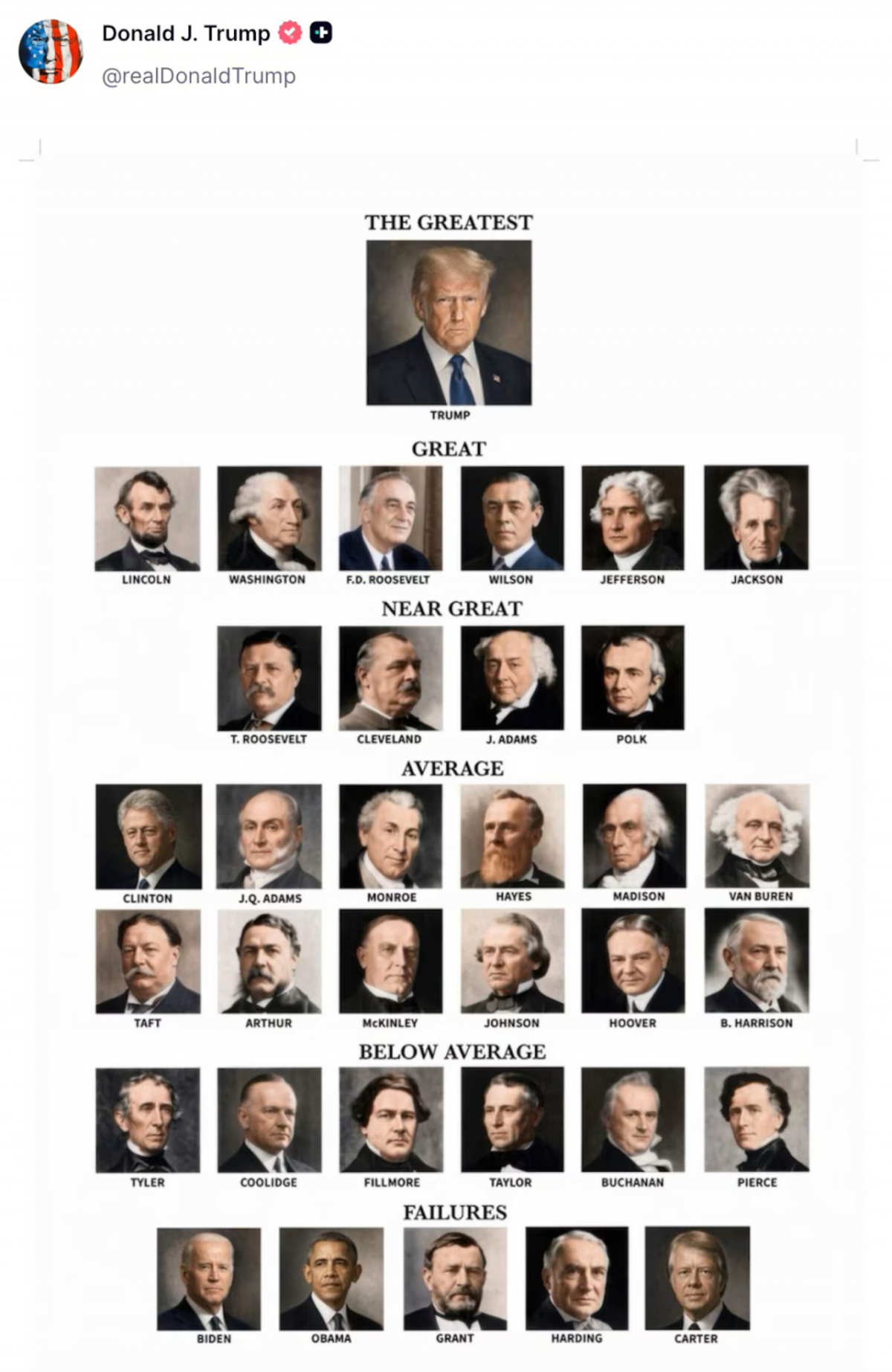
"The Greatest"
In a ranking of U.S. presidents released by President Donald Trump on social media last month 27 (local time), only President Trump himself received the highest evaluation as "the greatest." Founding father George Washington, Abraham Lincoln who abolished slavery, and other historical figures with Nam Gin (President) achievements are rated one level lower than him as "Great." The post openly revealed how President Trump wishes to be remembered in history.
Trump's attempts to leave behind his "greatness" can be easily found both inside and outside the White House. He has proposed erecting a large golden Yeon (Chairman) at the White House and is pushing for the construction of a 76-meter-tall triumphal arch in Washington D.C., decorated with golden angels and eagles. He intends to name roads, airports, and aircraft carriers after himself. He even attempted to rename the Kennedy Center, already bearing another president's name, as "Trump-Kennedy Center."
He also had his face engraved on limited-edition passports, commemorative one-dollar coins, and national park entrance tickets. The Wall Street Journal (WSJ) cited a close associate, reporting that Trump has entered "legacy mode." This signifies that Trump, who had shown lingering attachment to a potential third term in jest or earnest, is finally beginning to consider what comes after his departure from office.
For a leader, legacy refers to assets that survive even after power ends. All leaders have pondered what they will leave behind. Paradoxically, Trump's obsession with leaving his mark may serve as evidence that his power is finite. Rumors of a lame duck period have already begun to circulate. Analysis indicates that Trump's approval ratings are at an all-time low and that the Republican Party faces a bleak outlook in November's midterm elections, which carry the nature of a presidential mid-term evaluation.
However, we must not focus solely on the monuments he will leave behind. There is a true legacy that Trump will leave for the United States and the international community even after he departs the White House: it is the new grammar of politics and diplomacy he has written during his two terms. It is transactional diplomacy and unilateralism that prioritize immediate gains and national interests above all else, rather than the existing international order based on values and alliances. The situation where multilateralism and alliance principles accumulated by the international community over decades have become mere leverage in negotiations is an irreversible reality.
Many may think things will change if a U.S. president changes. However, it is not time to simply wait for Trump's term to end. The tenacious vitality of so-called "Trumpism" has already been proven by his second presidential election victory. It is now the time to prepare long-term strategies on how to respond and survive in this new order that will remain even after Trump.

 in OPINION
