

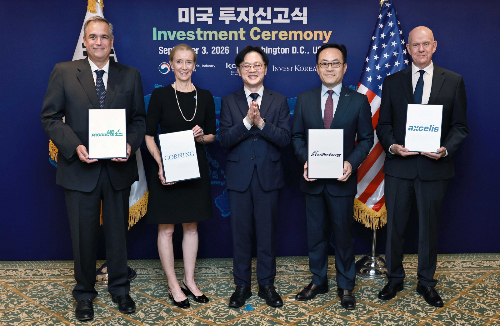
The U.S. investment project agreed upon by South Korea and the United States during last year's trade negotiations has reached its final confirmation stage. Both sides plan to include provisions in the final project agreement document scheduled for release on the 18th, detailing cooperation to construct eight nuclear power plants in the United States. Additionally, plans have been developed to build a gas-fired combined-cycle power plant in Texas to address electricity demand from artificial intelligence (AI) data centers within the U.S.
Through last year's July trade agreement, South Korea and the United States agreed to reduce mutual tariffs imposed by the U.S. from 25% to 15%, while South Korea committed to implementing $350 billion in investments in the U.S. However, no specific details emerged beyond the $150 billion shipbuilding cooperation component, leading to persistent concerns about discord during the negotiation process. Critics also pointed out that progress was slower compared to Japan, which announced its second investment plan earlier this year. Since announcing the construction of a semiconductor industrial complex in South Korea's Honam region under the Lee Jae-myung administration, the U.S. has increased pressure by referencing tariffs on forced labor and overproduction. In this context, finalizing and executing the investment project could help alleviate U.S. pressure.
Amid the Trump administration's blueprint for a nuclear renaissance, the joint cooperation plan for constructing nuclear power plants in the U.S., with an estimated total investment of $130 billion, could mark a new turning point for domestic nuclear energy companies. Specifically, it is reported that six of the eight reactors will use Westinghouse's AP1000 reactor design, while the remaining two will utilize Korea Hydro & Nuclear Power's APR1400 model. This collaboration expands opportunities between Westinghouse, which possesses foundational design technology as the world's first builder of commercial nuclear power plants, and Korean companies renowned for their superior construction capabilities.
The U.S. government, currently experiencing trade friction with Canada over a nuclear power plant company owned by a Canadian private equity firm—Westinghouse—is deeply concerned about its governance structure and is exploring potential joint equity acquisition opportunities with South Korea and other partners. Depending on the progress of these developments, South Korea could overcome its historical concentration in nuclear exports to Asia and break through barriers preventing entry into U.S. and European markets. Discussions on stalled security issues such as uranium enrichment and reprocessing rights, as well as the introduction of nuclear-powered submarines, should continue along the extension of nuclear cooperation frameworks.
Through projects like gas-fired power plants and nuclear cooperation, negotiations must be pursued to ensure that South Korea does not unilaterally assume all risks while conducting business for the United States.

 in OPINION
