

Shares of HLB Group rose across the board on the KOSDAQ market on the 28th following news that HLB's bile duct cancer treatment had received approval from the U.S. Food and Drug Administration (FDA). This marks the first case in which a domestic company directly submitted a New Drug Application (NDA) for a global anticancer new drug to the FDA and obtained approval. However, with mixed signals such as news of Lupus clinical trial failure at Hanall Biopharma on the same day, cautious views suggest that it may take more time for overall investor sentiment in the KOSDAQ bio sector to recover.
On the 28th, HLB Group shares were trading at the upper limit across the board during the early session of the KOSDAQ market. HLB was trading at 39,700 won, up 9,150 won (29.95%) from the previous trading day's closing price (based on Korea Exchange after-market close). HLB Pharmaceutical, HLB Life Science, HLB Innovation, HLB Therapeutics, and HLB BioStep also all hit the upper limit. In the KOSPI market, HLB Global also reached the upper limit.
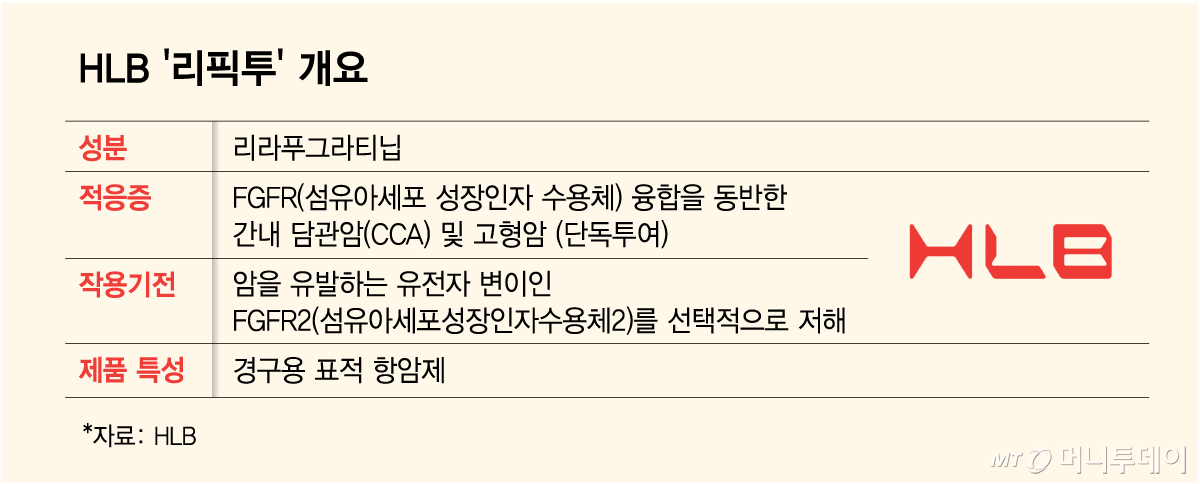
According to the pharmaceutical and bio industry, HLB's U.S. subsidiary Eleva Therapeutics received product approval from the FDA on the 23rd (local time) for 'Rifictu' (generic name: Lirafugratinib), an FGFR2 (fibroblast growth factor receptor 2)-targeted anticancer drug. Rifictu was approved as a second-line treatment for patients with bile duct cancer who have FGFR2 fusion or rearrangement. Bile duct cancer is a type of cancer that occurs in the bile ducts, the passageways through which bile flows, and approximately 8,000 new cases occur annually in the United States.
Although anticancer new drugs such as 'Lekraz' (generic name: Lazeritinib) have previously received FDA approval, this is the first time a domestic pharmaceutical or bio company has directly submitted an NDA for a global anticancer new drug to the FDA and obtained approval. Eleva plans to launch Rifictu in the U.S. market by the fourth quarter of this year and supply it to patients.
On the same day HLB announced this news, a clinical trial for Hanall Biopharma's autoimmune disease treatment 'IMVT-1402' (generic name: Aimerofrubarate) targeting cutaneous lupus erythematosus (CLE) failed to demonstrate efficacy. After administering Aimerofrubarate and a placebo to a total of 57 patients, there was no statistically significant difference in the change rate of CLASI-A, a key evaluation indicator for disease area and skin lupus activity, at week 12. Consequently, Immunovent (parent company: Royvant), which received technology transfer of this substance from Hanall Biopharma, decided to halt development of indications for cutaneous lupus erythematosus considering the clinical results and market conditions.
Following this news, Hanall Biopharma shares were trading at 43,850 won, down 2,750 won (5.90%), on the KOSPI market. However, securities firms generally assess that since the market value of lupus is the lowest among the six indications for Aimerofrubarate, this clinical trial halt will not be fatal to corporate valuation.
A researcher at a securities firm who requested anonymity said, "In the case of CLE, it was an asset in the earliest stage of clinical trials and the market size is also small," adding, "Rather, rheumatism and Graves' disease, which are other indications, are core assets, and there is expectation that good results will come from them."
Even if the negative impact of Hanall Biopharma's clinical trial halt is limited, evaluations suggest it is too early to expect investor sentiment toward the KOSDAQ bio sector to improve based solely on HLB's positive news. The point is raised that supply and demand must shift toward semiconductors and the problem of rising interest rates unfavorable to bio stocks must be resolved.
On the other hand, there are also forecasts that this positive news will positively contribute to forming a sector bottom. Hee-min Hur, a researcher at Kiwoom Securities, predicted, "The approval of Rifictu is an event with low market attention, and it is expected that positive results from underdog companies that have been met with skepticism by the market will contribute to building trust in the sector."
However, advice suggests that for a trend-driven rise, fundamental changes must be supported. Researcher Hur stated, "While the price correction bottom of the sector has been confirmed, to complete the period adjustment, it is necessary to confirm not only favorable external environments and sector rotation but also fundamental improvements in fundamentals."

 in STOCK
