

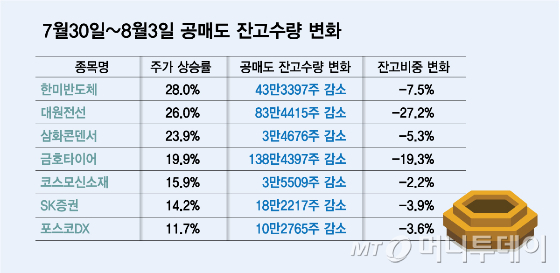
It has been observed that short-selling investors are engaging in short covering (repurchasing stocks to close out short positions) on certain stocks. Amid high market volatility, investors who had bet on falling stock prices have now shifted their investment direction in anticipation of future price increases. Attention is focused on whether this will lead to broader market support.
According to the Korea Exchange on the 6th, the proportion of short-selling transactions in KOSPI reached 3.89% that day. This marks the first time since the 23rd that the figure has dropped from the 4th% range into the 3rd% range. Although the KOSPI index fell from the 7th,000s to the 6th,000s during this period, the share of short-selling investors betting on a declining market actually decreased.
Over the three trading days from July 30 to August 3, when extreme volatility was observed, among the top 50 stocks with the highest net short positions, 26 companies saw their short-selling proportions decline. These include Daewon Electric Wire (3.91%→2.99%), Dalba Global (3.96%→3.40%), Kumho Tire (2.50%→2.13%), Samwha Capacitor (2.40%→2.07%), and Hanmi Semiconductor (6.07%→5.81%).
Notably, short-selling positions decreased primarily among companies whose stock prices rebounded sharply. Companies with double-digit gains include Hanmi Semiconductor (up 28.00%), Daewon Electric Wire (26.00%), Samwha Capacitor (23.90%), Kumho Tire (19.90%), Cosmos New Materials (15.90%), SK Securities (14.20%), and POSCODX (11.70%).
The decline rates in short-selling position proportions for these companies were recorded as follows: Daewon Electric Wire 27.20%, Kumho Tire 19.30%, Hanmi Semiconductor 7.50%, Samwha Capacitor 5.30%, SK Securities 3.90%, POSCODX 3.60%, and Cosmos New Materials 2.20%.
The reduction in short-selling position proportions is being viewed as signs of short covering. It indicates that short-selling forces, which had previously borrowed and sold stocks expecting price declines, are now repurchasing stocks to close out their short positions or limit losses amid expectations of rising prices.
However, some observers suggest that the volume of short-covering may be limited in its ability to aggressively lift the index. This is because the short-selling positions of SK Hynix and Samsung Electronics, which together account for half of KOSPI's market capitalization, are showing divergent trends.
SK Hynix's net short position reached 20 billion won on the 3rd, a decrease of 105.7 billion won compared to July 30. In contrast, Samsung Electronics' position increased from 870.5 billion won to 1.3389 trillion won.
A financial investment industry official stated, "When examining the situation of certain stocks last week, there were signs that short-covering buying pressure driven by profit-taking and risk management by short-selling forces flowed in during the index's decline." The official added, "Among 14 sectors with high short-selling holdings where stock prices rose more than 10%, short-selling positions decreased in 10 of those sectors."
Meanwhile, as the stock market has shown significant volatility, investor fatigue is growing. On this day, KOSPI closed regular trading at 6,296.38, down 301.88 points (4.58%) from the previous session. Hwang San-hae, a research analyst at LS Securities, said, "The Korean stock market has repeatedly shown patterns of being pulled toward rising trends due to historically high export growth rates, followed by diffusion after peaking." He further noted, "In addition to improvements in supply-demand conditions, signals indicating a reduction in concentration effects are emerging based on the spillover benefits of the AI (artificial intelligence) cycle."

 in STOCK
