

A survey indicates that the top six securities firms, excluding those under financial holding companies, will bear an education tax of 340 billion won this year. In the financial investment industry, there are complaints that the education tax effectively functions as a so-called "windfall tax" levied on excess profits. Furthermore, it is pointed out that the tax structure is unreasonable because securities firms acting as liquidity providers (LPs) in the ETF (exchange-traded fund) market face higher taxes the more faithfully they fulfill their LP roles.
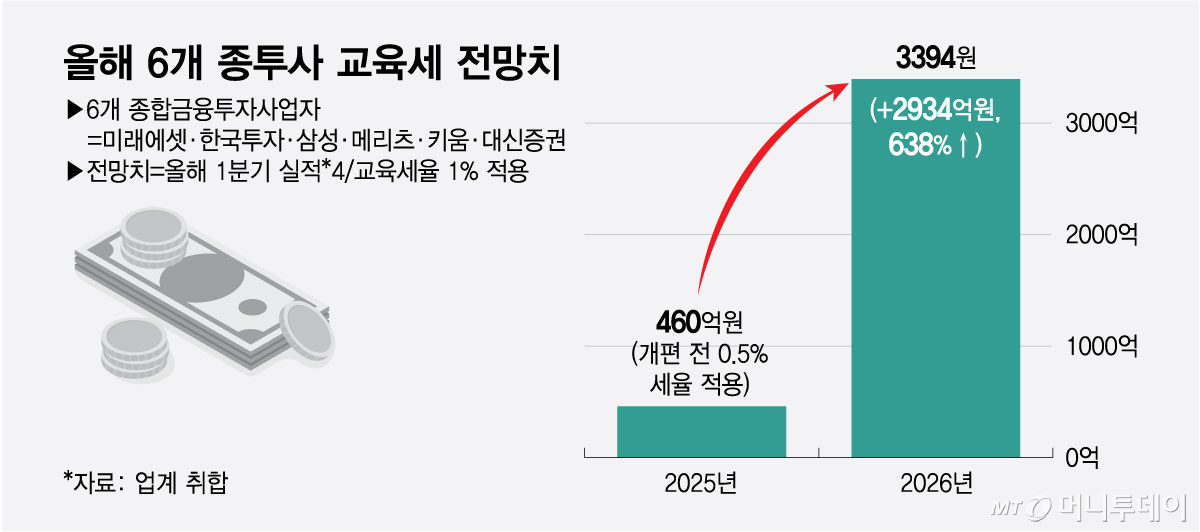
According to the financial investment industry on the 11th, a simulation of six comprehensive financial investment companies (CFICs) estimates that the education tax to be borne this year will amount to 339.4 billion won. This represents an increase of more than seven times compared to last year's education tax of 46 billion won. The six CFICs are Mirae Asset, Korea Investment, Samsung, Meritz, Kiwoom, and Daishin Securities.
The estimated education tax amount for this year was calculated by applying the increased 1% education tax rate to stock trading profits and collective investment securities trading profits from first-quarter results. Following the passage of last year's amendment to the Education Tax Act, the education tax rate for financial institutions with a taxable base exceeding 1 trillion won was doubled from 0.5% to 1%.
Securities firms that anticipated strong performance due to the bullish stock market in the first half of the year encountered an unexpected obstacle: the education tax. With trading volumes expected to decline in the second half, the addition of the education tax is projected to lead to poor performance.
The securities industry lowered Kiwoom Securities' target price despite its strong second-quarter results, citing the burden of the education tax as a reason. Jang Young-im, a researcher at SK Securities, explained, "Taxes and fees increased from 18.2 billion won in the first quarter to 83.9 billion won in the second quarter, with approximately 60 billion won estimated to be the education tax." He added, "For Kiwoom Securities, which has strengths in ETF LPs, the premium factor has somewhat weakened due to the increased cost burden compared to the past." Samsung Securities also saw its target price adjusted downward despite recording its largest quarterly profit in company history in the second quarter. This reflected factors such as controlling shareholder net profit falling short of market expectations due to the impact of the education tax.
The industry argues that the formula for calculating the education tax is unreasonable. This is because securities firms face higher taxes the more they perform LP roles in the ETF market. In particular, there is strong dissatisfaction that while the role of "market making" by securities firms has grown larger due to the expansion of ETF assets driven by a bullish stock market, it has instead resulted in an education tax bomb.
Securities firms simultaneously perform both LP and hedging transactions in the ETF market. They provide buy and sell quotes for each listed security (LP) and engage in opposite-position trading (hedging) to reduce price volatility risks, thereby playing a role in building infrastructure in the ETF market. Even if securities firms earn profits from LP transactions, they may incur losses from hedging transactions, meaning that overall profit from both LP and hedging transactions combined may not be significant. For example, even if a trading profit of 10 billion won is generated depending on index fluctuations, a loss of 5 billion won could occur.
The problem is that the education tax is levied only on trading profits without reflecting losses. Taxes are calculated separately for LP transaction profits and hedging transaction profits, causing the education tax burden to surge as securities firms conduct more LP transactions. As in the example above, while actual net profit may be only 5 billion won, taxes are levied on a revenue of 10 billion won. In the first quarter this year, out of 1,049 trillion won in ETF trading volume, LP transactions accounted for 24%, reaching nearly 256 trillion won, significantly increasing the burden on securities firms responsible for LPs.
An industry official pointed out, "Economically integrated LP and hedging transactions are evaluated separately, so operating losses (costs) are not reflected in the taxable base," adding that "the education tax burden increases regardless of a securities firm's actual operating profit."
Concerns also arise that if ETF LP transactions shrink due to each company's education tax burden, investors could suffer larger losses. This is because increased education tax burdens from LP transactions make it difficult for firms to actively fulfill their role in building the ETF market. If LP transactions decrease and bid-ask gaps occur in ETFs, prices may become distorted, increasing the risk of investor losses.
In response, the industry argues that when calculating the education tax base, LP and hedging transactions should be taxed based on actual profits. The view is that netting profits and losses—calculating profit after deducting operating costs from operating revenue—is desirable.
The industry has been urging tax authorities and the National Assembly to apply a netting method for transactions with strong market-making characteristics, centered around the industry association. Since this was not reflected in the government's tax reform plan, the goal is to incorporate the netting provision during the National Assembly's budget deliberation process.

 in STOCK
