

The government, as part of its the 13th housing supply measures, called on the financial sector to expand funding for real estate project financing (PF). In response, the financial investment industry expressed bewilderment, saying, “The policy direction has suddenly changed.” With PF loan delinquency rates exceeding 30% and soundness management being the top priority, the industry is now required to increase PF supply less than a month after tightening regulations on PF soundness. As regulations on real estate project financing swing between strict and relaxed stances, the financial investment industry unanimously calls for additional regulatory relief incentives, such as recognizing PF as venture capital.
On the 13th, the Financial Services Commission announced a plan to expand guarantees and funding for real estate project financing as part of comprehensive measures to stabilize the property market. The core of the plan is to supply over 47.8 trillion won in PF funds through strengthened public guarantees by the Housing Finance Corporation and a temporary exemption from regulations on the equity ratio for residential development projects.
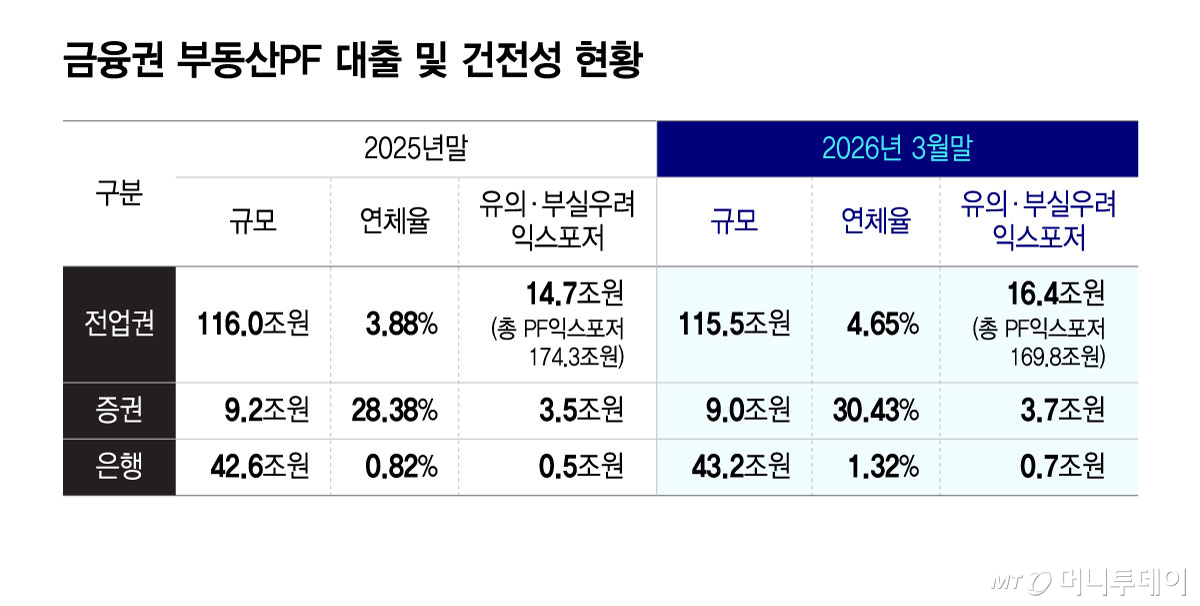
The financial investment industry is struggling to grasp the shift in policy direction from soundness management to supply expansion. As of the end of the first quarter this year, securities firms’ PF loans and debt guarantees totaled 31.2 trillion won, with significant and potentially distressed exposures amounting to 3.7 trillion won. The outstanding balance of PF loans stood at 9 trillion won, with a delinquency rate of 30.43%. This represents a 2.05 percentage point increase from the end of last year (28.38%). A financial investment industry official stated, “Recent trends show rising PF delinquency rates due to high interest rates, increased construction costs, and prolonged slowdowns in the real estate market,” adding, “With large loan loss provisions accumulated only recently, soundness management has become the top priority.”
Considering the upward trend in delinquency rates, some industry voices argue that measures such as strengthened public guarantees announced on this day will not sufficiently offset the burden of private risk management. Although the Housing Finance Corporation plans to expand construction cost support and raise guarantee ratios up to 100%, the burden of risk management remains even greater. An industry official explained, “Regulations on real estate project financing NCR (net capital ratio) and loan loss provisions have already been strengthened and are in effect,” noting that “the capacity for new PF loans or proactive investments has significantly declined compared to the past.”
Less than a month after regulations on the equity ratio for real estate project financing were reflected in the Korea Financial Investment Association’s risk management committee, a temporary exemption plan was introduced, leaving the industry confused once again. The Financial Investment Association had revised its risk management committee rules on July 9 to reflect the PF equity ratio relative to project costs starting next January, with plans to gradually increase the equity ratio from 5% in the coming year to 20% by 2030. However, the Financial Services Commission decided to exempt residential development projects from PF equity ratio regulations for two years, forcing another revision of the rules.
Other soundness-enhancing regulations are also facing repeated changes. Regulations such as differentiated risk-weighted assets based on PF equity ratios and adjustments to loan loss provision accumulation rates will likely require further revisions. The financial authorities plan to pursue re-revisions of the risk management committee rules through communication with industry groups like the Financial Investment Association.
The financial investment industry holds the view that large-scale new funding will be difficult unless additional relaxations are made to existing regulations on real estate project financing, such as caps (100% equity) and capital ratio requirements like NCR. Another industry official remarked, “As the construction and real estate markets become unstable, even mid- and small-sized securities firms that previously actively invested in PF are now exercising caution, as junior tranches face principal losses.” They added, “Securities firms still holding potentially distressed projects find it difficult to invest further due to burdens from loan loss provisions and equity ratio regulations before they can resolve existing assets.”
Some industry voices also called for additional incentives to ensure that private financial institutions can achieve certain levels of profitability through real estate project financing. Another official stated, “It would be beneficial to segment risk values based on specific criteria such as the degree of credit enhancement per project site and seniority status, and reflect them in NCR calculations.” They further emphasized, “To activate housing supply, financial institutions must move beyond being mere lenders or guarantors and participate in PF projects through equity investments and profit-sharing models.” This year, securities firms are required to allocate at least 10% of their issued note funding to venture capital; some have also proposed that real estate project financing should similarly be recognized as venture capital.

 in STOCK
