

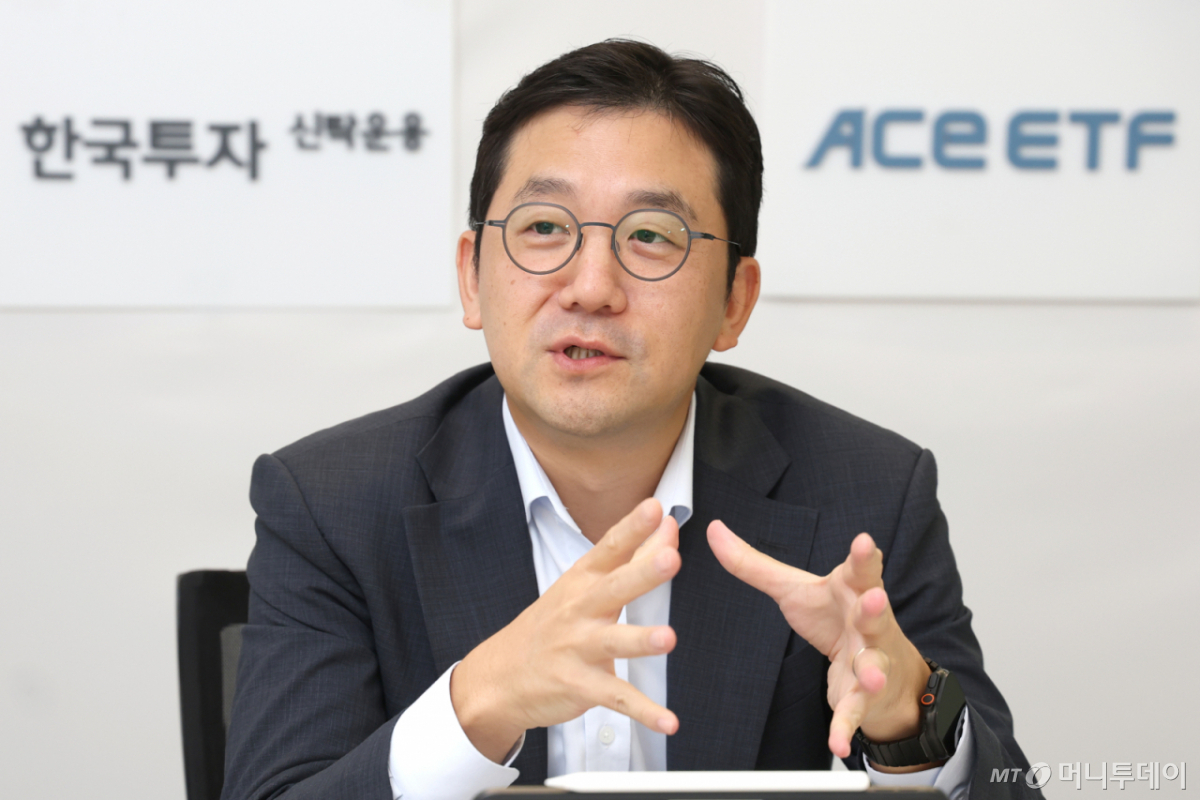
"From a macroeconomic perspective, hegemonic competition and AI (artificial intelligence) are the two most critical core factors. South Korea is a market worth watching closely because it possesses industries with moats in both of these areas."
In an interview with MoneyToday recently, Nam Yong-soo, Head of ETF Division at Korea Investment Trust & Management, stated, "Although the domestic stock market plummeted last month, investors should still stay and monitor the domestic market."
Korea Investment Trust & Management launched 13 new ETFs (exchange-traded funds) this year, 10 of which are domestic equity products. This decision was made based on the judgment that there has been an increase in sectors and stocks suitable for long-term investment within the Korean stock market.
The division head noted, "Because the domestic stock market was dominated by cyclical industries, corporate earnings were strong but multiples (price-to-earnings ratios) declined. As this experience accumulated, investors failed to engage in long-term investing. However, we now expect industrial cycles to lengthen."
He explained, "In hegemonic competition, one of the core pillars of macroeconomics, the most important element is an alliance with reliable technology. In terms of AI as well, South Korea possesses industries with moats."
The sectors Nam division head is focusing on are semiconductors, shipbuilding, defense, and nuclear power. Accordingly, Korea Investment Trust & Management has launched ETFs this year including the 'ACE K Semiconductor TOP2+', 'ACE K Defense TOP5+', and 'ACE Semiconductor Plus Strategic Industry' ETFs.
In particular, the ACE Semiconductor Plus Strategic Industry ETF, listed on the 11th, is a product that allows investment in representative stocks from the semiconductor, shipbuilding, defense, and nuclear power industries all at once.
The division head said, "Previously, there was a memory demand cycle, but going forward, demand for HBM (high-bandwidth memory) will continue. Since growth is driven by AI, investors must continue to hold semiconductors."
He added, "In the case of shipbuilding, orders for LNG (liquefied natural gas) carriers are continuing. Orders will persist until 2031 and will be reflected in earnings." He also noted, "Nuclear power has recently undergone a correction, but as data centers increase, demand for nuclear power plants must rise. Investors should pay attention to nuclear power and defense."
Volatility in the domestic stock market is also expected to ease compared to last month. The division head diagnosed that leverage investments by overseas hedge funds, such as Situational Awareness, drove volatility in global semiconductor stocks and the domestic stock market last month.
The division head stated, "As the leverage positions of overseas hedge funds have been somewhat unwound, supply-demand instability in the domestic stock market appears to have eased somewhat. Concerns regarding AI CAPEX (capital expenditure) by big tech companies will also gradually improve."
He continued, "While an overshoot like we saw in the first half is hard to expect, I believe the index will gradually trend upward. Alongside staggered stock purchases, I recommend investing in assets that can serve as buffers, such as MMFs (money market funds), high-yield bonds, and gold."

 in STOCK

