

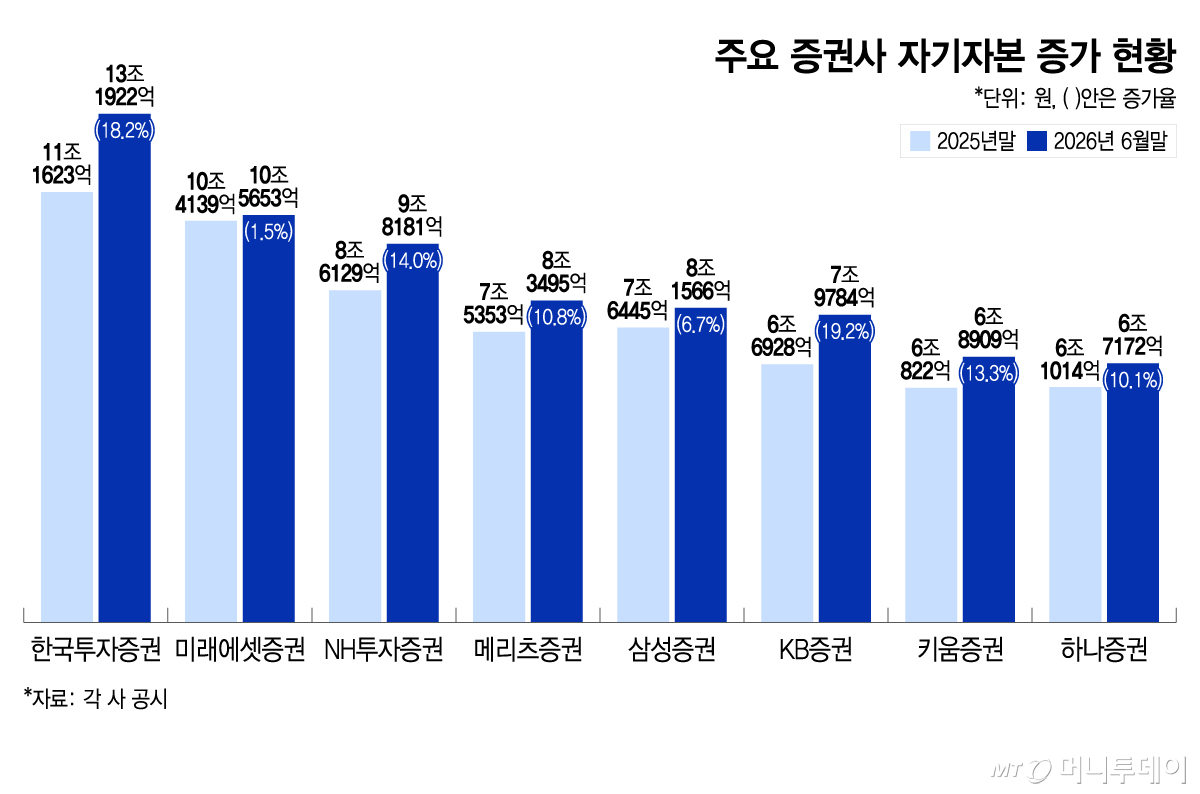
Domestic brokerage firms are rapidly expanding their scale. As profits earned from strong performance accumulate as capital, coupled with efforts to bolster capital for new business expansion, the own capital of major brokerages has increased by nearly 20% in just six months. Korea Investment & Securities has risen to over 13 trillion won, NH Investment & Securities has reached 10 trillion won, and KB Securities is on the verge of surpassing 8 trillion won.
Rapid expansion presents both new opportunities and challenges for brokerages. While larger capital enables expansion into corporate finance (IB) and entry into new businesses such as Integrated Management Accounts (IMA), failure to generate returns commensurate with the pace of capital growth will reduce capital efficiency. As brokerages simultaneously grow in size, competition over a limited market intensifies, potentially increasing risk-taking in pursuit of higher profitability.
According to the financial investment industry on the 19th, Korea Investment & Securities' own capital rose from 11.1623 trillion won at the end of last year to 13.1922 trillion won by the end of June, an increase of 18.2%. NH Investment & Securities increased from 8.6129 trillion won to 9.8181 trillion won during the same period, a 14% rise. With only 181.9 billion won remaining to reach 10 trillion won, it is poised to become the third brokerage firm after Korea Investment & Securities and Mirae Asset Securities to enter the 10th trillion won tier.
Growth among mid-to-upper-tier firms is also steep. KB Securities increased from 6.6928 trillion won to 7.9784 trillion won, a 19.2% rise—the highest growth rate among the major eight firms. Meritz Securities grew from 7.5353 trillion won to 8.3495 trillion won (10.8%), and Kiwoom Securities rose from 6.822 trillion won to 6.8909 trillion won (13.3%). Hana Securities increased by 10.1%, and Samsung Securities by 6.7%.
Brokerages have been accumulating earned profits internally while actively bolstering capital for business expansion. Own capital serves as the foundational strength determining a brokerage's operational capacity. Greater capital allows brokerages to assume more risk in large-scale IB transactions and expand proprietary investment (PI). Brokerages designated as comprehensive financial investment firms with own capital of at least 4 trillion won can engage in commercial paper issuance after obtaining separate short-term financial business licensing. Those with own capital of 8 trillion won or more meet the capital requirements for designation as 8 trillion won-tier comprehensive investment firms eligible to conduct IMA operations.
The challenge arises after expansion. If profits do not increase proportionally with rising own capital, return on equity (ROE) will decline. As multiple brokerages simultaneously expand their capital, competition to secure new businesses that can convert this growth into revenue will inevitably intensify.
A brokerage executive stated, "While an increase in own capital is positive as it reflects strong profitability, the current focus is less on further expanding capital and more on how to generate higher returns and diversify revenue sources."
Experts emphasize the importance of building business foundations commensurate with the pace of capital growth among brokerages. If domestic IB and investment markets do not grow at the same rate as brokerage expansion, competition over limited businesses could intensify. Margins may shrink, prompting funds to shift toward higher-risk ventures in an attempt to compensate.
Lee Seok-hoon, senior research fellow at the Capital Market Research Institute, noted, "Expansion offers clear advantages such as achieving economies of scale and expanding capital-driven businesses," but added, "Expanding operations through capital utilization is not merely about growth. When expanding businesses, it is crucial to secure profitability while also carefully considering risk management."
The past real estate project financing (PF) market serves as a cautionary example. Brokerages rapidly expanded their operations in pursuit of high profitability, but when the real estate market turned downward, accumulated exposures became a burden on financial soundness. Capital-driven businesses can generate substantial profits during boom periods, but if market trends shift, so too does the risk of significant losses.
Ultimately, the success or failure of brokerage expansion depends less on capital size and more on the ability to utilize it effectively. Securing a stable customer base and expertise in the domestic market while exploring new revenue sources abroad is also necessary. This fellow remarked, "Each brokerage must clearly define its positioning and establish a stable business foundation. If there are limitations in the domestic market, expanding into overseas markets may be essential."

 in STOCK
