

At a time when the KOSPI began showing clear growth momentum from the second half of last year, an asset management firm launched U.S.-stock-centric asset allocation-type ETFs. This decision was based on the belief that to fulfill the essence of ETFs—long-term and diversified investing—it is essential to first build a lineup of suitable products. The firm sequentially listed so-called "and (&)"-type products combining the S&P 500, gold, high-dividend U.S. stocks, and AI (artificial intelligence) tech stocks. As market volatility increased in both domestic and international stock markets during the second half of this year, the importance of diversified investing was re-emphasized, and the strategy of this firm, which stuck to fundamentals, proved successful.
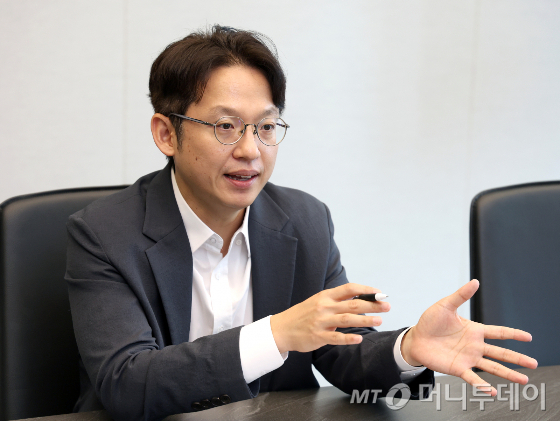
Lee Kyung-jun, Head of ETF Management Division at Kiwoom Asset Management who led the launch of asset allocation-type ETF products, recently cited "comfortable investing" and "healing investing" as the company's core ETF management philosophy in an interview with MoneyToday. Since joining Kiwoom Asset Management last year, he has launched approximately 18 ETFs. Excluding five of them, all are investment products targeting the U.S. market (including 'KIWOOM Korea High Dividend & U.S. AI Tech'). He believes that to achieve comfortable investing, a low-volatility portfolio is necessary, and the United States offers assets best suited for this purpose.
The head of division forecasted the stock market by citing British economist Carlota Perez's theory on stages of technological development. He diagnosed that with the emergence of AI as an innovative technology, the current stock market has entered the early stage of a volatile phase. While he expects volatility to continue until 2029, he anticipates a historic bull market will unfold thereafter.
He stated, "Even if AI-related companies record significant revenue growth, investors remain sensitive to AI profitability due to historical events such as the dot-com bubble." He added, "Such concerns are spreading beyond semiconductors to the entire AI value chain, including big tech firms, which will increase market volatility."
He predicted that until winners among various companies within the AI value chain are determined and the market stabilizes, a roller-coaster trading pattern will persist. Given the difficulty in predicting stock prices, he emphasized the importance of managing risk through diversified and long-term investing. Accordingly, the firm has focused on designing products capable of withstanding current volatility while maintaining an upward trend in the market.
The head explained, "Stock investing consists of four types: growth (△Growth), momentum (△Momentum), high dividend (△High Dividend), and high beta (△High Beta)." He further clarified, "Stable upward-trend investing involves well-diversified allocation across these four categories."
As examples of products corresponding to the four investment types, he cited 'KIWOOM U.S. Growth Dow Jones', 'KIWOOM U.S. S&P 500 Momentum', 'KIWOOM U.S. High Dividend & AI Tech', and 'KIWOOM U.S. AI Tech High Beta'. The head noted, "From the perspective of long-term investing such as retirement preparation, sustainability is more important than the principle that 'more is better' through high-beta investing." He added, "We must focus on creating sustainable cash flows throughout our lives."
He diagnosed the Korean market as corresponding to the high-beta category among investment types. Therefore, he advised against constructing a portfolio consisting solely of the Korean market from a long-term investment perspective. The head explained, "In the U.S. market context, even the KOSPI index itself is considered a high-beta investment; thus, the Korean market as a whole is viewed as a high-risk category." He elaborated, "When examining global supply chain value chains, the receiving side (mainly Korea) tends to be shaken depending on the preferences and trends of the ordering side (primarily the U.S.)."
Kiwoom Asset Management has determined that it has established all 'core' products within its portfolio and is now preparing to launch 'satellite' products. However, even if investors create portfolios concentrating on specific sectors for higher returns, the firm stressed the importance of avoiding excessive concentration in any single area. The head stated, "When launching 'KIWOOM U.S. Space Data Center Infrastructure', unlike other firms that included only the space sector, we structured approximately half with semiconductors." He added, "We designed it to capture thematic characteristics while ensuring diversification effects are realized."

 in STOCK

