

Despite comebacks by BTS, BIGBANG, aespa, and others, entertainment ETFs (exchange-traded funds) remain sluggish. Since the beginning of the year, returns have hovered around -40%, and capital is continuing to exit. Experts in the financial investment industry diagnosed that there is currently insufficient momentum to lift entertainment stocks.
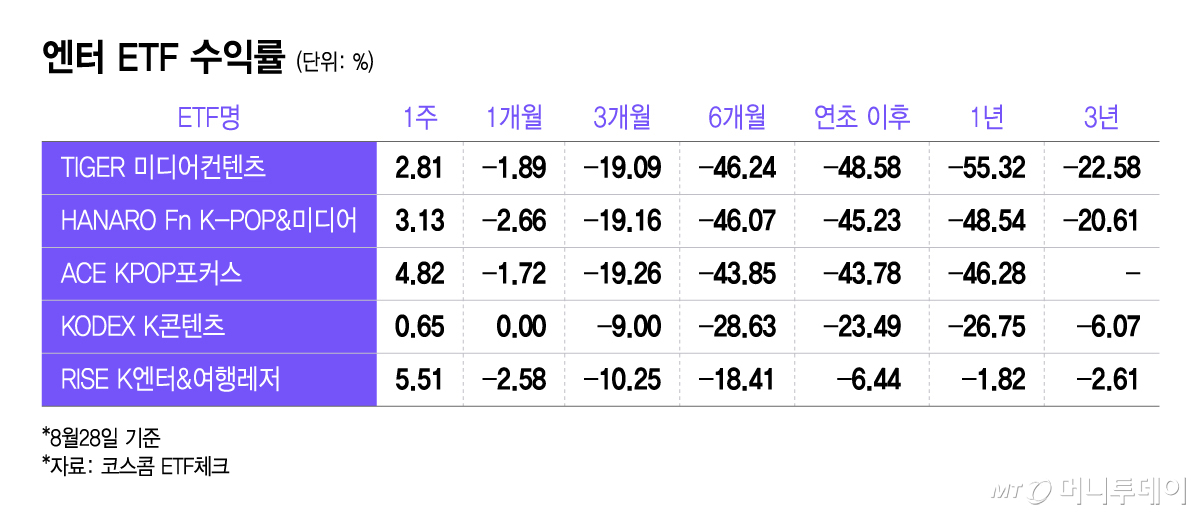
According to KOSCOM’s ETF Check on the 31st, as of the 28th, the return for "TIGER Media Contents" since the start of the year stands at -48.58%. This ranks as the third-lowest return among all domestically listed ETFs.
"HANARO Fn K-POP & Media" and "ACE KPOP Focus" also recorded returns of -45.23% and -43.78%, respectively, placing them in the lower tier of performance. Other entertainment-focused ETFs such as "ACE KPOP Focus" (-43.78%), "KODEX K-Content" (-23.49%), and "RISE K Entertainment & Travel Leisure" (-6.44%) also posted negative returns.
Except for the past week, period-based returns for entertainment ETFs have all been negative. This is due to the concentration of investments in semiconductor stocks since the beginning of the year, which marginalized entertainment stocks in the market, combined with a lack of momentum capable of reversing the situation.
Following BTS’s comeback in March and controversy over attendance numbers at the Gwanghwamun outdoor free concert, sell orders centered on HYBE began to weigh heavily on entertainment stocks. Although expectations rose later with news that popular idols such as BIGBANG and aespa would return in the second quarter, these developments were insufficient to revive investor sentiment.
Notably, JYP Entertainment’s consolidated operating profit for the second quarter fell 41.4% year-on-year to 31 billion won, while revenue declined 15.1% to 183.1 billion won, both missing market consensus estimates. Given the large scale of results from the same period last year, a decline was inevitable, compounded by weak album sales per unit. While HYBE, SM Entertainment, and YG Entertainment reported results that met or exceeded consensus estimates, their stock prices failed to follow suit.
Capital outflows continue in entertainment ETFs as well. Since the beginning of the year, 118.7 billion won has exited from five entertainment ETFs, with an additional 13.1 billion won flowing out over the past three months.
Although recent market rotation has led to some gains in entertainment stocks, experts believe the likelihood of a successful rebound remains low.
Lee Hwan-wook, a researcher at Yuanta Securities, stated, “A cautious approach is needed regarding whether investor sentiment will continue to improve,” adding that “there is currently no clear upward momentum.” He further explained, “The entertainment industry has entered a phase of growth slowdown due to the peak-out of album sales in the first half of 2023 and the burden of mega IP (intellectual property) base effects. Consequently, there is a need for realistic adjustments to the previously 20–30 times range of 12-month forward PER (price-to-earnings ratio).”
Indeed, since the beginning of this month, multiple securities firms have uniformly lowered their target prices for HYBE, SM Entertainment, JYP, and YG Entertainment.
Looking ahead, entertainment stocks could gain strength if factors such as the lifting of China’s Hallyu ban or other developments involving Suga occur; however, projections suggest that any upside will remain limited due to the absence of visible results so far.
Lee Hwa-jeong, a researcher at NH Investment & Securities, remarked, “For entertainment stocks to pass their valuation decline peak and for stock price rebounds to become visible, earnings stability must be fundamentally supported, and an investment narrative capable of driving investor sentiment must be established.” She added, “Long-term accumulated earnings uncertainty has been acting as an obstacle to stock price rebounds from the outset.”

 in STOCK
