

This week (the 7th–11), the domestic stock market is expected to face heightened caution as both futures and options contracts are set to expire simultaneously with the release of U.S. inflation data. The employment report released in the U.S. on the 4th (local time) came in hotter than expected, making the August PPI (producer price index) and CPI (consumer price index) key indicators for gauging the direction of the U.S. base rate.
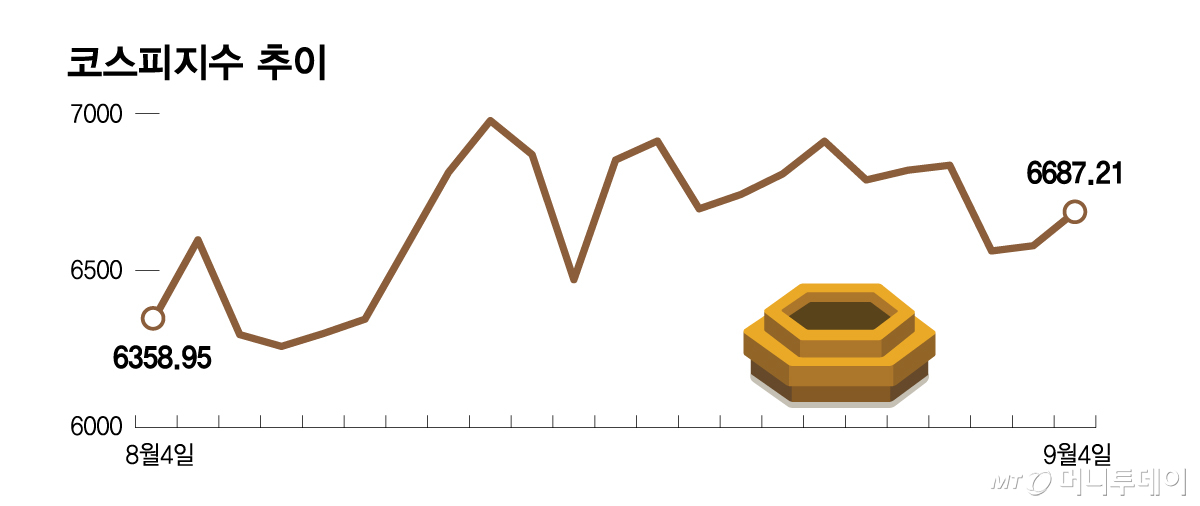
According to Korea Exchange data on the 6th, the KOSPI index closed last week (August 31–September 4) at 6,687.21, down 1.50% from Jeonju. Market instability was fueled by hawkish remarks from Federal Reserve System Chairman Kevin Warsh at the Jackson Hole conference (favoring monetary tightening), compounded by geopolitical risks in the Middle East.
On the 10th, the domestic stock market will face "Witches' Day," when both stock index futures/options and individual stock futures/options expire simultaneously. As expiration dates approach, profit-taking trades driven by position adjustments may emerge, requiring caution regarding short-term volatility.
Domestic semiconductor industry conditions and exports are supporting the lower bound of the index. According to the Ministry of Trade, Industry and Energy, semiconductor exports last month reached $46.65 billion, a 209.0% increase compared to the same period last year—the largest monthly figure in history. Additionally, other corporations, presumed to include share buybacks from Samsung Electronics and SK Hynix, emerged as downward support forces by recording net purchases of only ₩6.468 trillion in the KOSPI market last week.
The U.S. Treasury Department's plan to expand its long-term bond buyback program is also cited as a positive backdrop for the stock market. The Treasury has decided to raise the buyback limit per auction from $2 billion to at least $4 billion for 10–20 year and 20–30 year bonds, effective from the 9th through November 4.
Key indicators drawing market attention this week are the August PPI and CPI, scheduled for release on the 10th and 11 (local U.S. time). These inflation reports, released ahead of the Federal Reserve's Federal Open Market Committee (FOMC) meeting on the 15th–16, are expected to significantly influence base rate decisions. Earlier, the U.S. Department of Labor reported on the 4th that non-farm employment surged by 162,000 jobs month-over-month, far exceeding market forecasts (53,000–56,000 job increases), leading to assessments that this provided justification for an interest rate hike at the Federal Reserve.
According to a survey of economists conducted by Dow Jones, the August core CPI—excluding volatile food and energy prices—is projected to rise 0.2% month-over-month and 2.4% year-over-year. The expected month-over-month increase matches July's figure, while the year-over-year increase is 0.1 percentage points lower than previously anticipated.
Jo Byung-hyun, a researcher at Daul Investment & Securities, stated, "We expect the trading range between 6,200 and 7,000 established since August to continue this week." He added, "Given heightened sensitivity to inflation, the upcoming U.S. inflation data release this week may also serve as grounds for a wait-and-see stance." Meanwhile, the U.S. stock market will be closed on the 7th in observance of Labor Day.

 in STOCK
