

Amid rising investor demand for target-conversion funds, the Financial Supervisory Service (FSS) advised that Class A funds, which apply front-end sales loads, are not suitable for "short-term investments." The FSS emphasized the need for investors to exercise caution when selecting fee structures and reviewing returns.
On the 9th, through its "Guidance on the Status of Public Target-Conversion Funds and Investor Precautions," the FSS urged investors to carefully check whether they have selected fees inappropriate for their actual investment horizon. A target-conversion fund is a type of fund that raises capital over a set period, invests in stocks or other assets, and upon reaching a pre-set target return rate, converts to safe assets like bonds and continues operations until maturity.
The total amount raised by target-conversion funds surged from 1.4 trillion won in 2024 to 5.2 trillion won last year, and reached 3.2 trillion won in the first half of this year.
The period required to achieve the set target return rate and switch operations to safe assets like bonds has shortened dramatically. In 2024, it took 249 days; by 2025, it was reduced to 105 days, and in the first half of this year, it was further shortened to just 57 days.
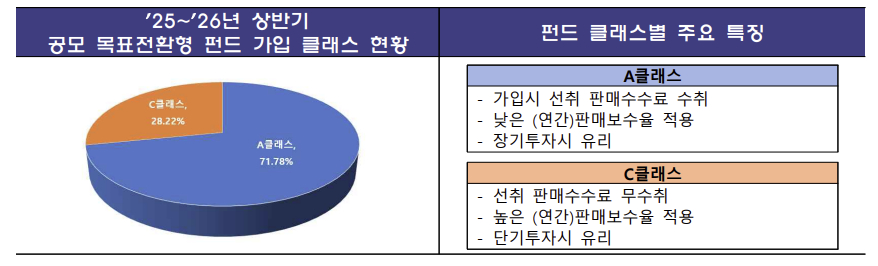
Although the period before switching to safe assets like bonds has become shorter, investors continue to choose fee structures suitable for medium- to long-term investments. From last year through the first half of this year, 71.8% of investors enrolled in Class A funds that charge front-end sales loads. Class A funds are advantageous for long-term investments as they deduct sales loads upfront and apply lower ongoing management fees. In contrast, Class C funds have no sales load but apply higher ongoing management fees, making them more suitable for short-term investments.
In response, an FSS official stated, "The total fee costs for Class A and Class C funds become similar after two years," adding, "If a short-term investment is anticipated, enrolling in a Class A fund may be disadvantageous from the perspective of investment costs."
Investors must also thoroughly understand the structure and characteristics of target-conversion funds. The target return rate of such funds represents the "return rate to be achieved," not a guaranteed actual return rate. During bull markets, investors can quickly achieve the target return rate; however, depending on market conditions, there is also a risk that the target may not be met. Consequently, significant losses can occur.
Even if the target return rate is achieved quickly in a target-conversion fund, subsequent lower returns can alter the final return rate. An FSS official noted, "There have been cases where market conditions changed rapidly during the period when investments were switched to safe assets like bonds, causing the price of investment-target assets to fall, resulting in the return rate on the conversion date being significantly lower than the target return rate." The official added, "Investors need to exercise caution."
The FSS plans to require disclosure of principal loss risks and risks associated with the fund's operational conversion process through the upcoming "Standard for Key Investment Risks of Funds," which is scheduled to take effect at the end of this month.
An FSS official stated, "To prevent misunderstandings about the characteristics of target-conversion funds, we will strengthen disclosures in fund registration documents and guide sales companies to provide thorough explanations to consumers regarding burdens such as sales fees."

 in STOCK
