

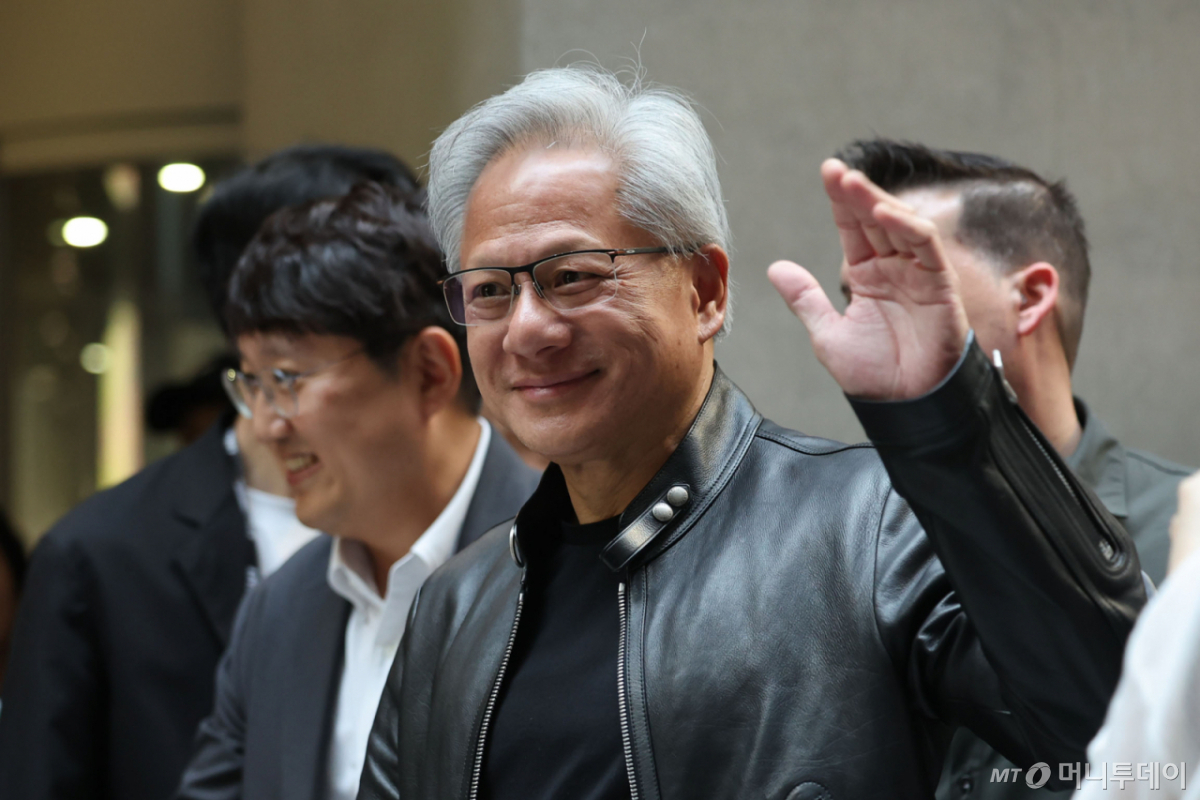
The KOSPI overcame the shock of a U.S. base rate hike within a single day. This is due to falling yields on long-term U.S. Treasury bonds and declining international oil prices, as well as NVIDIA CEO Jensen Huang's forecast that semiconductor sales next year will double compared to this year.
It remains to be seen whether Huang's remark will lift the semiconductor stocks and KOSPI, which had been hesitant amid arguments for slowing down AI development.
As of 9:08 a.m. on the 18th, the KOSPI was trading at 6,848.25, up 132.84 points (1.98%) from the previous day.
Despite the Federal Reserve System's (Fed) base rate hike on the 16th (local time), the KOSPI opened higher that day. This is because uncertainty regarding the Fed's policies eased following the conclusion of the September Federal Open Market Committee (FOMC) meeting. Additionally, news emerged that President Donald Trump would hold talks with Gulf state leaders next week, leading to declines in long-term U.S. Treasury yields and international oil prices.
Amid a more favorable environment for the stock market, Huang's remarks stimulated investor sentiment toward semiconductor stocks. Speaking to reporters ahead of his attendance at an AI summit held in Scotland hosted by King Charles III on the 17th (local time), Huang said, "We expect NVIDIA to sell twice as many chips next year compared to this year," adding, "This is because AI is making a very significant contribution to various industries and the economy."
Domestic and foreign semiconductor stocks, which had been sluggish due to high interest rates and arguments for slowing down AI development, rose across the board following Huang's remark.
At the current time, Samsung Electronics is trading at 258,750 won, up 6,250 won (2.48%) from the previous day. SK Hynix is trading at 182,000 won, up 75,000 won (4.3%). Semiconductor stocks also rose in overnight U.S. markets. SK Hynix's American Depositary Receipts (ADRs) jumped 4.64%, Micron rose 5.5%, Intel rose 7.7%, and Qualcomm rose 2.1%.
Experts in the financial investment industry analyzed that despite the high-interest-rate environment, semiconductor demand remains robust, as Huang predicted.
Kim Dong-won, head of research at KB Securities, stated, "Although the yield on 20-year long-term bonds has reached levels between 6.0% and 7.5%, we estimate that the volume of bond issuance by U.S. hyperscalers for AI infrastructure investment from January to September this year increased eightfold year-on-year to 337 trillion won." He added, "This indicates that investors expect to recover their investments within a few years through increased profits generated in AI cloud and AI services, even if they accept high borrowing costs, which is driving expanded investment." He further said, "The biggest beneficiaries of AI demand, which is stronger than interest rates, are Samsung Electronics and SK Hynix."
Analyses also suggest it is unlikely that overall industry investment will be cut due to the recently raised arguments for slowing down AI development. This is because it is realistically difficult for all companies to agree to simultaneously adjust their development speeds. In particular, given that the United States and China are engaged in a technological hegemony competition, the general consensus is that there must be a gap between any agreement on joint slowdowns and their actual implementation.
Lee Jae-won, a researcher at Yuanta Securities, explained, "It is difficult to definitively conclude that recent semiconductor corrections signal a reduction in AI investment until actual order declines are confirmed," adding, "We maintain our top preference for semiconductor and KOSPI large-cap stocks from a strategic perspective."
The researcher also said, "Profit differentiation continues even within IT (information technology). Samsung Electronics is scheduled to pay approximately 30 trillion won in cash dividends in the third quarter, and SK Hynix has announced plans to unveil additional shareholder return policies following its 40 trillion won share buyback and cancellation." He concluded, "A response centered on semiconductors, where earnings and shareholder returns are confirmed around the Chuseok holiday period, is effective."

 in STOCK
