

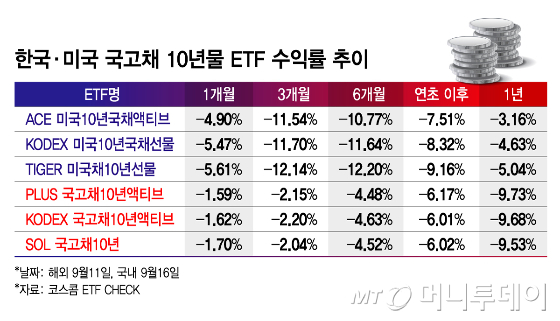
As fiscal deficits in major countries and high oil prices have led to high inflation and high interest rates, the returns of Treasury bond ETFs (exchange-traded funds) have turned negative across the board. In particular, for U.S. long-term bond ETFs listed domestically, the strengthening of the won increased exchange rate loss costs, further pressuring returns downward. Experts in the financial investment industry say it is unlikely that international oil prices will stabilize before the U.S. midterm elections and advise that investors need not rush into bond investments until after the election.
According to KOSCOM ETF CHECK on the 19th, as of the 11th, the one-month return for 'TIGER US Treasury 10-Year Futures' was -5.61%, and 'KODEX US 10-Year Treasury Futures' was -5.47%. This places them in the bottom tier among 140 bond ETFs listed domestically. Returns over three months and six months both fell into the double-digit negative range of -10% or more.
This is attributed to the sharp rise in U.S. 10-year Treasury yields, which dragged down ETF returns. Bond prices move in the opposite direction of bond yields; when yields rise, prices fall. Consequently, during periods of rising interest rates, long-term bonds tend to see deteriorating profitability. Because they remain locked at relatively low yields for longer periods, their prices must decline to avoid losing attractiveness compared to new bonds offering higher yields. On the 11th (local time), the U.S. 10-year Treasury yield reached 4.97%, and during trading hours it climbed as high as 5.041%, marking its highest level in over 19 years since July 2007.
The surge in U.S. 10-year Treasury yields to levels seen at the onset of the global financial crisis is driven by expanding fiscal policies in major countries and high oil prices, which have heightened inflation concerns. In particular, on this day, U.S. Treasury Secretary Scott Bessent stated during a House hearing that the rise in 10-year yields was also influenced by the U.S. fiscal deficit issue.
International oil prices are also exceeding $100 per barrel as geopolitical tensions in the Middle East remain unresolved. On this day, West Texas Intermediate (WTI) crude rose $4.44 (4.38%) from the previous session to close at $105.83 per barrel, while Brent crude climbed $3.07 (2.9%) to reach $108.75 per barrel. Both benchmarks hit their highest levels since May 19. Concerns over oil supply have intensified following reports that a Saudi Arabian crude oil bypass pipeline was attacked by Yemeni Houthi rebels, halting operations, and that three oil fields in Libya have also stopped production.
In particular, the sharp appreciation of the won added exchange rate loss costs, further dragging down returns on U.S. 10-year Treasury ETFs. On the 9th, the won/dollar exchange rate in the Seoul foreign exchange market closed at 1,336.1 won, down 9.5 won from the previous trading day, ending the week's trading. This is the lowest level on a closing price basis since October 2024, marking the first time in approximately 23 months. Most U.S. 10-year Treasury ETFs are set with exchange rate exposure. As a result, the won/dollar exchange rate plummeted by about 220 won over two months, and this decline was fully reflected in prices.
Korea also saw its 10-year Treasury yield break through 4.6% on the 15th, reaching its highest level in nearly four years since 2022. Consequently, red lights have been triggered for 10-year Treasury ETFs as well. As of the 16th, 'PLUS Korea Treasury 10-Year Active' (-1.59%), 'KODEX Korea Treasury 10-Year Active' (-1.62%), and 'SOL Korea Treasury 10-Year' (-1.70%) all posted returns in the -1% range.
Experts believe it is unlikely that the Middle East war will end or international oil prices will ease significantly before the U.S. midterm elections. Accordingly, they advise taking a conservative approach to bond investments while waiting for the election results. Moon Hong-cheol, a researcher at DB Securities, stated, "The attack on Saudi Arabia's crude oil bypass export route could become a new game-changer for inflation." He added, "Since markets are extremely sensitive to interest rate hike factors, it is necessary to set no upper limit and operate as conservatively as possible."

 in STOCK
