

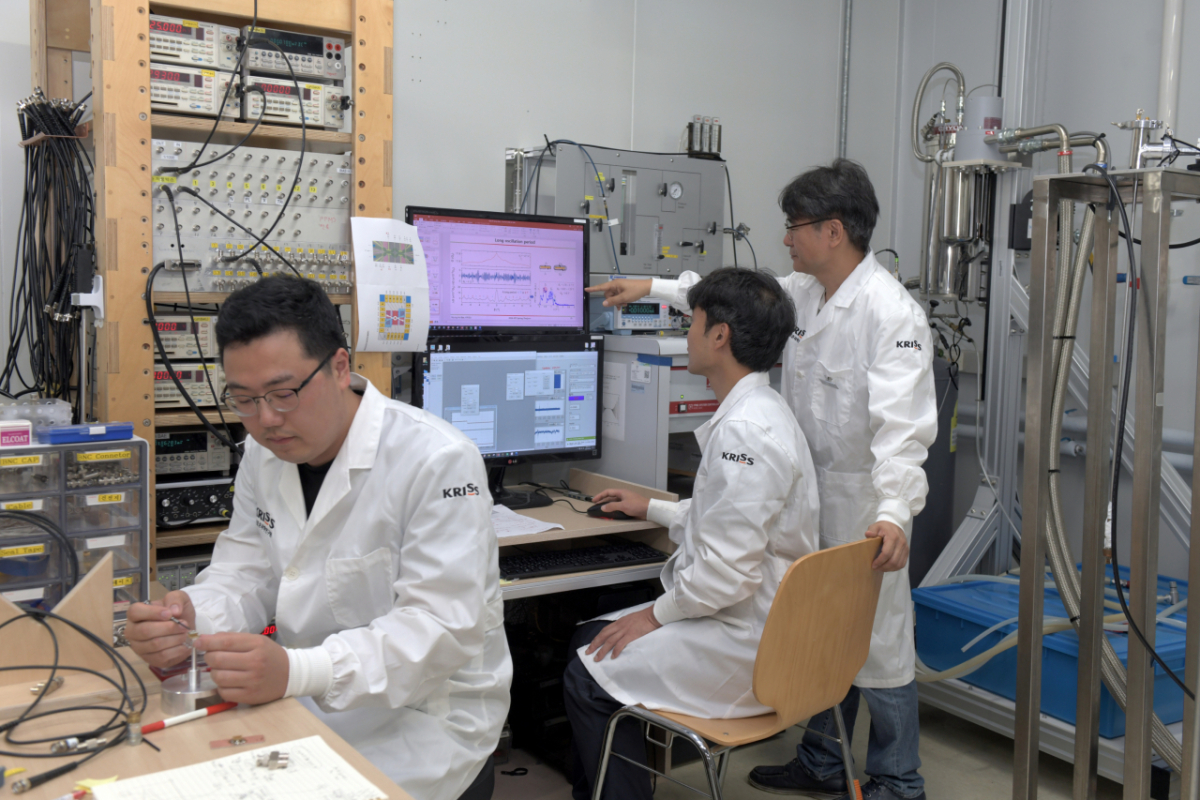
A domestic research team has found a clue to reducing errors in quantum computers.
The Korea Research Institute of Standards and Science, GIST (Gwangju Institute of Science and Technology), and National Kongju University announced on the 19th that they have for the first time identified the cause of the 'beating' signal in topological insulators. The research results were published as a cover article in the international academic journal 'Nano Letters' last month.
A quantum material is called a 'topological insulator' when electricity flows well inside but a special electronic state exists on its surface. When a topological insulator is made into a thin nanowire, electrons on the surface move along the circumference. However, when actual topological insulators are fabricated, a thin layer where electrons flow can form below the surface due to impurities mixed in during the manufacturing process.
However, it was unknown whether this newly formed thin layer affects the 'Aharonov-Bohm' phenomenon. This has been one of the mysteries in the physics community for a long time.
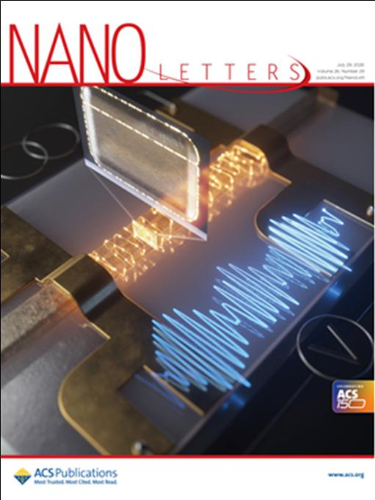
The Aharonov-Bohm phenomenon is one of the signals that can confirm the electronic state of topological insulators. When a magnetic field is applied to a nanowire, electrons circling clockwise along the surface circumference and those circling counterclockwise interfere with each other, causing conductivity to change periodically. Precisely observing this phenomenon allows for error-free interpretation of quantum signals generated in topological insulators and precise control of quantum states as desired. It is one of the key elements for implementing quantum computer operations.
While checking whether the Aharonov-Bohm phenomenon occurs in the fabricated nanowires, the research team observed a 'beating' phenomenon. Beating is a phenomenon where signal intensity changes as vibrations with slightly different periods overlap, similar to how two tuning forks produce a 'hum-hum' sound. This means there are other vibration components that the research team did not expect.
After years of tracking and analysis, the researchers concluded that the beating originated from the 'two-dimensional electron gas (2DEG),' a general electron layer below the surface of the nanowire. The areas enclosed by the two electron paths around the nanowire were slightly different, creating vibrations with different periods, and their superposition caused the beating phenomenon.
Research leader Bae Myung-ho explained, "This demonstrates that electrons can quantum-interfere while moving not only between topological states but also between general electronic states." He further interpreted, "To utilize only the desired topological state, it is important to precisely control doping and gates so that general conductive states do not interfere."
GIST Professor Choi Sang-jun predicted, "The principle of understanding and controlling interference between different electronic states can be utilized in the design of future topological quantum devices."

 in TECH

