

While the adoption of robots by companies is accelerating, preparations for actual operation are failing to keep pace. Although 60% of companies and institutional investors expect to be operating robots within the next five years, only 40% of organizations have formal strategies in place to manage humans and robots together.
According to Intel on the 23rd, these findings emerged from the "Robotics Readiness Gap Survey," conducted among approximately 800 executives, robotics experts, and government and healthcare officials from companies in South Korea, the United States, the United Kingdom, Germany, Japan, China, and other countries. The survey targeted organizations with annual revenues of at least $500 million.
Companies expressed high expectations for productivity gains resulting from robot adoption. They projected that full-scale robot deployment could boost operational productivity by up to two times, and 74% of respondents anticipated that by 2030, it would become increasingly difficult to separate corporate workforce planning from robotics strategy.
However, strategies and personnel to support actual implementation remain insufficient. While 67% of respondents expressed confidence in being prepared to manage environments where humans and robots work together by 2030, only 40% have officially established relevant strategies. Approximately 40% cited shortages in technology and skilled personnel as barriers to expanding robot adoption.
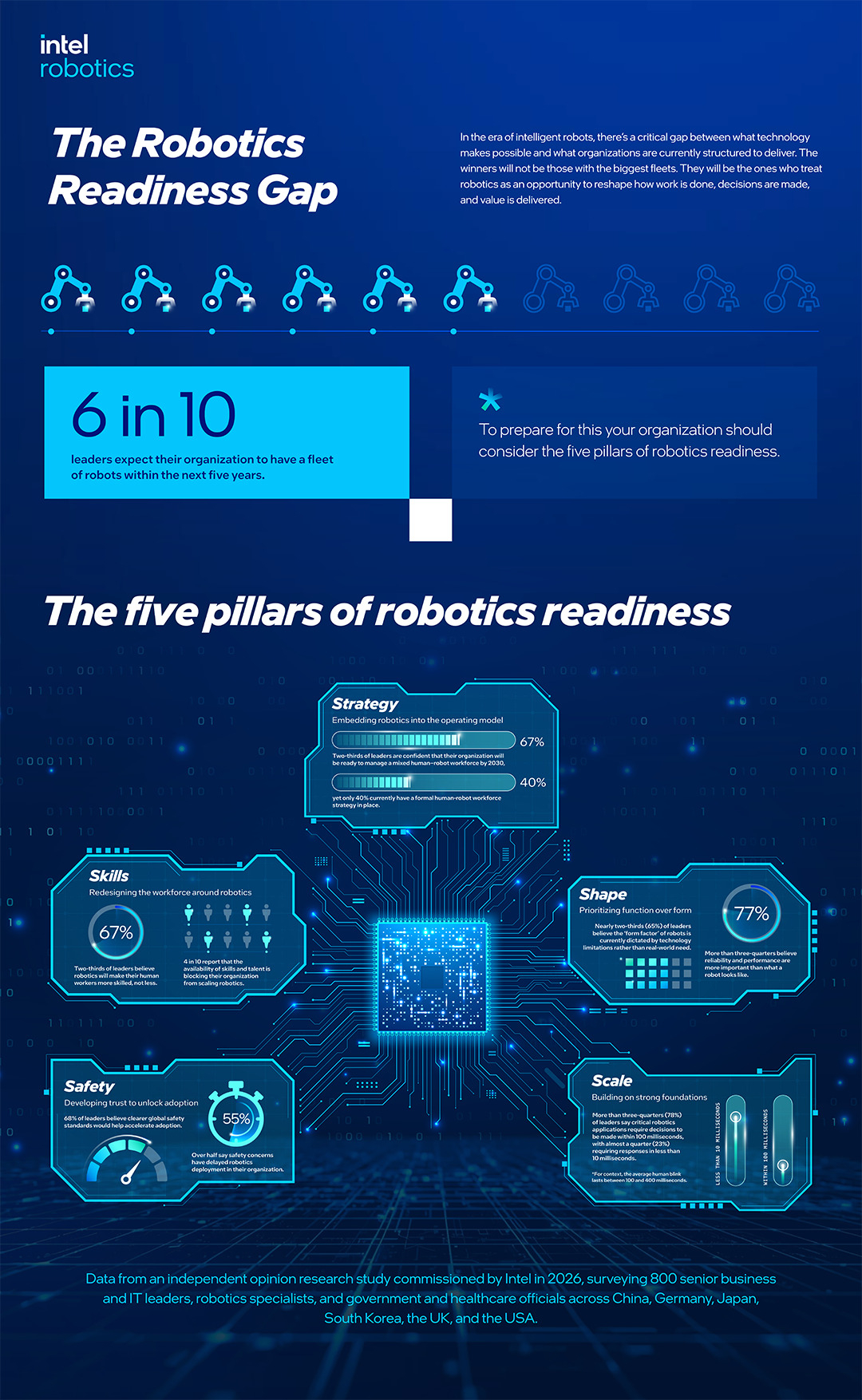
Expectations and concerns regarding safety also emerged simultaneously. While 31% of respondents identified safety as the primary advantage of robot adoption, 55% reported experiencing delays in actual robot implementation due to safety concerns. Additionally, 68% predicted that establishing clearer global safety standards would accelerate the pace of robot adoption.
As physical AI (artificial intelligence) capable of perceiving surrounding conditions and making real-time decisions spreads, the importance of computing infrastructure is also growing. More than 75% of respondents stated that major robot applications must make decisions within 100 milliseconds (0.1 seconds), while approximately 25% indicated a need for response speeds under 10 milliseconds (0.01 seconds). Currently, 42% have secured budgets and strategies related to edge or on-device AI, and 39% are in the process of developing such strategies.
John Hillery, Intel's Senior Vice President and General Manager of the Industry and Robotics Division, stated, "The next phase of robotics adoption will be determined not by whether an organization can adopt robots, but by whether it is prepared to scale them." He added, "Organizations that harmoniously build strategies, workforce development, safety measures, and infrastructure will be best positioned to realize the benefits of intelligent robots and physical AI."

 in TECH

