

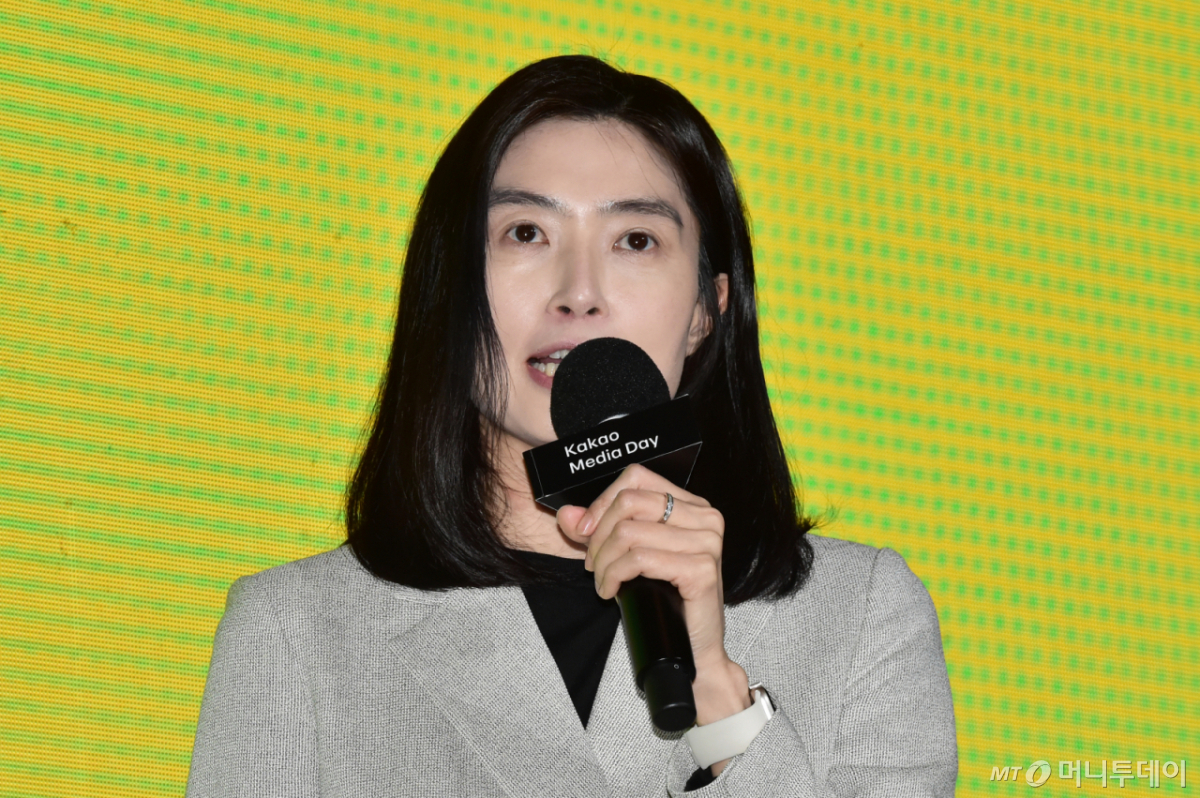
Jeong Shin-a's "Human-Centered AI," which she introduced at the beginning of the year, is shifting from a slogan to a business model. This change comes as KakaoTalk was separated into a new company alongside AI, advertising, and commerce. Kakao's vision does not rely on competing with a single massive AI model. Instead, it aims to embed an AI agent that understands each user's unique context within the 50th million-user KakaoTalk platform, connecting these agents to revenue streams in advertising, commerce, and subscriptions.
Jeong (CEO), who has been appointed as CEO of the newly established company KakaoAI, stated, "We will create a new AI experience that drives actions based on the relationships and contexts of 50 million individuals," adding, "We will allocate all resources to creating new growth opportunities centered around AI."
The first condition is running AI at a low cost. Kakao has designed its system so that 'Kanana Nano,' a lightweight model, directly processes about half of user requests within smartphones, forwarding only complex requests to server-based AI. The company also plans to implement an "AI Conductor" that selects the appropriate model based on request complexity, aiming to reduce server inference costs by up to 90%. The judgment is that enabling AI for all citizens requires breaking the structure where server costs skyrocket as the number of users increases.
The second strategy is transforming KakaoTalk into an AI interface. Under the belief that the AI era will bring "One Person, One Agent" following the eras of "One Person, One PC" and "One Person, One Smartphone," Kakao plans to build general-purpose assistants, expert agents for commerce and finance, and "AI Digital Twins" that understand users and proactively make suggestions within KakaoTalk. The weapon is not model size but context. Jeong (CEO) said, "We need a model that can understand my contextual data rather than one that scores 70 or 90 on large-scale big models." As AI becomes cheaper, more users will join; as more contextual data accumulates, recommendations become more sophisticated, creating a virtuous cycle leading to advertising and commerce revenue. This is the ecosystem Kakao envisions.
The corporate split is also a move for this competition. In the past five years, about 85% of the 23rd abnormal decisions made by the Kakao board were related to problems with subsidiaries, and 84% of agenda items in the last year involved subsidiary matters. By transferring the burden of managing subsidiaries to KakaoX, KakaoAI can focus solely on AI.
The goals are aggressive: more than 20 million daily AI users by 2030, a 50% increase in time spent within KakaoTalk, surpassing 1 trillion won in AI revenue, and total corporate revenue exceeding 6 trillion won. The foundation is existing users. There are 30 million KakaoTalk users who actively converse daily, and 'Kanana in KakaoTalk' shows a stickiness level of 60–70% regarding usage continuity compared to monthly active users (MAU). Furthermore, the time AI users spend in KakaoTalk is more than 50% longer than that of non-users.
While Naver is investing heavily in large-scale AI factories and SK Telecom is expanding data centers, Kakao has prioritized a B2C battle to convert its 50 million KakaoTalk users into AI users. The strategy involves lowering costs through lightweight models and on-device processing, and connecting AI usage directly to transactions and payments within KakaoTalk.
There is still a gap between the plan and market evaluation. On the day of the announcement, Kakao's stock price closed at 35,800 won, down 7.49%. Uncertainty regarding the split ratio and future corporate valuation was reflected before expectations for the AI business. Kakao explained that KakaoAI will be re-evaluated as an AI company in the market following the spin-off.
The key issue is whether Kakao can make the 50th million daily messenger users also use AI every day. Kakao has staked its entire corporate body on this experiment to compete as "the AI that knows me best."

 in TECH
