

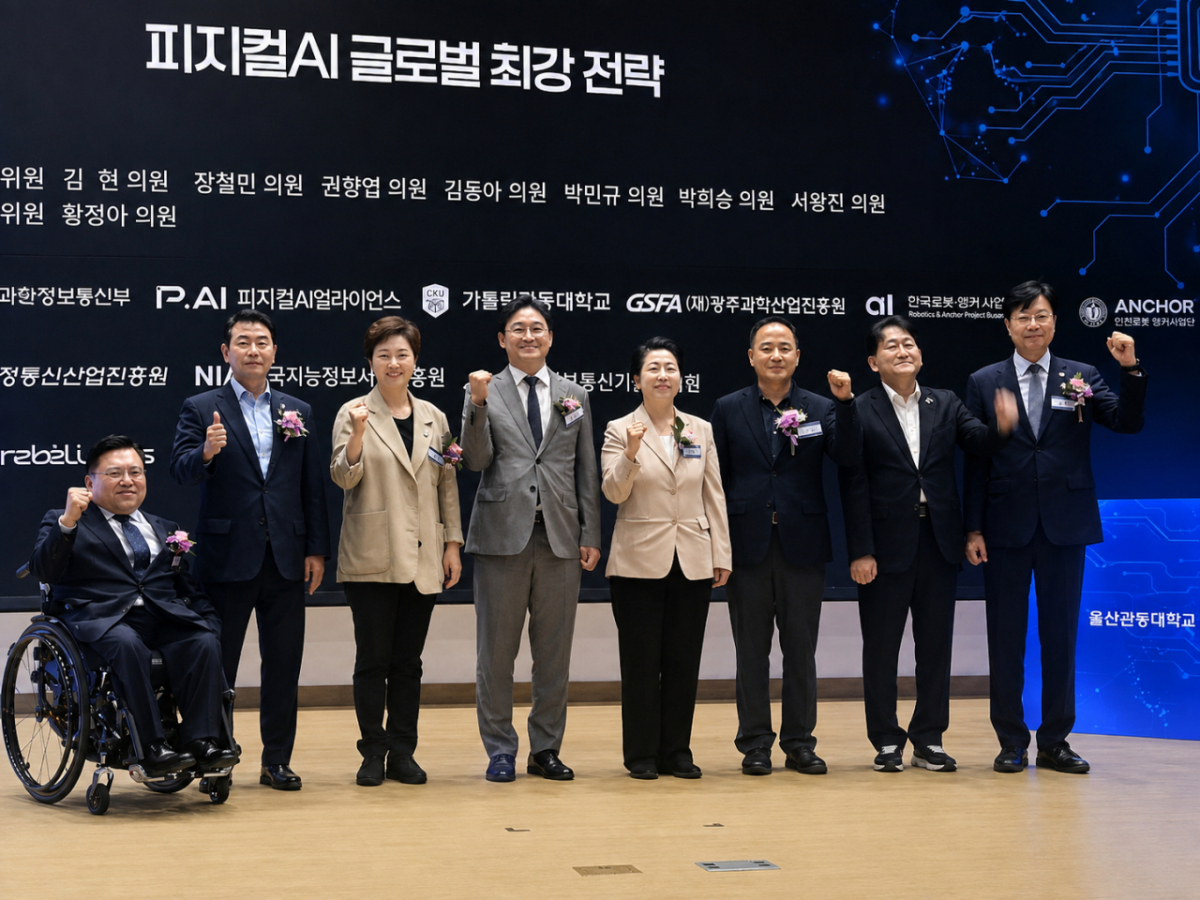
The government will launch large-scale R&D (research and development) support next year for developing general-purpose physical AI (artificial intelligence) models. In this early-stage market where the technical "correct answer" has not yet been determined, the strategy is to secure data and AI software first to establish competitiveness in the "brain" of physical AI.
Song Chang-jong, head of the Device AX Innovation Team at the Ministry of Science and ICT, stated on the 25th at the one-year anniversary event of the Korea Physical AI Association titled "K-Physical AI Technology Self-Reliance to Open Korea’s Industrial Ecosystem Daejeon Roundtable – Physical AI Global Top Strategy," that "starting next year, we plan to support as many diverse attempts as possible through large-scale R&D support."
While LLMs (large language models) have established a certain "scaling law" where performance improves by increasing parameters, data, and GPUs (graphics processing units), the situation differs for physical AI. Constraints on model size and a lack of real-world learning data mean that an optimal technical structure has not yet been established.
Team Leader Song said, "Big tech companies accumulate failure experiences while making various attempts based on their capital power, but individual companies in Korea find it difficult to bear this burden alone." He added, "We aim to build an R&D system that disperses failure risks at the ecosystem level and enables the government to support diverse attempts."
China is rapidly advancing in hardware. At the 100th-meter preliminary round of the Second World Humanoid Robot Games held on the 22nd in Beijing, China's "Tianzhuo" team's humanoid robot recorded a time of 9.39 seconds. This is 0.19 seconds faster than Usain Bolt's 100-meter world record of 9.58 seconds.
Park Tae-wan, Director General of the Information and Communications Industry Policy Office at the Ministry of Science and ICT, referenced this case, saying, "You might have been slightly surprised seeing China's hardware technology that runs faster than Usain Bolt, but that is not everything." He emphasized, "What matters most is how well the software—the brain inside the robot—performs."
The government will first establish a cross-ministerial system for data acquisition and management. Data on failure and recovery processes, which are difficult to obtain in actual field settings, will be mass-produced as synthetic data using world models, and a data library will also be created. Based on this, the government will pursue the development of world-class general-purpose physical AI models capable of recognizing physical situations and taking action.
The Ministry of Science and ICT has begun five-year leading demonstrations in manufacturing sectors in Jeonbuk and Gyeongnam starting this month. It plans to build a "data flywheel" that utilizes data secured on-site for further model training, and will collaborate with the Ministry of Trade, Industry and Energy and the Ministry of SMEs and Startups to spread these results to other industries.
Yoo Tae-jun, President of the Korea Physical AI Association, presented a "K-Physical AI Technology Self-Reliance Pipeline" that leads from industrial site data to proprietary world models, domestic AI semiconductors, robots, and other industrial applications. Yoo (Chairman) stated, "We will focus on securing core technologies independently and applying them in industrial settings to make Korean technology a global standard."
KAIST President Bae Chung-sik emphasized, "The country that quickly dominates the physical AI field within five years will become the world's top leader. Currently, technological hegemony is an era of winner-takes-all, and this trend will be even more intense in the AI age, making the next five years critically important."

 in TECH
