

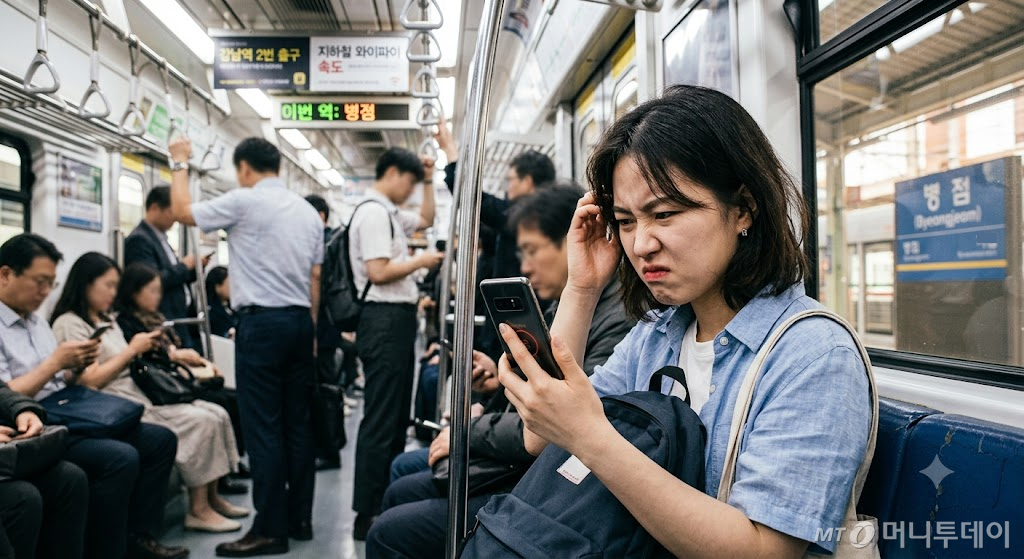
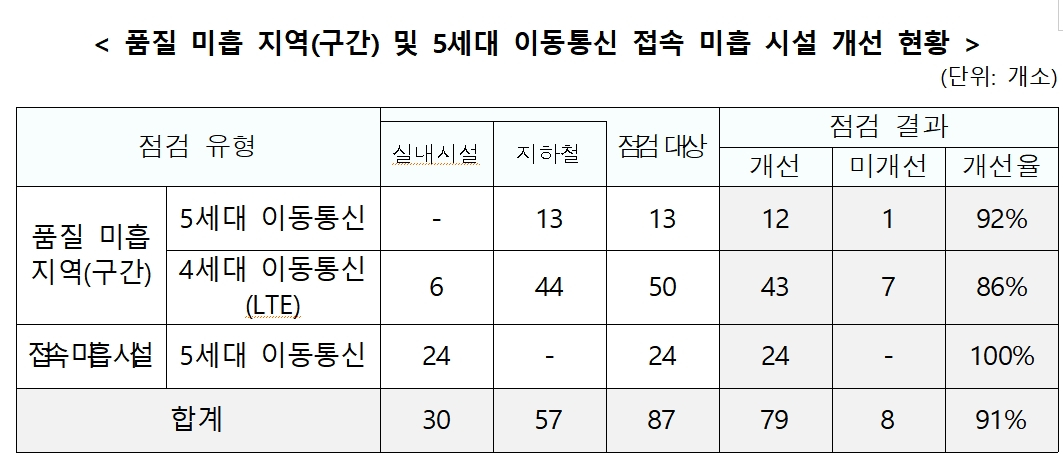
A full survey of 87 locations with poor communication quality last year revealed that while 79 locations have improved, the communication quality in 8 locations remains insufficient.
The Ministry of Science and ICT and the Korea Institute for Information Technology Advancement (NIA) announced on the 30th that this result was obtained after re-examining whether improvements were made to 87 locations identified as having slow transmission speeds (insufficient quality) or weak radio signal strength (insufficient connectivity) in the 2025 Communication Service Quality Evaluation.
This inspection focused on indoor facilities and subway areas and facilities with insufficient quality.
All 30 indoor facilities that were previously rated as insufficient have now seen quality improvements. The average download transmission speed improved from 33.61 Mbps before the improvement to 99.34 Mbps after, representing a 196% improvement rate and significant quality enhancement.
In subway sections, 5G saw improvements in 12 out of 13 insufficient locations, but the Seonghwan-Jiksan section on Line 1 still had poor quality. For LTE, 37 out of 44 sections (84%) were improved, while 7 sections still require improvement.
Specifically, communication quality was poor in the 'Seryu-Byeongjeom' and 'Seonghwan-Jiksan' sections of Line 1 in the metropolitan area, and connections were also poor on the Suin-Bundang Line (Oido-Galwol) and Busan-Gimhae Line (Bulam-Daesa). Specific sections within Busan Line 1 (Myeongnyun-Oncheonjang), Busan Line 3 (Gangseo-gu Office-Sports Park), and Busan-Gimhae Line (Gwaebeop-Renaisette-Sasang) also required quality improvements.
Regarding high-speed rail sections that were most frequently criticized for poor communication quality, the plan is to improve them before the Chuseok holiday to enhance the communication environment for travelers returning home during the holiday. Communication delays frequently occurred in heavily used sections such as 'Pyeongtaek-Jije-Daejeon', 'Daejeon-Miryang', 'East Daegu-Ulsan', 'Osong-Iksan', and 'Iksan-Jeonju'.
Additionally, once the joint network 2.0 facility investment for remaining sections of the Gyeongbu and Honam lines is completed in the second half of the year, those sections will also be inspected by the end of this year.
The Ministry of Science and ICT plans to continue quality evaluations and re-inspections of insufficient areas to create a high-quality communication environment that citizens can experience in their daily lives.
In particular, the 8th subway sections where quality has not yet improved, as well as high-speed rail sections such as the Gyeongbu and Honam lines, will be inspected more strictly during the second-half quality evaluation.

 in TECH

