

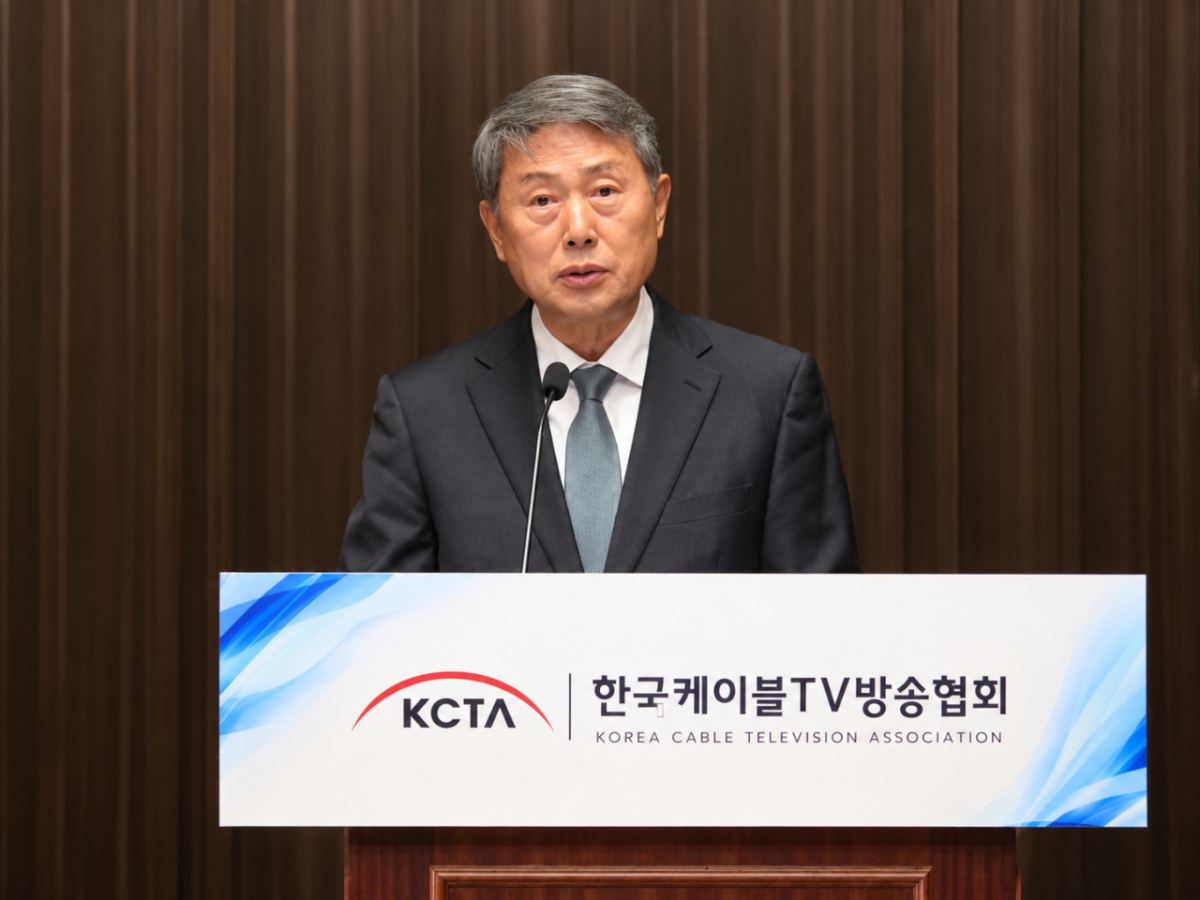
The cable TV industry filed a complaint on the 8th in protest against the collection rate for the Broadcasting and Communications Development Fund (BCDF), which has been maintained since 2017. The industry decided to contest the legality of the current system in court, under which it bears a BCDF burden exceeding its total operating profit, and levies are imposed even on deficit operators.
Shin Ho-cheol, Jeong Chaek (Head) of the Korea Cable TV Broadcasting Association, stated at a press conference held on the 8th at Seoul Garden Hotel in Mapo-gu, Seoul, "We have continuously requested the government to lower the collection rate and grant exemptions, but our requests were not accepted," adding, "We filed the lawsuit to seek a legal ruling on whether the levy is lawful."
The defendant in the lawsuit is the Korea Communications Commission (KCA), which is responsible for assessing and collecting the BCDF. The target of the suit is the 2026 BCDF assessment notice issued at the end of August. The collection rate applied to cable television operators (SOs) has been maintained at 1.5% of broadcasting service revenue since 2017. The structure imposes levies even on deficit operators.
The total operating profit of SOs decreased to 45.1 billion won last year. The industry argues that the BCDF burden exceeds its total operating profit. The Enforcement Decree of the Broadcasting and Communications Development Basic Act stipulates that when determining the collection rate, factors such as market competition conditions, operators' revenue scale, and financial status must be considered.
Kim Hyuk, head of cable business at SK Broadband, said, "Approximately 10 million subscribers still use cable TV," adding, "As operators' investment capacity decreases, users are increasingly placed in a disadvantaged position regarding internet quality and broadcast picture quality."
The legal issues presented by the industry are △non-exercise of discretion, △violation of the principle of proportionality, and △violation of the principle of equality. Shin pointed out that while exemption criteria have been established for local terrestrial broadcasters, no separate criteria exist for SOs. The industry aims to revise the collection rate by August next year.
Current issues for individual operators are also ongoing. The first hearing in the program usage fee lawsuit filed by CJ ENM against LG Hello Vision was held on the 2nd at the Goyang Branch of the Uijeongbu District Court. The two sides are in conflict over the usage fees and settlement methods to be applied after the termination of their existing supply contract.
Lim Seong-won, executive vice president of the Public Relations and External Cooperation Center at LG Hello Vision, explained, "A lawsuit and government dispute mediation are currently underway," adding, "We will only be able to proceed with negotiations after a judicial ruling or dispute mediation result is issued." He emphasized that autonomy in channel product composition is also necessary to shift from price competition to service competition.
The Broadcasting and Communications Commission resolved on the 7th to issue a corrective order to Dlive for violating re-licensing conditions related to debt ratio reduction measures. A Dlive official stated, "Our goal is to prepare a plan that meets the standards of government institutional investors as much as possible within three months." However, they remained silent on specific financial restructuring or sale plans.

 in TECH
