

[For more diverse corporate information on the startups featured in this article, please visit the Unicorn Factory big data platform 'Data Lab'.]
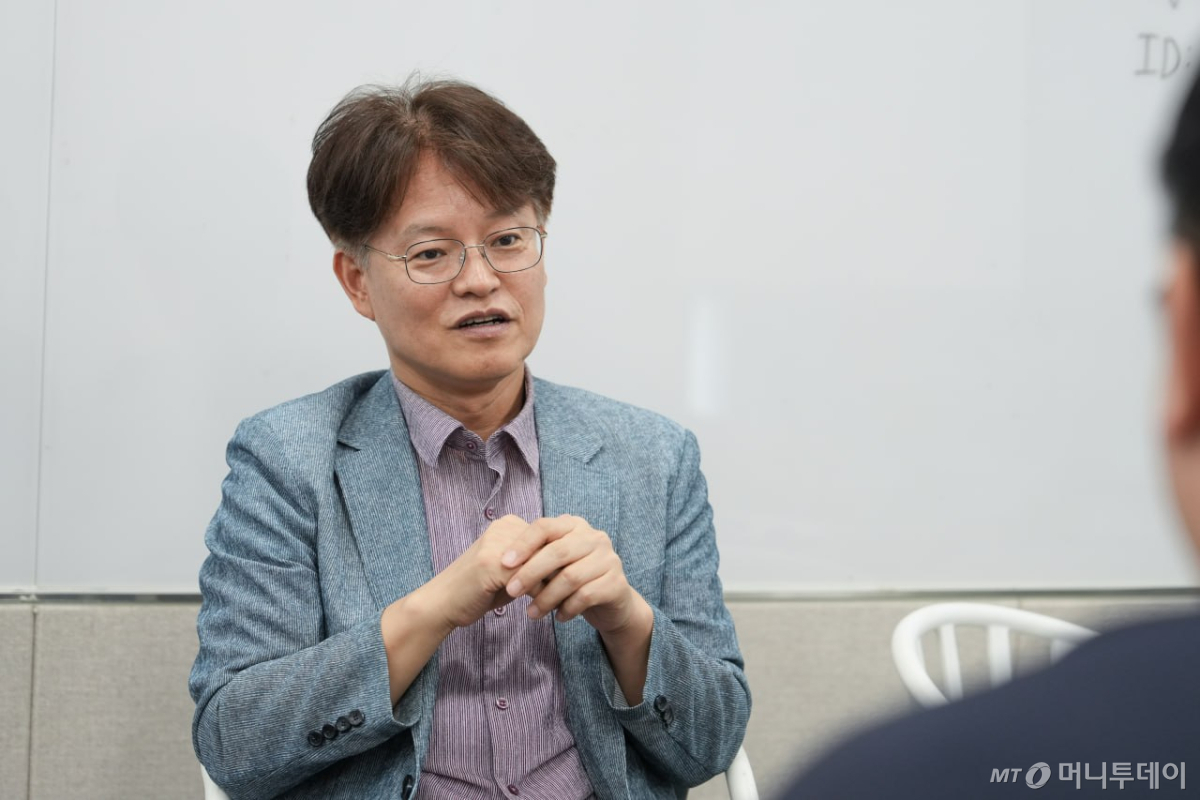
On the 17th of last month, while waiting to meet Kim Young-sik, Director of the Venture Foundry (Startup Center), in a hallway on the second floor of Ulsan National Institute of Science and Technology's (UNIST) Industry-Academia Cooperation Building, a university student emerged from his office. The student is Choi Seo-hyun, a visually impaired student at Daegu University. Choi is working to digitize physical information necessary for the mobility of visually impaired individuals, such as the location of building entrances, input it into a system, and prepare a navigation service for the visually impaired based on this data. Director Kim said of Choi, "She has set up a small office in UNIST's student startup space and is preparing to launch her business," adding, "Aspiring entrepreneurs from Ulsan and nearby areas, like Ms. Choi, often come to us for consultations."
UNIST launched its Startup Center by reorganizing its Industry-Academia Cooperation Division last June, naming it the "Venture Foundry." Director Kim explained, "UNIST Technology Holdings recently received a venture capital (VC) license. If technology holdings signify Capital, then Venture Foundry is a factory that creates startups. We chose the name with the intention of a structure where the two pillars of entrepreneurship and capital work together."
The main mission of the Venture Foundry is to discover technologies within the university that have commercialization potential, find companies in need of such technologies, and facilitate actual startups through proof of concept (PoC). Director Kim stated that four things are necessary for this process to function properly: △ specialized programs that systematically support entrepreneurship, △ a demand-centric approach that seeks what the market wants, △ a structure that generates actual revenue through technology commercialization, and △ an organization capable of sustaining these efforts continuously.
Director Kim said that the needs of 40,000 companies in the southeastern region are the starting point. He noted, "There are about 14 global anchor enterprises in the southeastern region in sectors such as automotive, shipbuilding, energy, and chemicals, along with approximately 40,000 related small and mid-sized companies," adding, "These companies want to undergo AX (Artificial Intelligence Transformation) now, and that demand is very strong." The goal set by UNIST Venture Foundry is to "complete a deep tech startup supply chain leading the AX transformation of southeastern industries and the pioneering of new industries."
To this end, the Venture Foundry is building two databases (DBs). One is the "Demand Company DB," which contains information on the technology needs, collaboration history, value chains, and PoC demands of anchor enterprises in the southeastern region. The other is the "Promising Technology DB," designed to analyze patents, papers, and researcher information scattered across UNIST using AI to identify technologies with high commercialization potential.
Director Kim said, "Previously, patents and papers were scattered sporadically, but by building an AI system, we can now search for necessary information immediately." He added, "If we find the technologies that companies actually need and connect them to startups, the likelihood of success will increase significantly."
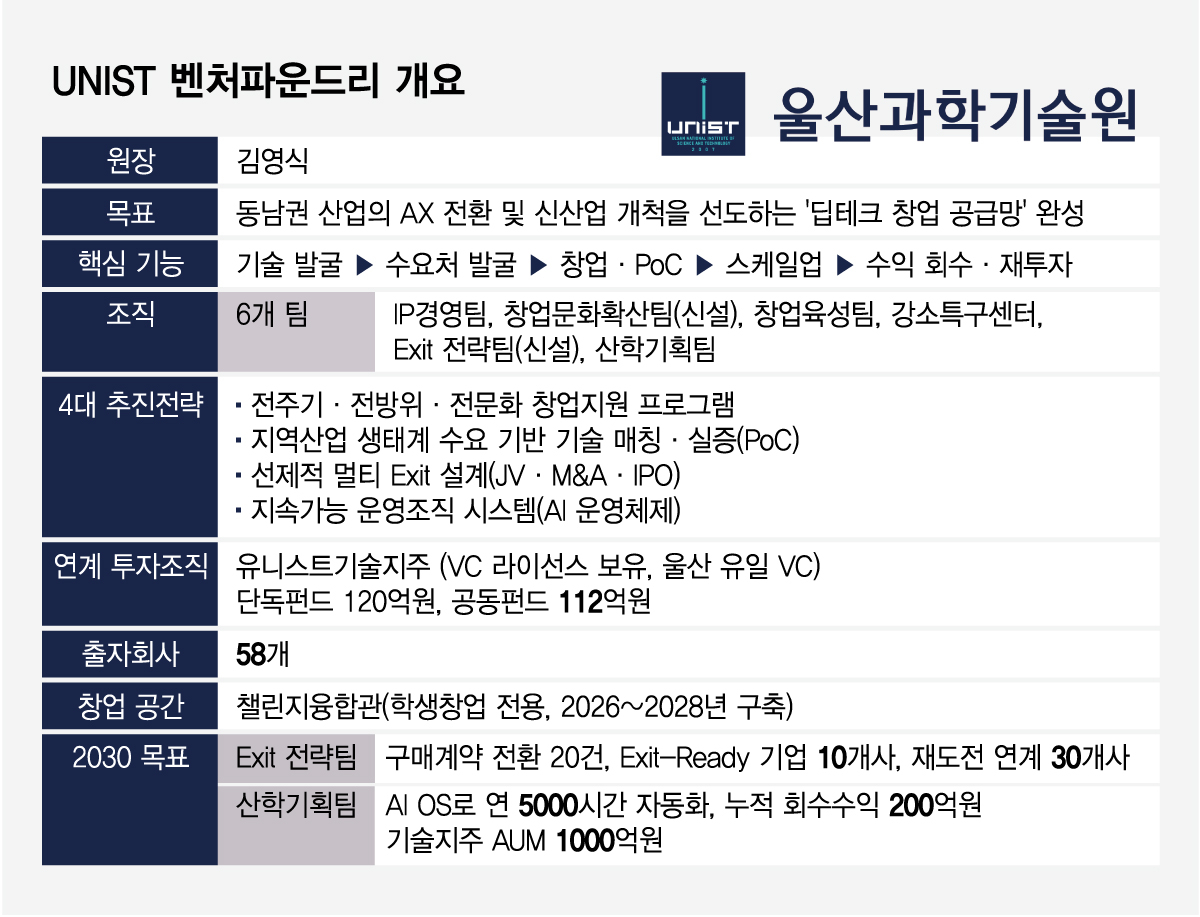
The most eye-catching element in the Venture Foundry's organizational chart is the "Exit Strategy Team." It was newly established alongside the Startup Culture Diffusion Team, in addition to the existing IP Management Team, Startup Cultivation Team, Small and Medium Innovation Zone Center, and Industry-Academia Planning Team of the Industry-Academia Cooperation Division. If the Startup Culture Diffusion Team handles the entry point for startups, the Exit Strategy Team designs the exit routes for startup companies. Director Kim explained the background for establishing the Exit Strategy Team by saying, "Currently, if a company succeeds, we simply hold an initial public offering (IPO) and celebrate, but there is little consideration for what to do if it does not succeed. No matter how many startups are created, there must be an exit."
They pre-design exit paths according to the nature of the companies. Companies with high synergy with existing firms are directed toward joint ventures (JVs), core materials and components companies toward mergers and acquisitions (M&A) by demand companies in the southeastern region, and platform or ultra-competitive companies capable of creating independent ecosystems toward IPOs. Director Kim said, "There are people who want an IPO, but many also want to exit midway," adding, "Only when small-scale exits become active can a startup culture of 'maybe I should try it too' spread."
Another exit route the Exit Strategy Team is preparing for is "failure." Director Kim noted, "Over 90% of startups fail, but currently, many are simply left to fend for themselves," stating, "We will create procedures for business closure and connect them with lawyers and others to help facilitate a smooth wind-down process." The Venture Foundry aims to convert 20 purchase contracts with anchor enterprises, have 10 "Exit-Ready" companies, and link 30 companies for re-challenges by 2030. It also plans to reduce the period for liquidation, equity, and debt settlement to within 12 months.
Another vision Director Kim is drawing is an "AI Operating System (OS)." While existing university industry-academia cooperation has focused on providing startup spaces or support programs, the future plan is to connect the entire process—from talent discovery to startup, proof of concept (PoC), investment, and exit—using data and AI.
Currently, as ideas are generated, intellectual property (IP) is created, teams are formed for startups, and processes proceed to PoC and investment, a vast amount of data accumulates but remains scattered across the experience of personnel or individual documents. Director Kim said, "Right now, humans judge one by one what support to provide to which company, but as data accumulates, AI can learn from past cases to assist in better decision-making," adding, "Each team is steadily collecting the necessary data."
For example, if a professor with battery technology prepares to start a business 10 years from now, the AI would recommend which companies to meet first, what PoC to conduct, and which VCs to approach, based on data from the 1,000 companies supported so far. UNIST aims to make startup support work faster and more efficient through this. The Industry-Academia Planning Team plans to automate 5,000 hours of work annually and achieve cumulative revenue of 20 billion won by 2030.
The space is also expanding. With a 30 billion won development fund donated by Lee Jun-ho, honorary chairman of Deuk-San Group—recognized as Ulsan's first venture company—a dedicated student startup building called the "Challenge Convergence Hall" is being constructed on campus. Director Kim said, "Current space is limited because it is shared between faculty and student startups, but the Challenge Convergence Hall will be a space truly for students and regional young entrepreneurs."
Director Kim stated, "We encourage regional aspiring entrepreneurs who are not UNIST students, like Ms. Choi, to come here and give it a try," adding, "Nurturing the passion and potential of these individuals is what our university should do for the local community."
[Money Today startup media platform Unicorn Factory]

 in TECH

