

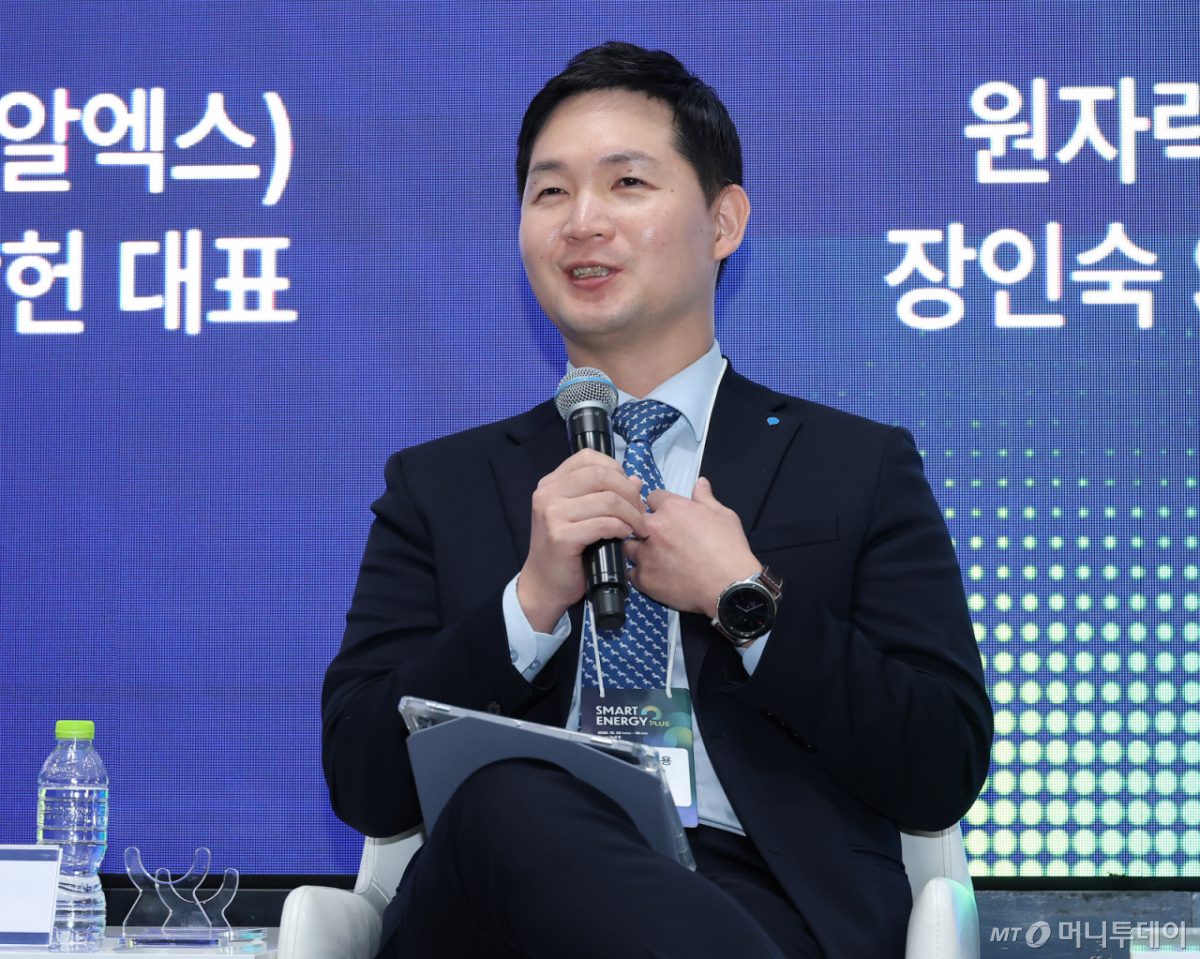
"AI big tech companies require electricity around the clock worldwide, so I believe that if they cannot secure power quickly, in advance, and over the long term, they may lose the AI war."
Jung Jae-wook, head of the ETF Management Team 3 at Samsung Asset Management, stated this on the 28th at 'Smart Energy Plus (SMART ENERGY PLUS·SEP) 2026' held at COEX in Seoul, noting that "AI data centers are already consuming a large amount of electricity."
He further emphasized, "As AI big tech companies like Google and Amazon participate in nuclear or SMR-related firms, they are making efforts to secure electricity as quickly as possible, so power demand will manifest very strongly over the long term."
Team Leader Jung predicted that proactive investment by big tech companies could accelerate SMR technology development. He said, "In fact, it is a process with significant difficulties, cost issues, and risks, but because long-term demand is extremely certain, big tech firms are proactively providing investment support and presenting their own long-term demand, which allows for rapid development of new SMR technologies." He assessed that "the emergence of AI as a new long-term demand driver for SMRs is a very positive direction."
Team Leader Jung pointed out that the long-term growth potential of SMRs and the actual profitability of companies should be judged separately. He stated, "The fact that long-term demand for nuclear or SMRs has emerged is one thing, but whether these companies are actually making money right now is a separate issue," adding, "From an investor's perspective, it is important to invest while keeping this in check." He added, "There is also a view that U.S. nuclear projects require time and carry many risks, so investors should focus on means or companies that can quickly secure power currently rather than project investments. Additionally, there is a cautious stance noting that the economic viability of SMRs has not yet been verified."
As evidence for this, he presented an analysis that enthusiasm for nuclear-related investment in the global capital markets has recently cooled somewhat. Team Leader Jung said, "The net inflow over the past three years was approximately 11.8 trillion won, indicating that investors have shown significant interest." However, he diagnosed, "In the last three months, there has been a net outflow of 20 billion won, meaning funds are actually flowing out. Looking at it right now, it seems accurate to say that investment in SMRs has slowed down in the capital markets compared to before."
Team Leader Jung also repeatedly emphasized the gap between the pace of development in the AI industry and the actual timing of power supply from nuclear energy. He said, "Investor expectations may resurface around 2030, but no matter how quickly AI develops, the timing for nuclear or electricity demand to materialize may be slightly delayed." He concluded, "Considering this time lag, I believe investing in the nuclear sector will yield good long-term results."

 in INDUSTRY
