

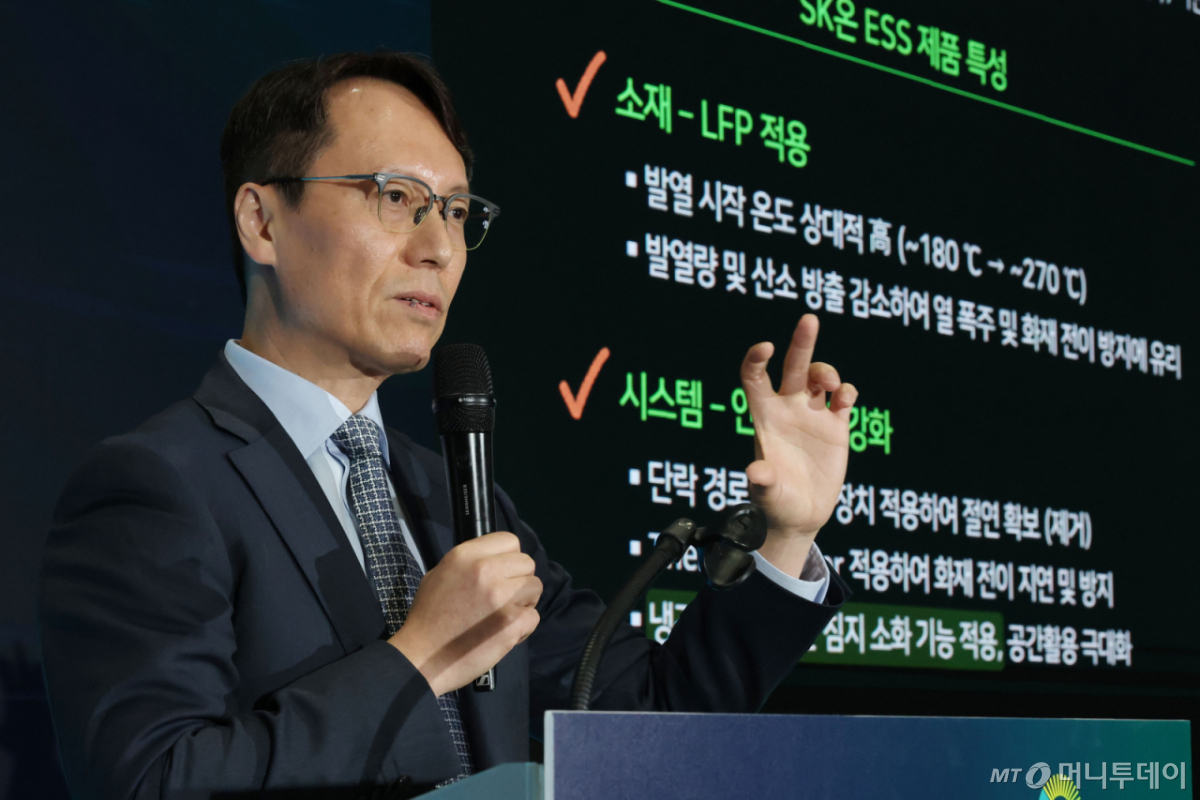
"Our short- and medium-term strategy is to supply products optimized for local markets and conduct business tailored to each country's regulatory environment and market conditions."
Choi Dae-jin, head of SK On's ESS (Energy Storage System) division, stated this regarding the company's ESS business strategy at the 'AI (Artificial Intelligence) Gold Rush' session of 'Smart Energy Plus (SEP) 2026,' held on the 30th in Hall B of COEX in Samsung-dong, Seoul Gangnam-gu. The strategy involves targeting markets favorable to SK On first, rather than engaging in a head-on price battle with Chinese companies.
Division Head Choi diagnosed that the influence of battery manufacturers is growing in the recent ESS market. In the past, system integrators (SIs) that designed and supplied entire ESS systems led the market. However, he explained that as battery types have diversified and demand-side specifications have become more segmented by sector, such as AI data centers, the role of battery manufacturers has also expanded.
Division Head Choi said, "Battery companies are not merely supplying batteries; their business is expanding in a direction to move up the value chain."
Choi cited the spread of AI data centers as a new growth driver for the ESS market. This is because AI data centers consume large amounts of power and exhibit high demand volatility, making the role of ESS crucial for stable power supply.
He noted, "With the surge in power demand from AI data centers, cases have emerged where it takes up to 60 months to connect to existing power grids (in the U.S.)," adding, "A model in which data centers secure their own power generation sources and use ESS to compensate for fluctuations in power demand is establishing itself as a new business model."
Choi's judgment is that a business strategy tailored to regional market characteristics is more important than price competition with Chinese firms.
He said, "If produced in China using Chinese materials and local labor, the cost is around $80 to $90 per kWh (kilowatt-hour) for a 4-hour ESS battery container, but production in the U.S. raises it to $150 to $160."
He added, "Realistically, there is no place where we can win a head-on price battle against Chinese companies." He further added, "It is important to build local production and supply systems tailored to each country's regulations and market conditions."
SK On is moving to expand its market by leveraging its global production hubs and non-Chinese battery supply capabilities. According to Choi, SK On's production capacity stands at 102 GWh (gigawatt-hours) in the U.S., 21 GWh in Korea, and 48 GWh in Europe. In particular, the strategy is to use the U.S., where maximum production capacity has been secured, as a key market to respond to AI data center and utility-scale ESS demand.
Choi explained, "We are emphasizing to customers that we have a production foundation capable of responding to any demand arising in the global market," adding, "In the U.S. market, we are expanding our business by leveraging the strengths of sufficient production capacity and non-Chinese batteries."
In Europe, the company plans to actively utilize local production hubs to respond to strengthening intra-regional production requirements. The approach involves producing cells locally and collaborating with local and Korean companies for module and system supply.
Choi said, "Our basic strategy is to promote local cell production using the production capacity secured in Europe and to supply modules and systems through cooperation with local partners," adding, "We plan to expand our business scope not only to Western Europe but also to Eastern Europe, where the market is growing."

 in INDUSTRY
