

Currency hedging intended to protect investments from exchange rate fluctuations is now weighing on overseas real estate investment trusts (REITs).
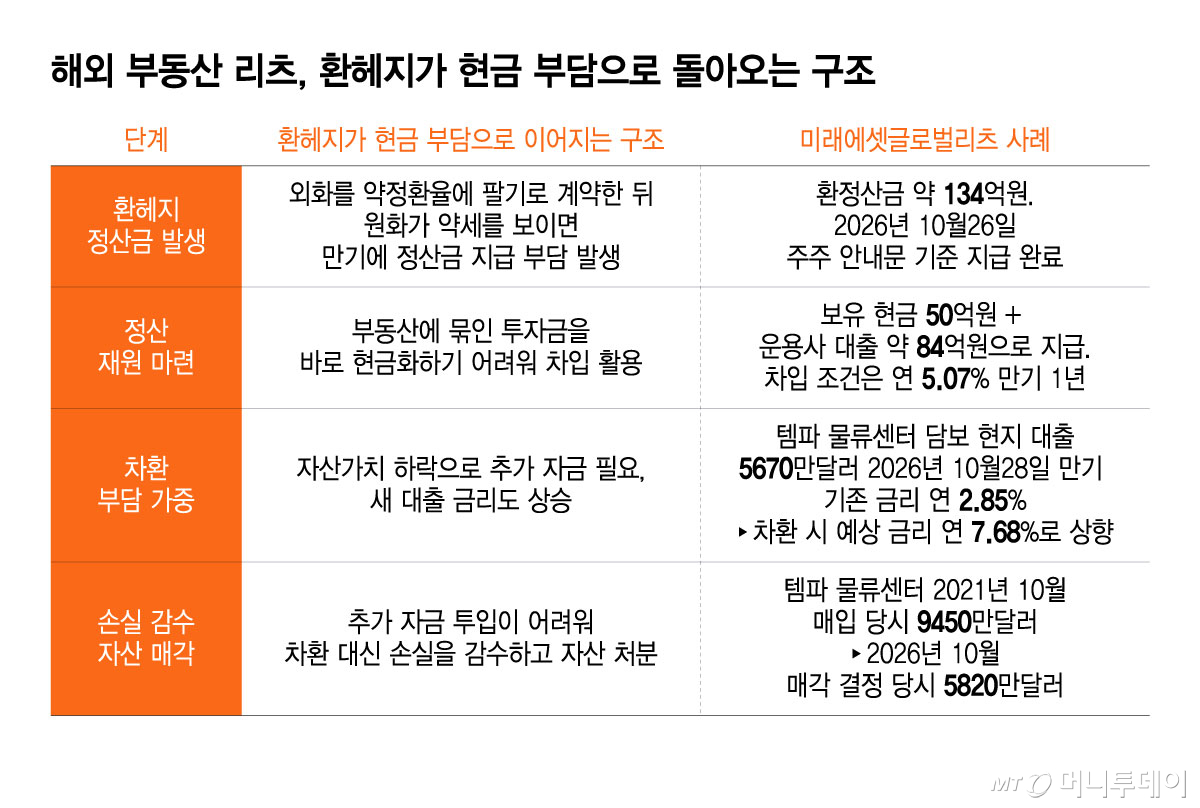
Mirae Asset Global REITs sold a U.S. logistics center at a loss after facing 13.4 billion won in currency hedge settlement costs and the added burden of refinancing local debt, resulting in a net loss of more than 60 billion won.
JR Global REITs, which previously filed for corporate rehabilitation, also saw its liquidity crisis worsen due to currency hedge settlement costs.
According to disclosures on the Financial Supervisory Service’s electronic disclosure system on the 11th, Mirae Asset Global REIT disclosed on the 10th that its net loss for the period from April to September this year, on a standalone basis, was 62.7 billion won.
The disclosure obligation arose because its standalone revenue fell below 5 billion won. It swung into the red from a profit of 5.1 billion won in the previous accounting period (October last year to March this year).
Revenue decreased by 49.7% to 2.9 billion won, and operating profit decreased by 57% to 2.2 billion won. Mirae Asset Global REIT settles its accounts on a six-month basis.
The loss occurred from selling the core asset, the FedEx “Tampa Logistics Center” in Florida, U.S., at a loss. In its disclosure, Mirae Asset Global REIT explained that it had brought forward the expected loss from the sale to be reflected in the September settlement.
Settlement losses arose due to the maturity of FX hedge contracts, and burdens also emerged during the process of refinancing loans for the Amazon-leased U.S. Houston logistics center (separate from Tampa) and another investment asset, Fund No. 17-1.
Mirae Asset Global REIT decided to sell the Tampa Logistics Center due to interest burden from loan refinancing and the burden of FX hedge settlement payments.
According to a notice sent to shareholders last month regarding the sale of the Tampa Logistics Center, an FX hedge settlement payment of approximately 13.4 billion won was incurred, but the company faced difficulties in securing the related funds.
It initially attempted to secure funds through corporate bond issuance but could not proceed due to the contraction of the REIT corporate bond market.
Ultimately, it covered part with its held cash of 5 billion won and borrowed the remaining approximately 8.4 billion won from Mirae Asset Asset Management under conditions of an annual interest rate of 5.07% and a one-year maturity to make the payment.
Simultaneously, refinancing was required to maintain the Tampa Logistics Center, but additional funds were needed as the loan-to-value ratio (LTV) exceeded 70% due to a decline in asset value.
The Tampa Logistics Center is an asset that Mirae Asset Global REIT purchased for $94.5 million in October 2021. Of the purchase amount, $56.7 million, which is 60%, was financed through local loans, and the remaining $37.8 million was funded with equity. FedEx Ground leased the entire area of the logistics center, and rent was being paid normally.
The problem lay in the decline in asset value and loan maturity. According to a shareholder notice dated the 26th of last month, the local loan was approaching its maturity on the 28th of that same month, and all extension options under the existing contract had already been used.
The refinancing interest rate was expected to jump by more than 2.5 times from the previous annual rate of 2.85% to approximately 7.68%. Consequently, there was no choice but to sell the logistics center while accepting a loss. The sale price decided by Mirae Asset Global REIT last month was $58.2 million, which is 38.4% lower than the purchase price.
Even after selling the asset, it is difficult to fully repay the 8.4 billion won borrowed from the asset management company for FX hedge settlement payments.
The expected recovery amount, reflecting local loan repayment and sale costs, is approximately 3.05 billion won. The company stated that it will use this to repay the borrowing from the asset management company, and sequentially repay the remainder with the relevant amount and subsequent dividend funds after the release of reserves related to the sale at the end of April next year.
The structure is such that the burden of FX hedge settlements affects future dividend capacity through borrowing.
FX hedging is a mechanism to reduce fluctuations in the won value of overseas assets and dividends according to exchange rates. It prevents the risk of the won conversion amount of investment funds decreasing due to exchange rate declines by contracting to sell foreign currency at a predetermined exchange rate.
Conversely, if the won weakens, settlement payments based on exchange rate differences may need to be paid upon contract maturity. Even if the won-converted value of overseas real estate rises, cash does not come in before sale, while settlement payments must be secured at maturity. If this is compounded by refinancing burdens or funding difficulties, liquidity problems grow larger.
JR Global REIT is a representative case. It attempted a 120 billion won rights offering to supplement FX hedge settlement payments and repay borrowings, but faced disruptions in securing funds.
A cash trap was triggered by the decline in the appraised value of the Belgium Finance Tower, tying up local cash, making it difficult to bring funds back to Korea. Ultimately, in April last year, it filed for rehabilitation proceedings without being able to repay 40 billion won worth of electronic commercial paper.
This was the result of overlapping FX hedge burdens with declining asset values, restricted fund inflows, and debt maturities. It resembles Mirae Asset Global REIT in that the burden of FX hedge settlements pressured cash flow.
Other overseas REITs responded to manage the burden of FX hedge settlements by securing funds in advance or lowering hedge ratios. KB Star REIT decided to invest 29.5 billion won in a subsidiary rights offering in June last year to secure funds for FX hedge settlements.
Shinhan Global Active REIT recently lowered its new FX hedge ratio from 100% of net asset value to 50%, explaining that this was “to alleviate the burden of securing large settlement payments and liquidity that could arise due to exchange rate increases if maintaining the existing 100% FX hedge.”
Mirae Asset Global REIT plans not to enter into new FX hedges after settling existing contracts. In exchange for reducing settlement burdens, it will bear the risk of decreased won-converted income when the exchange rate falls.
Licensing practices also influenced REITs maintaining high FX hedge ratios. While there is no legal obligation uniformly requiring 100% FX hedging for overseas real estate REITs, it was pointed out that the Ministry of Land, Infrastructure and Transport recommended it during the establishment licensing process, leading the industry to treat it as a de facto obligation.
An asset management industry official said, “JR Global REIT also confessed that it was difficult to autonomously adjust the ratio initially, as it was a condition recommended at the time of its 2020 business license.”

 in STOCK
