

The government's tax reform plan related to the stock market has faced self-correction for two consecutive years. This comes after President Lee Jae-myung ordered a complete review from scratch following continued criticism from young people and investors regarding the reform plans for ISAs (Individual Comprehensive Asset Management Accounts) and measures to prevent stock price suppression.
According to political sources on the 8th, President Lee was reported to have instructed a full review after receiving reports from his staff during a situation check meeting the previous day regarding investor backlash against the ISA reform plan. He reportedly asked, "Why were we proceeding without proper reporting when existing benefits are being reduced?" Regarding the 'Anti-Stock Price Suppression Bill,' he similarly questioned why the original intent of the reform was not preserved and why the system was designed that way.
ISAs were launched in 2016 with the aim of helping ordinary citizens build assets. They allow investment in various financial products such as time deposits, savings accounts, funds, and stocks within a single account.
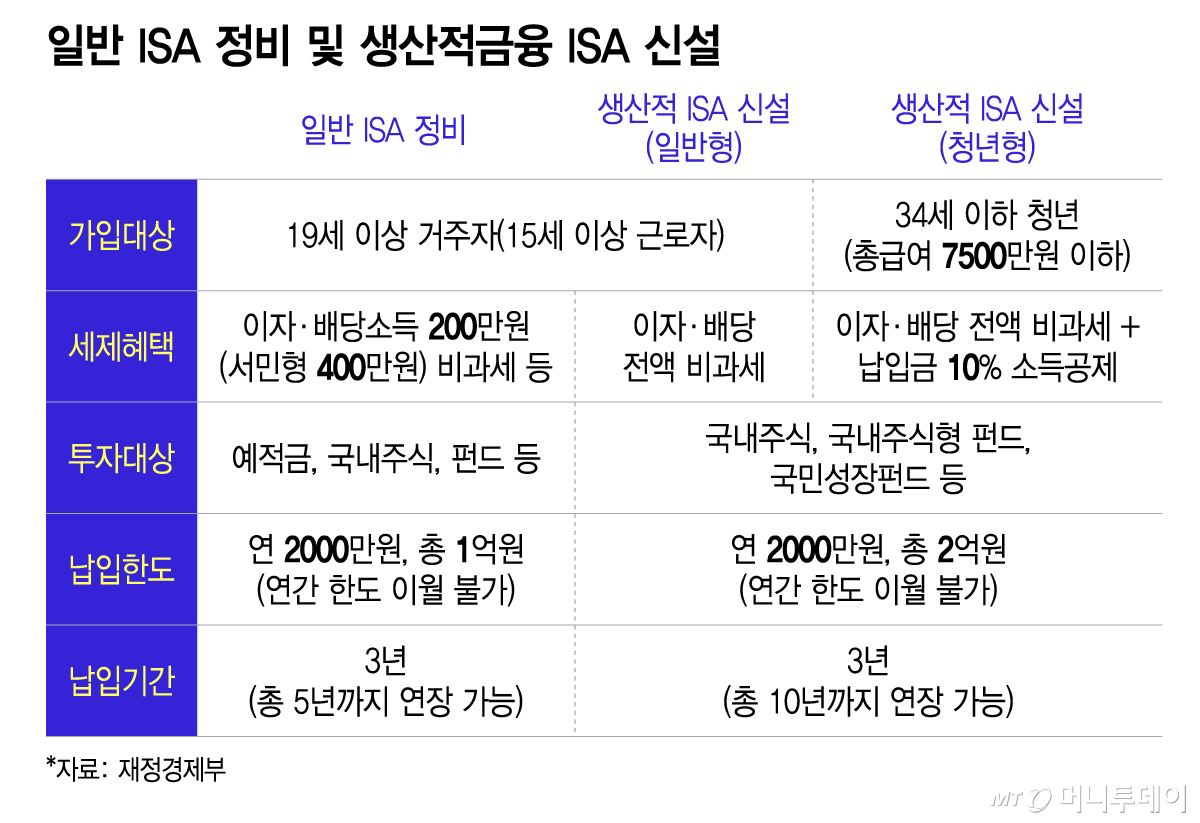
Although there is a mandatory three-year participation period, taxes are levied only on net profits after combining gains and losses within the account before withdrawal. For general-type ISAs, the first 2 million won of net profit is tax-exempt, while for low-income and rural/fishery residents' types, the exemption extends to 4 million won. A low tax rate of 9.9% applies to amounts exceeding these thresholds. Additionally, maturity periods can be continuously extended, earning ISAs the nickname "all-purpose tax-saving accounts."
However, controversy erupted among investors following the government's announcement of its tax reform plan. The government decided to establish a new 'Productive Finance ISA' that allows investment only in so-called 'domestic stocks,' including domestic stock-type funds and National Growth Funds, while simultaneously reducing existing ISA benefits.
First, the contract period for existing ISAs will be limited to an initial three years and a maximum of five years. This means investors must close their ISA accounts and settle taxes every five years.
For example, if an investor incurs a loss of 5 million won through an ISA over five years and then re-enrolls in an ISA to earn 1 billion won later, the actual net profit is 5 million won. However, under the government's reform plan, taxes would be calculated based solely on the 10th million won gain from the second enrollment, without considering prior losses. This diminishes one of ISAs' key advantages: the ability to offset gains and losses.
The feature allowing unused contribution limits to be carried over to the following year will also be eliminated. Currently, if an investor contributes only 5 million won out of the annual limit of 20 million won, the remaining 15 million won can be carried over, enabling investments up to 35 million won in the next year. Under the reform plan, the unused 15 million won limit will disappear, and investment will be capped at only 20 million won in the following year.
Despite the good intention of simultaneously achieving two goals—activating the domestic stock market and increasing national assets—complaints arose among investors that existing ISA benefits were cut to highlight the Productive Finance ISA. This criticism was further fueled by recent extreme volatility in the domestic stock market, which has heightened investor concerns about long-term investment in domestic stocks.
The government explains that the reform aims to enhance tax fairness. Under current rules, individuals subject to comprehensive taxation on financial income cannot participate in ISAs, which were designed to help ordinary citizens grow assets. However, a loophole exists: once enrolled, it is difficult to identify cases where participants later become subject to comprehensive taxation due to unlimited extensions.
Yoo Yun-cheol, Deputy Prime Minister and Minister of Economy and Finance, recently appeared on MBC Radio's "Kim Jong-bae's Focus" and stated, "The purpose is to check every five years whether individuals are subject to comprehensive taxation on financial income or not." He added, "If they are not subject to such taxation, they can re-enroll; thus, it should be understood as a five-year review system."
Regarding the elimination of carryover for unused portions of the 20th million won annual contribution limit, the Ministry of Economy and Finance explained that this measure aims to encourage systematic investment rather than short-term or temporary speculation.
Some have also raised suspicions that the government proposed this ISA reform plan with future introduction of a Financial Investment Income Tax (FIIT) in mind. The suspicion is that the 'tax-exempt account' known as Productive Finance ISA was created in advance to prepare for potential taxation on gains from domestic stock trading under FIIT, given that the value of Productive Finance ISAs could surge significantly upon FIIT's introduction.
The 'Anti-Stock Price Suppression Law' included in the government's tax reform plan is also set to undergo review. The core provision imposes a 30% surcharge on stock values and levies additional taxes if individuals intentionally suppress stock prices to reduce inheritance or gift taxes.
Under current law, when evaluating listed stocks for inheritance or gift purposes, the average market price over two months before and after the transfer is used as the basis. This rule was introduced because major shareholders repeatedly engaged in deliberate stock price suppression to minimize inheritance and gift tax liabilities.
The key lies in defining 'stock price suppression.' The government's proposal specifies that a company is presumed to be suppressing stock prices if its PBR (Price-to-Book Ratio) falls within the bottom 25% of its industry for KOSPI or 10% for KOSDAQ in at least 12 out of the most recent 13 semiannual periods. It also applies to companies that have undergone dual listings, issued exchangeable bonds, or experienced a decline in market valuation exceeding 30% compared to three years ago within the past year.
This has sparked backlash from both the market and political circles. Critics argue the proposal contains too many loopholes, allowing companies to manipulate their PBR rankings during specific periods only. According to the Korea Corporate Governance Forum, the number of companies subject to the government's proposal would be limited to 84–87 KOSPI firms and 43 KOSDAQ firms, totaling no more than 130 companies.
Even within the ruling party, public concerns have been raised repeatedly. The Democratic Party of Korea Lee So-yeong (Rep.) already proposed a bill last year citing 'PBR below 0.8' as an example of stock price suppression cases, and Lee Hun-gi (Rep.) recently introduced a bill to supplement the government's proposal.
Lee Hun-gi (Rep.) sharply criticized the plan, stating, "The Ministry of Economy and Finance's proposal does not block incentives for stock price suppression but instead offers companies ways to avoid being classified as such."
Following President Lee's order for a complete review, the government's plans regarding ISA reform and the Anti-Stock Price Suppression Law will inevitably require major revisions.
The current tax reform plan, which is in the legislative notice phase, is scheduled to be submitted to the regular National Assembly after passing through the Vice-Ministerial Meeting on the 28th and the State Council meeting next month on the 1st.
There is a possibility that the government will release revised proposals for ISA reform and the Anti-Stock Price Suppression Law before the Vice-Ministerial and State Council meetings. Of course, it remains possible to present new government proposals during discussions in the regular National Assembly. However, given President Lee's instruction for a complete review, analysts believe there is a higher likelihood that new government proposals will be submitted directly to the regular National Assembly.
Meanwhile, in last year—the first year of the Lee Jae-myung administration—the government also made a sudden revision to its tax reform plan regarding the stock market. At that time, the government announced plans to strengthen the major shareholder threshold for capital gains tax on listed stocks from 50 billion won per stock (market capitalization) to 10 billion won. Lowering the threshold to 10 billion won raised concerns that it could negatively impact the stock market due to year-end selling pressure from large investors, often referred to as "big hands." This move was also criticized for directly contradicting the Lee Jae-myung administration's emphasis on 'money moves' into the stock market. As controversy persisted, President Lee stated that the government did not need to insist on its proposal, and ultimately, the government decided to abandon the adjustment of the major shareholder threshold for stock transfer taxes.

 in ECONOMY
