

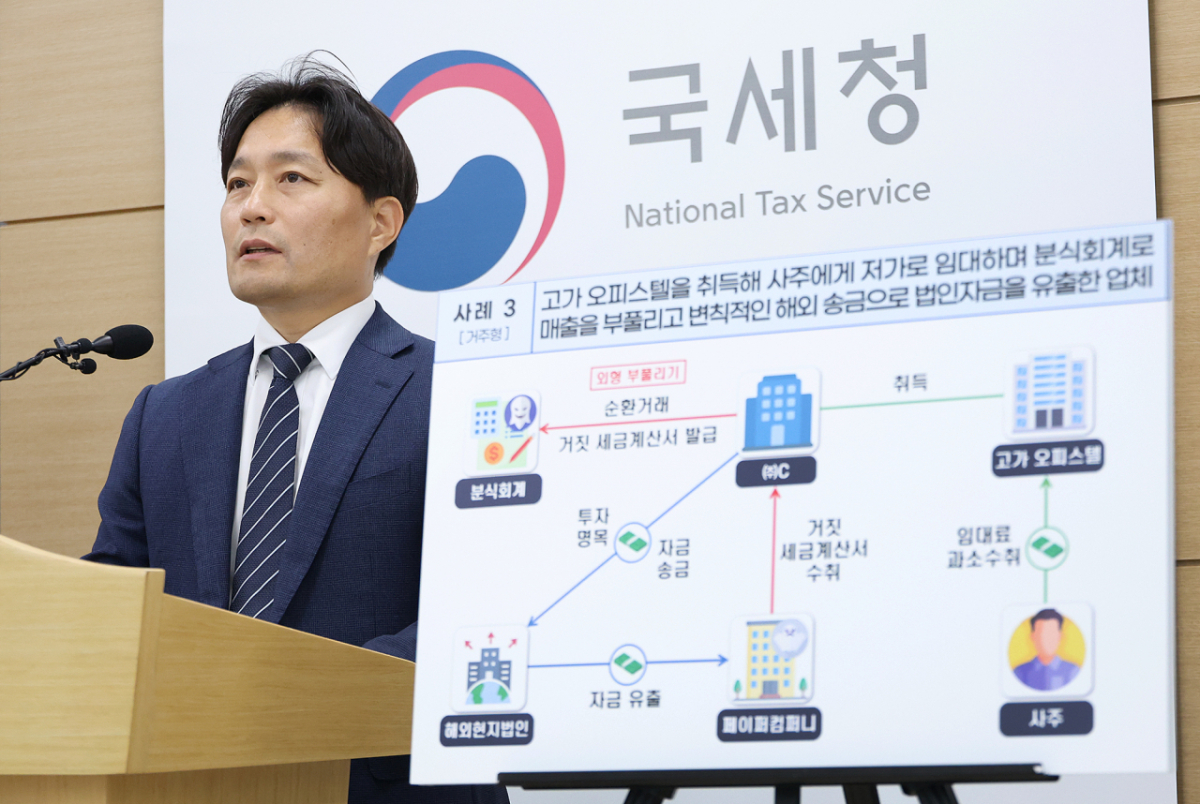
The National Tax Service is launching a massive tax investigation into the private misuse of assets by company owners and their families who have exploited loopholes and privileges. To realize tax justice while implementing a fair society where the majority who follow rules are respected, the agency plans to thoroughly verify non-business-use real estate such as corporate-owned homes.
On the 25th, the National Tax Service announced that a comprehensive verification of all corporate-owned high-value homes (homes subject to comprehensive real estate tax with an assessed value exceeding 900 million won) revealed that among a total of 2,639 properties, 1,097 units (approximately 42%) were used for private purposes by company owners and their families. This figure excludes 1,157 rental units owned by leasing companies and 385 business-use units such as employee dormitories.
According to the National Tax Service, in addition to private use of real estate, most of the companies under investigation were found to have engaged in tax evasion practices such as paying fabricated labor costs to company owners and their families and receiving false tax invoices.
Consequently, the National Tax Service will conduct tax investigations on 50 companies where serious suspicions of overall corporate tax evasion were identified among those that provided 'emperor's residences.'
The types of private use are categorized as follows: owner-family residence type (28 cases), real estate speculation type (5 cases), and vacation home type (17 cases). The total amount suspected of tax evasion reaches approximately 1.9 trillion won.
The 'owner-family residence' type involves companies that acquired high-value homes unrelated to their business operations and provided them free of charge or at a low price so that company owners and their families could reside there.
One investigated company acquired a luxury home worth around 20 billion won in Hannam-dong, Yongsan-gu, Seoul, and used company funds for lavish expansion and interior renovation projects worth about 10 billion won, allowing the owner's family to use it privately. The company also illegally diverted approximately 20 billion won of corporate funds under the guise of labor costs.
Another investigated company allowed its owner to use a high-end villa in Cheongdam-dong, Gangnam-gu, Seoul, worth around 4 billion won as an exclusive 'emperor's residence' without even filing a change-of-residence notice. This company also diverted about 3 billion won of corporate funds by paying false labor costs to the owner's spouse to cover rental expenses for a high-end residence and living expenses for the owner's children studying abroad overseas.
One company, while conducting business in Busan, acquired an apartment worth around 4 billion won in Banpo-dong, Seocho-gu, Seoul, unrelated to its corporate operations, to provide housing convenience for the owner's family members, including children working in Seoul, and provided it free of charge.
The 'real estate speculation' type involves cases where company owners used corporations under their control to evade government policies such as heavy taxation on multiple properties and loan restrictions aimed at stabilizing the real estate market.
In one case, the owner of an investigated company acquired an apartment scheduled for redevelopment in Banpo-dong, Seocho-gu, Seoul, just before approval of its management division plan. Upon becoming a single household with two homes, the owner transferred an existing high-value home worth about 4 billion won to the investigated company within the temporary two-home period, enjoying non-taxable benefits as a single household with one home while continuing to reside in that property free of charge.
In another case, an investigated company provided a high-end apartment in Hannam-dong, Yongsan-gu, Seoul, valued at approximately 10 billion won where many celebrities reside, to the owner's family and processed interior renovation costs as corporate expenses.
Even more, the owners held two Gangnam apartments under their own names to profit from price appreciation while residing in a home owned by the corporation, thereby evading multiple-home regulations such as heavy comprehensive real estate tax.
It was also confirmed that among two high-value homes with a total assessed value of approximately 20 billion won, one was acquired under corporate name for the owner to use as a single living space, reducing the burden of comprehensive real estate tax.
The 'vacation home' type involves companies that acquired luxury condos and vacation homes under the pretext of employee welfare but used them exclusively for the 'chairman.'
One investigated company secretly acquired a super-luxury vacation home worth around 10 billion won using its affiliates and used it exclusively for the owner's family while strictly blocking access.
Another foreign-owned company used a high-end single-family condo valued at about 6 billion won, costing up to 3 million won per night, as an exclusive 'chairman's vacation home' for the owner's family. The company also paid approximately 2 billion won in interior renovation costs for the owner's apartment located in Dogok-dong, Gangnam-gu, Seoul. Additionally, it diverted about 6 billion won of corporate funds to a domestic affiliate controlled by the owner's younger brother and to the owner's elderly sister under the names of commissions and salaries, respectively.
Another investigated company acquired a luxury condo located within a members-only golf course in Pyeongchang, Gangwon-do, for about 3 billion won and fraudulently received input value-added tax deductions by fabricating internal documents and usage logs under the guise of employee welfare benefits.
The National Tax Service stated that it will thoroughly investigate all targeted companies using every available means, including temporary seizure, account inquiries, and digital forensics, to ensure that this tax investigation serves as an opportunity for companies with blurred boundaries between their public roles and the owners' pursuit of private interests to uphold principles.
In particular, the agency plans to carefully examine whether the diverted corporate funds have formed the personal assets of company owners and their families. For owners who illegally diverted corporate funds to gain private benefits, the agency intends to clearly determine the ownership of such gains and tax them accordingly (income disposition).
Furthermore, if tax evasion or other tax violations such as receiving false tax invoices are detected, measures will be taken to ensure that those responsible are punished in accordance with the 'Act on the Punishment of Tax Crimes.'
Lee Sung-geul, Jo Sa (Director) of the National Tax Service, stated, "We are currently analyzing suspicions of tax evasion among corporate entities not included in this round of investigation. For those found to have serious suspicions, we plan to conduct tax investigations sequentially." He added, "In addition to 'domestic emperor's residences,' we will expand verification to cover all forms of corporate fund embezzlement, including the free provision of overseas residences and support for study abroad expenses for chairmen's children studying abroad."

 in ECONOMY
