

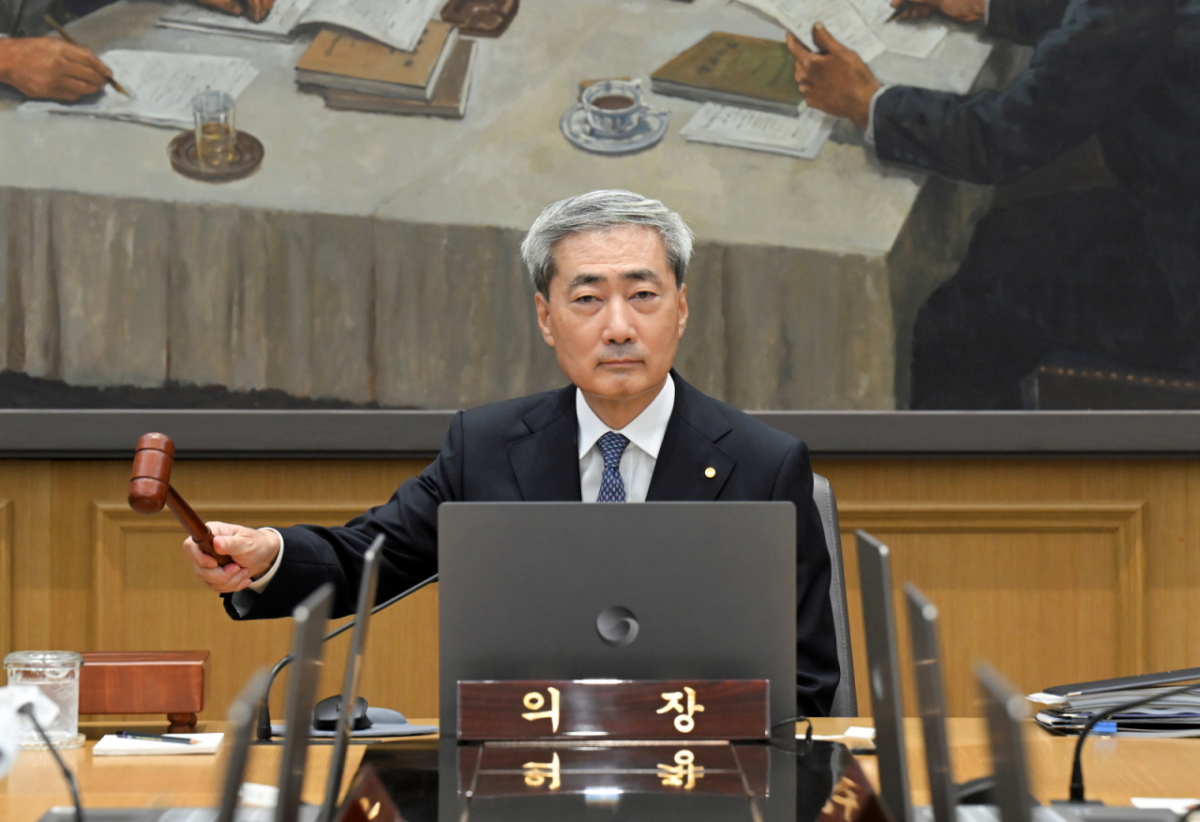
The Bank of Korea Monetary Policy Board (hereinafter referred to as the Monetary Policy Board) raised the base rate from an annual 2.75% to 3.0%, a 0.25 percentage point increase. This marks the second consecutive rate hike, dubbed a 'back-to-back' increase, following last month's move. As a result, the 'base rate 3% era' has officially reopened after 1 year and 9 months.
This decision is interpreted as a response to the fact that consumer price inflation continues to exceed the Bank of Korea's target level of 2%, amid lingering effects from the Middle East war. Meanwhile, economic growth driven by the semiconductor supercycle (a period of exceptional prosperity) has eased the pressure on the Bank of Korea to raise interest rates. The Bank of Korea also revised its economic growth forecast for this year upward from the previous 2.6% to 3.3%.
On the morning of the 27th, the Monetary Policy Board held a meeting in the Monetary Policy Board conference room at the Bank of Korea's main building in Jung-gu, Seoul, to decide on monetary policy direction and raised the base rate from an annual 2.75% to 3.0%. Out of seven Financial and Monetary Committee members, six voted in favor of raising interest rates. One member, Hwang Geon-il, expressed a minority opinion in favor of keeping rates unchanged.
This is the second consecutive rate hike following last month's increase. Last month, the Bank of Korea raised the base rate, which had been held at an annual 2.5% for about one year and two months, by 0.25 percentage points, once again ushering in a 'monetary tightening era'.
In its monetary policy direction statement, the Monetary Policy Board stated: "Amid stronger-than-expected growth driven by robust exports and domestic recovery, inflation is expected to remain above the target level for a considerable period. Therefore, it is crucial to prevent the spread of rising prices through preemptive measures, while continuing to monitor financial stability risks. Accordingly, we have deemed it appropriate to raise the base rate by 0.25 percentage points."
The background behind the Bank of Korea's back-to-back interest rate hike lies in stronger-than-expected economic growth and concerns over rising inflation. With inflationary pressures mounting due to the aftermath of the Middle East war, recent economic upturns have further added demand-side pressure on prices.
In fact, last month's consumer price inflation rate fell to 2.8%, marking a return to the 2nd% range for the first time in three months, yet it still significantly exceeds the Bank of Korea's target level. Notably, the core inflation rate (excluding food and energy), which the Bank of Korea prioritizes, reached 2.6%, the highest since December 2023 (2.8%), marking a two-year and seven-month high.
Furthermore, the clear economic recovery driven by the semiconductor boom has alleviated some of the burden associated with the Bank of Korea's monetary tightening.
In the second quarter this year, South Korea's real GDP grew by 0.6% compared to the previous quarter. Considering the base effect from the surprising 1.8% growth in the first quarter, this indicates a continuation of strong economic momentum.
Accordingly, the Bank of Korea raised its growth forecast for this year from 2.6%, previously announced in May, to 3.3% within just three months.
Moreover, such high growth rates are likely to fuel inflation. Rising incomes increase consumption capacity, creating demand-side pressure on prices. In fact, real Gross Domestic Income (GDI) for the second quarter surged by 15.6% year-on-year, recording the highest increase since the first quarter of 1988 (16.4%), a span of 38 years and three months.
The Monetary Policy Board stated: "In the future, prices are expected to continue rising above the target level for a considerable period as cost pressures previously elevated persist and demand-side pressures from improved income conditions gradually intensify."
Meanwhile, this interest rate hike by the Bank of Korea has narrowed the interest rate differential between South Korea and the United States from 1.0 percentage point to 0.75 percentage points (based on the upper bound of rates). With expectations that the Federal Reserve System (Fed) will likely hold its base rate at the current range of 3.5% to 3.75% at next month's Federal Open Market Committee (FOMC) meeting, analysts predict that the won/dollar exchange rate will continue to decline for the foreseeable future.
The Monetary Policy Board plans to maintain its stance on raising interest rates in the future. In fact, the dot plot showing the six-month-ahead interest rate projections by Monetary Policy Board members has been revised upward over the past three months.
Out of 21 anonymous points cast by seven Monetary Policy Board members (three each), ten points were distributed at 3.25%, six at 3.5%, and five at the current level of 3.0%.
In the May dot plot, ten points were concentrated at 3.0%, with only two points at 3.25%. Considering that Monetary Policy BoardWon I (EVP) had previously projected 3.5%, this indicates a significant strengthening of expectations for further rate hikes among board members within just three months.
The Monetary Policy Board stated: "Going forward, monetary policy will be determined by closely monitoring inflation trends, economic conditions, and financial stability, while deciding on the timing and pace of any additional rate increases."

 in ECONOMY
