

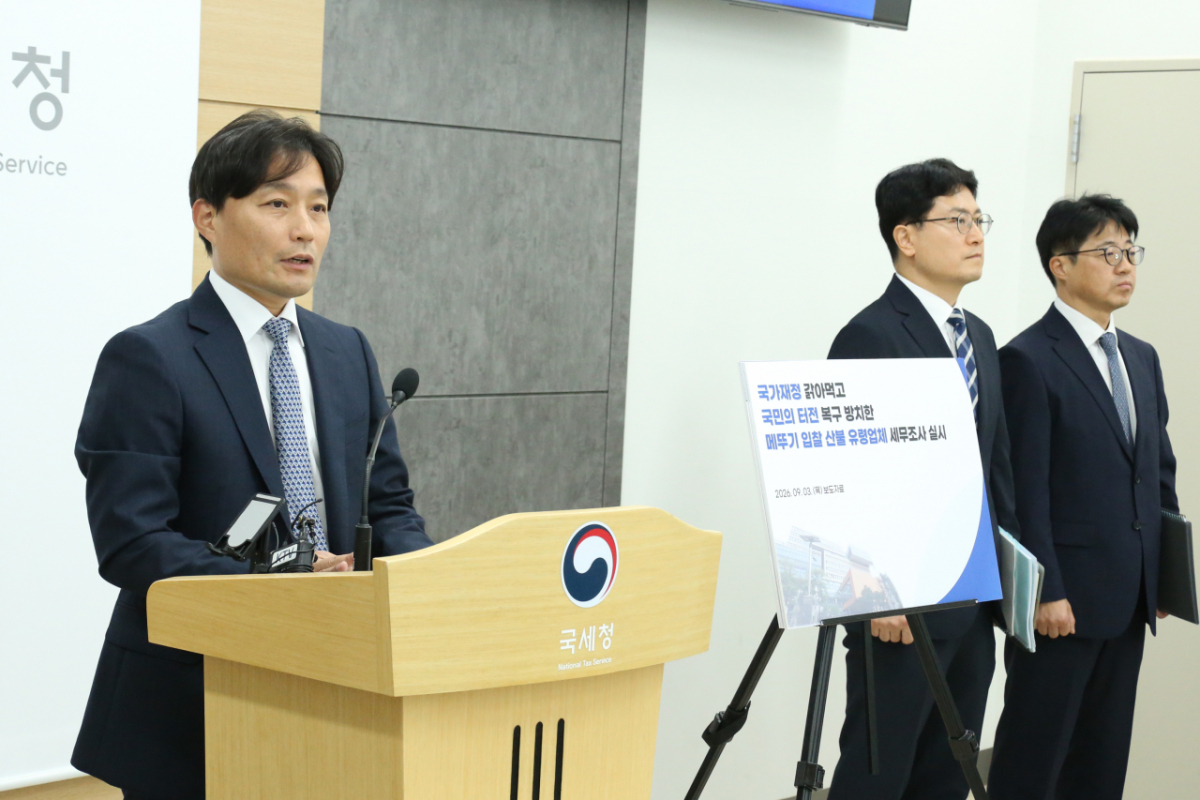
The National Tax Service will conduct tax audits on companies that participated in bids for wildfire damage recovery projects by using phantom companies. This move comes after the establishment of the People's Sovereign Government, with the aim of continuing continuous tax verification of companies involved in local corruption and public contract fraud.
On Wednesday, the National Tax Service announced that it has launched a tax audit targeting 10 companies (41 phantom companies) where clear tax violations were identified.
In particular, to eradicate fraudulent bidding practices that allow economic gains through illegal means, the agency will conduct thorough verification of tax violations and evasion, separate from criminal and administrative penalties. This includes intensively checking for tax evasion among small-scale public bidding participants who have long been overlooked in tax audits due to their small size.
Accordingly, starting in May, the National Tax Service has begun verifying 'wildfire cartels,' a representative case of fraudulent bidding where actual owners establish phantom companies to increase winning probabilities and forestry technicians lend their qualifications to these phantom companies as a common practice.
Based on basic business information such as company representatives and phone numbers from public procurement notices issued by the Public Procurement Service over the past six years, 5,331 companies that participated in wildfire damage recovery projects were extracted. Among them, 138 companies with total winning bid amounts of 1 billion won or more were subjected to detailed analysis of transaction records and other data.
As a result, not only tax-related issues such as the issuance of false tax invoices and the inclusion of fictitious costs were uncovered, but also fraudulent bidding practices were detected.
First, during the investigation period, these companies used phantom companies to participate in over 6,500 bids for wildfire damage recovery projects, winning approximately 260 bids worth about 23 billion won.
Additionally, to circumvent regional restriction bidding regulations designed to protect local small and medium-sized enterprises, they repeatedly moved their business locations to participate in bids. One company relocated its business premises 16 times over five years.
The total amount suspected of tax evasion by the investigated companies is approximately 70 billion won. During the process of mobilizing phantom companies, false tax invoice transactions were conducted for purposes such as meeting business performance criteria required during bidding.
They issued tax invoices with discrepancies between the winning bidder (phantom company) and the actual service provider (real operator), and also distributed income amounts.
Furthermore, they included illegal costs in deductible expenses by not actually hiring essential technical personnel for forestry projects but instead making indirect payments in the form of salaries for qualification lending fees.
In addition, Yoo Ryeong-eop-che (CEO)s diverted corporate funds to relatives of actual owners who had no connection to real projects in the form of salaries, or took advantage of the relatively simplified verification process for small-scale companies by falsely recording expenses that were not incurred as 'miscellaneous expenses' or 'other costs.' They also arbitrarily prepared and submitted lists of payments to daily wage workers.
In response, the National Tax Service plans to thoroughly recover evaded taxes from 'wildfire phantom companies' that exploited structural loopholes in the public contract bidding system to gain unfair benefits through rigorous investigations.
During the investigation process, all means including temporary asset seizure and account inquiries will be mobilized for thorough examination. For actual owners suspected of illegally forming assets by diverting unjust profits, their sources of funds will also be closely scrutinized.
Furthermore, since fraudulent bidding practices are accompanied by tax crimes such as the issuance of false tax invoices, measures will be taken to ensure that those who meet the requirements under the 'Act on Punishment of Tax Crimes' are definitely punished.
Lee Sung-geul, a senior reporter at the National Tax Service, stated, "Going forward, we will relentlessly pursue companies involved in public contract fraud that exploit government projects for private gain and engage in anti-social tax evasion, regardless of company size, to establish fair and transparent tax justice."
Meanwhile, the National Tax Service launched an investigation immediately following an instruction from President Lee Jae-myung last month, who pointed out the issue of phantom companies in wildfire damage recovery projects and ordered that "structural corruption must be penalized and fundamental countermeasures must be prepared," leading to the initiation of this tax audit.

 in ECONOMY
