

This year, per capita gross national income (GNI) is expected to exceed $40,000, while revenue from the wage income tax next year is also projected to surpass 100 trillion won for the first time in history. The so-called "quiet tax hike," where salary earners face increased tax burdens, is becoming a reality.
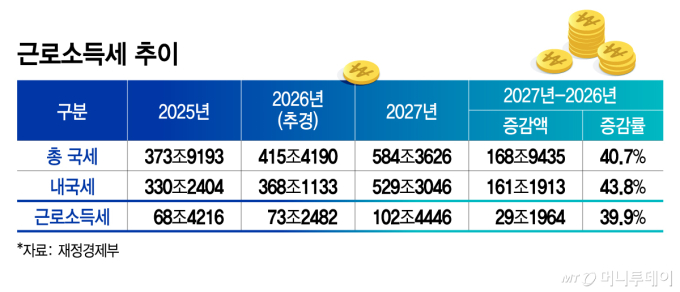
According to the Ministry of Economy and Finance on the 13th, the projected revenue from income tax on wages for next year is 102.4446 trillion won. This figure, incorporated into next year's national tax revenue budget, represents a 39.9 percent increase compared to this year's projection of 73.2482 trillion won. It marks the first time that income tax on wages is projected to exceed 100 trillion won.
A significant increase in next year's income tax revenue from wages is largely attributed to performance bonuses at large corporations. However, experts also note that the current income tax system has failed to adequately reflect the steady rise in incomes across the entire population, which is having a considerable impact.
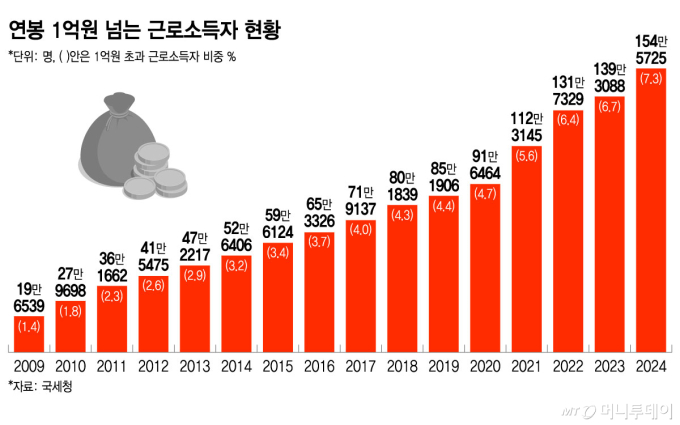
In 2024, the number of individuals with total annual compensation exceeding 10 thousand won reached 1.545725 million. Compared to 2014, ten years prior, when there were 526,406 such individuals, this figure has increased by a factor of 2.94. Relative to 2009, which saw 196,539 high earners, the number has risen by 7.86 times. The proportion of million-won salary earners, which stood at just 1.4% in 2009, climbed to 7.3% in 2024.
The change in the income tax system is lagging behind the pace of income growth. Income tax is calculated by deducting various exemptions from diverse sources of income, such as employment income, to determine the taxable base. Multiplying the taxable base by the applicable tax rate yields the calculated tax amount.
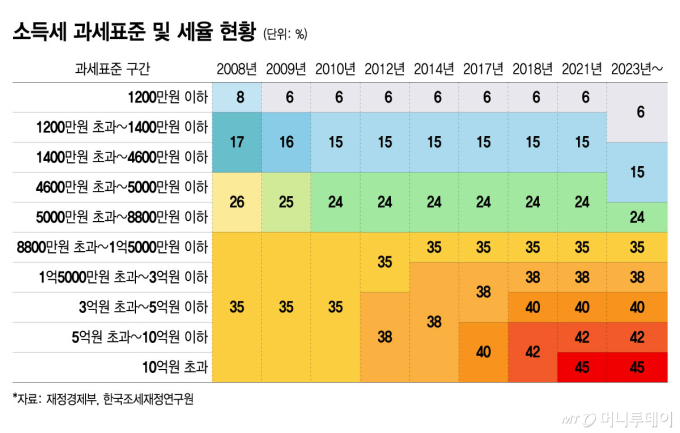
The current income tax taxable standard consists of eight brackets (tax rates ranging from 6% to 45%). It is a progressive system where higher taxable standards result in higher tax rates. Although numerous reforms have been implemented, the overall framework of the taxable standard has remained largely unchanged.
For instance, the tax bracket for taxable income exceeding 88 million won up to 1.5 million won (tax rate 35%) has remained unchanged since 2008, marking its 18th consecutive year. While wages and prices have risen, the taxable income brackets have stood still, creating a structure where workers with increased nominal incomes are pushed into higher tax brackets.
There were no objections raised. Last February, while serving as the leader of the Democratic Party of Korea, President Lee Jae-myung stated, "Due to inflation, nominal wages may rise without a corresponding increase in real wages, yet taxes continue to climb under the progressive tax system," adding, "Are salary earners just being given raises?"
Experts have proposed alternatives such as a price-linked system that raises the income tax taxable base in line with inflation levels.
The tax authorities are also reviewing the overall income tax system, but this tax reform plan does not include related content. Concerns over a decline in tax revenue, which had been an obstacle to reforming the income tax system, have somewhat eased due to recent improvements in tax revenue conditions.
Kang In-soo of Sookmyung Women's University Gyeong Je-hak-gwa (Prof.) stated, "It is not appropriate to continue using the same amount as a high tax rate basis despite rising prices and wages," adding, "If annual adjustments are difficult, it is necessary to readjust the taxable income brackets at least every three to five years."
President Lee Jae-myung posted an article titled "Are Salaried Workers Just Beasts of Burden?" on Facebook in February last year during his tenure as leader of the Democratic Party of Korea. He cited a report stating that taxes paid by salaried workers had surpassed 60 trillion won. The term "salaried worker taxes" refers to income tax on employment earnings.
President Lee said at the time, "Due to inflation, nominal wages rise while real wages do not, yet taxes continue to increase under the progressive tax system," and added, "The ultra-wealthy have received tax cuts while salaried workers have effectively faced tax hikes; isn't this a problem that needs to be fixed?"
Tax revenue from employment income, which was 68.4216 trillion won last year, is projected to rise to 73.2482 trillion won this year and 102.4446 trillion won next year. An increase in employment income tax means that more taxes have been collected from office workers.
If wages and bonuses have risen significantly, resulting in higher tax payments, that is a natural phenomenon. However, the situation changes if excessive taxes are paid abnormally because the system has failed to keep pace with reality. This is the case with income tax on employment earnings. As President Lee perceives it, a "de facto tax increase" or a "quiet tax hike" is taking place.
◇ 'Salary Earners' Tax, What Is Income Tax?'
What determines income tax on employment earnings is the taxable base and the tax rate. The taxable base is calculated by subtracting various deductions from employment income. Tax rates are applied differently depending on the taxable base. It follows a progressive system where higher taxable bases result in higher tax rates.
The current taxable income brackets for the resident income tax are as follows: up to 1.5 million won (6% or lower rate), up to 0.5 billion won (15%), up to 88 million won (24%), up to 1.5 million won (35%), up to 300 million won (38%), up to 500 million won (40%), up to 10 thousand won (42%), and over 10 thousand won (45%), totaling eight brackets.
Assume the taxable income after deducting various allowances is 60 million won. A tax rate of 6% applies to the first 1.5 million won, resulting in 840,000 won; a rate of 15% applies to the portion between 14 million and 0.5 billion won, amounting to 5.4 million won; and a rate of 24% applies to the remaining portion from 50 million to 60 million won, totaling 2.4 million won. This results in a total calculated tax liability of 8.64 million won.
Most employees see their annual salaries increase each year, reflecting factors such as inflation rates. Consequently, the tax rate on employment income also changes. For those earning an annual salary of up to 88 million won, the maximum tax rate is 24 percent. However, if a salary rises over several years to reach 10 thousand won, the tax rate for the portion exceeding 88 million won becomes 35 percent.
In this way, the income tax system is structured to collect taxes at a higher rate as salaries increase. The problem lies in the fact that the system fails to keep pace with the speed of income growth.
The "billion-won salary earner," once a dream for office workers, numbered 1.545725 million as of 2024, accounting for 7.3% of all taxable individuals. In 2009, billion-won earners represented only 1.4% (196,539 people) of the total taxable population. Over 15 years, the number of billion-won earners increased by a factor of 7.86, making them far more common.
◇ Era of $40,000 per capita GNI... Systems lagging behind reality
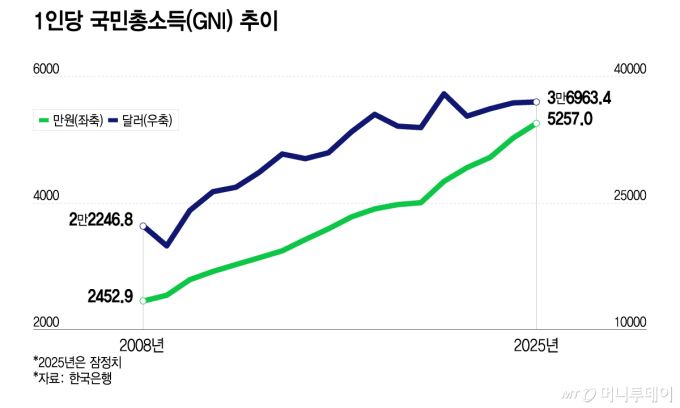
Per capita Gross National Income (GNI) increased by a factor of 2.14, from 25.421 million won in 2008 to 52.57 million won (preliminary estimate) in 2025. In dollar terms, it rose from $199.16 million to $369.63 million during the same period. A breakthrough of $400,000 this year is highly likely.
However, during this period, the tax system for employment income underwent only minor adjustments. Prior to 2008, there were four brackets: taxable income of up to 0.1 billion won (8%), up to 40 million won (17%), up to 80 million won (26%), and over 80 million won (35%).
However, starting in 2008, the tax standard was adjusted upward by up to 10 percent, with brackets set at 1.5 million won or less (8 percent), 46 million won or less (17 percent), 88 million won or less (26 percent), and over 88 million won (35 percent). This measure reflected rising prices.
Subsequently, measures were taken to subdivide the taxable standard. It increased from four brackets in 2008 to eight brackets in 2023. The approach was to reduce the burden on low-income households while increasing it for ultra-high-income earners. However, the tax bracket of 88 million won, which includes the middle class, has remained unchanged for 18 years since 2008.
As President Lee pointed out, the criticism that "salary earners are being taxed" arises from this reason. Even without institutional tax increases, workers are gradually moving into higher tax brackets based on taxable income, effectively suffering from tax hikes.
The basic exemption for income tax also contributes to a de facto tax increase. The basic exemption for income tax has remained unchanged at 1.5 million won since it was set in 2009, marking its 17th year without adjustment. Although the Democratic Party proposed legislative amendments last year to raise the income deduction from 1.5 million won to 1.5 million won, the proposal did not ultimately become law.
Some have proposed the inflation-linked income tax system as a solution. At the time of the 2007 revision of the Tax Act, the National Assembly stated in its review report that "in-depth discussions should be conducted in parallel on measures such as integrating an inflation-linked system into adjustments to taxable brackets or income deductions to provide stability."
As prices and wages rise, the taxable income base for income tax has remained stagnant for an extended period, leading to concerns that workers' tax burdens are effectively increasing. Experts have proposed that taxable income brackets and various deductions should be linked to inflation or adjusted periodically.
Experts consistently point out the gap between nominal income and real income. Even if wages rise due to inflation, real income does not increase if purchasing power remains unchanged. However, if tax brackets remain fixed, individuals may be pushed into higher tax rate brackets, increasing their tax burden.
Under the current income tax system, progressive tax rates ranging from 6% to 45% are applied based on taxable income. While the lower income brackets were adjusted once in 2023, the threshold of 88 million won for the 35th% tax rate has remained unchanged since 2008, marking its 18th year without modification.
Oh Moon-seong, a professor of taxation at Hanyang University for Women, said, "If the increase in nominal income due to rising prices leads to an expanded tax burden relative to income, real purchasing power could decline," and added, "The taxable income brackets and deduction amounts must reflect price fluctuations." It has also been pointed out that fixed deductions, such as those for dependents, have not been adjusted for a long time, weakening their function in alleviating household burdens.
Regarding the adjustment cycle, Professor Oh proposed that rather than mechanically applying the annual consumer price inflation rate, the Income Tax Act should explicitly mandate a review of price fluctuations every three to five years. He stated, "It is not desirable to fix something once and leave it unchanged for 10 or 20 years, only to make repairs when problems arise."
Former Gangnam University professor of taxation An Chang-nam proposed a plan to automatically adjust the entire tax code annually in line with inflation. Professor An stated, "If we do not adjust both taxable income and deductions together, it results in taxing nominal income that has increased due to inflation," adding, "It should be automatically adjusted every year according to the consumer price index, not just raised once."
Professor Oh pointed out that it is difficult to simply conclude that South Korea's income tax burden is low, given that the marginal tax rate for high-income earners, which combines the top statutory rate and local income tax, is high, and additional burdens such as social insurance premiums also exist.
Kang In-soo of Sookmyung Women's University Gyeong Je-hak-gwa (Prof.) stated, "We should conduct international comparisons by considering the overall tax burden, including quasi-taxes such as indirect taxes and social insurance premiums," and added, "Rather than starting from the total amount of tax revenue the government must secure, we should first determine what level of tax burden is appropriate for citizens."
Amid the recent semiconductor boom, which has led to increased tax revenues, arguments have also been made that now is the right time for tax reform. Professor An stated, "With semiconductor companies thriving and tax revenues rising, we now have the capacity to reform the tax system," adding, "As the economy grows, we must broaden the tax base and reduce the tax burden on wage earners."
Professor Oh also said regarding concerns over a decline in tax revenue due to adjustments in the tax table, "Given that corporate and income taxes are being collected more than expected at this time, it is not yet the moment to worry about a shortage of tax revenue."
On the other hand, Kim Woo-cheol, a professor of taxation at the University of Seoul, agreed with the principles of the price-linked system but cautioned that its implementation should be approached with care. Professor Kim stated, "While Korea's income tax system has a high progressivity rate, the revenue collected through individual income tax is low, so the redistribution effect does not fully materialize." He added, "Raising the taxable income threshold to 88 million won could further weaken the main revenue base."
Professor Kim argued that rather than further raising tax rates for high-income earners, the government should streamline various deductions and broaden the tax base to include middle- and lower-income groups to increase overall income tax revenue. He stated, "It is desirable to introduce an inflation-linked system only after income tax burdens and their share of total revenue have reached appropriate levels." He added, "Although recent increases in semiconductor-related tax revenues have reduced immediate pressure for tax hikes, expanding tax revenue over the medium to long term is necessary to prepare for rising expenditures driven by population aging."
Legislative efforts are also continuing within the political sphere. People Power Party Representative Lee In-seon introduced a bill to amend the Income Tax Act in March, proposing to first raise the taxable income brackets applicable from 2027 and then reflect the annual inflation rate each year. A fellow party member, Kim Mi-ae (Rep.), also submitted a revision bill in April that adjusts the standard amounts for each taxable income bracket annually according to the inflation rate.

 in ECONOMY


