

Banks have set the limit for residential mortgage loans on Seoul Seocho-gu’s DH Bangbae, where market prices have surged sharply, based on the sales price rather than the appraised value, leading to complaints among residents that their available loan amounts have decreased. However, banks are expected not to change this standard hastily, as financial authorities continue to maintain a policy of ensuring loans are distributed as evenly as possible among borrowers.
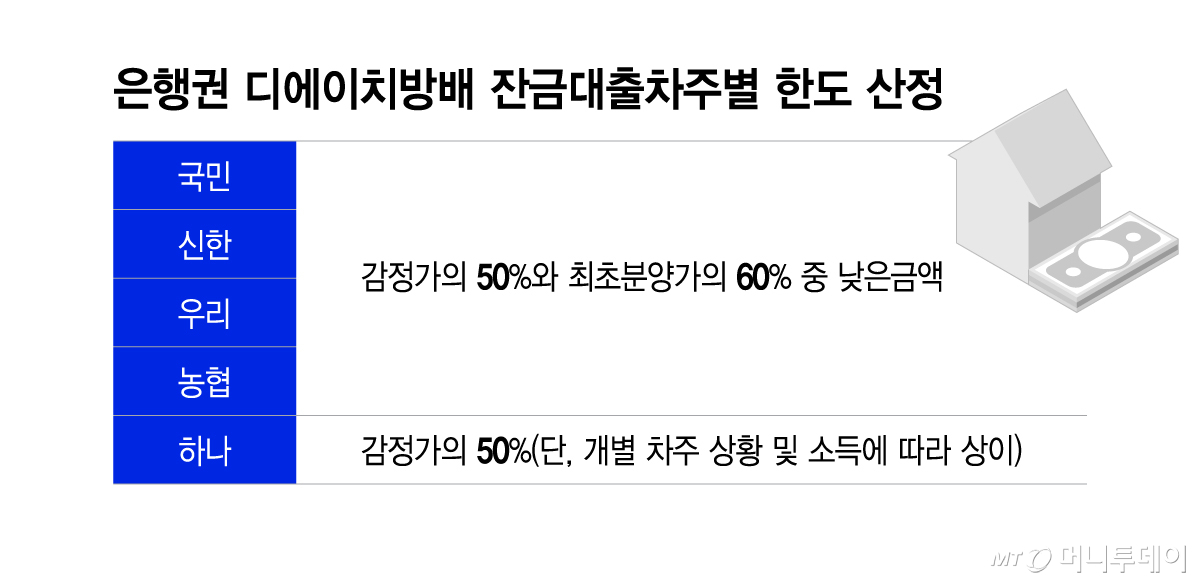
According to the financial sector on the 25th, KB Kookmin, Shinhan, Woori, and NH NongHyup Bank are using the lower of either 60% of the sales price or 50% of the appraised value as the benchmark for calculating loan limits when issuing residential mortgage loans for DH Bangbae, which is set to be occupied in September. Among banks that have confirmed supply of residential mortgage loans for this complex, only Hana Bank applies the 50th% appraised value standard. However, even Hana Bank attaches a precondition of considering individual borrower circumstances and income, making it difficult for the 50th% appraised value rule to be applied as is in practice.
Until now, banks have determined loan limits per borrower based on the appraised value. However, with market prices at DH Bangbae far exceeding the sales price, a new standard for determining collateral value has been established. The sales price for an 84㎡ unit at this complex was 2.2 billion won, but occupancy rights have traded between 2.7 billion and 3.9 billion won since the beginning of this year. This complex was sold before the the 27th real estate measures were announced in 2025, so it is not subject to the 60th million won limit on housing loans. Therefore, if applied as before based on a 4 billion won appraised value at 50%, a single borrower could borrow up to 2 billion won. However, with the decision to use the sales price, even high-income borrowers can now receive only 1.3 billion won in loans.
As complaints poured in from residents due to the reduced loan availability and controversy ensued, Financial Services Commission Chairman Lee Eoung-won stated on the 24th that banks should have the autonomy to determine limits for residential mortgage loans on newly constructed apartments.
Nevertheless, banks are expected not to easily modify their standards. Although there is no legal regulation, this reflects the government’s stance of supplying loans to as many borrowers as possible and preventing leverage from concentrating on specific borrowers. If a single borrower could obtain a 2 billion won loan, it would mean they could purchase an apartment while holding only about 10% of the sales price, which contradicts the purpose of the government’s relaxation of collective loan regulations.
A financial sector official said, “When residential mortgage loans were under total volume regulation, banks made decisions autonomously. However, with collective loans excluded from their holdings, there is no longer a need for them to voluntarily restrict themselves.” The official added, “It appears the authorities recognize that some standard is necessary in calculating loan limits, as it could affect housing price increases.”
Banks also feel burdened about providing excessive loans to a single borrower. Even within DSR regulations, lending excessively to borrowers with declining repayment capacity could impact future financial soundness. From the perspective of banks expecting ancillary transactions after lending, securing multiple customers is considered preferable.
Furthermore, equity with regional sales complexes is also a consideration. In the case of regional apartment complexes, collective loan supply remains insufficient, raising the possibility that this could lead to concerns about fairness among residents of regional apartments.
The controversy over the benchmark for calculating loan limits is expected to be the last for this complex. The only large-scale apartment complex in Seoul scheduled for occupancy by year-end is Hillstate Medialle in Seoul Eunpyeong-gu. Complexes occupied thereafter will be sold after the government’s real estate loan regulations were implemented, thus subject to loan limit restrictions. A financial sector official stated, “There are almost no large-scale housing supplies planned in Seoul, and DH Bangbae is expected to be the last complex where such controversy could arise.”

 in FINANCE
