

The Export-Import Bank of Korea is moving to terminate the non-face-to-face system for the External Development Cooperation Fund (EDCF), which it built three years ago at a cost of approximately 1.3 billion won. Although the system was created to meet non-face-to-face demand during the COVID-19 pandemic, its utilization remained low because key functions such as project development were missing.
According to data submitted by Democratic Party of Korea legislator Jung Tae-ho, a member of the National Assembly's Finance and Economic Planning Committee, on the 3rd, operations of the EDCF non-face-to-face system, which began in 2023, have been suspended.
EDCF is a fund dedicated to providing paid aid, such as loans, among development assistance programs supporting industries in developing countries. The Ministry of Economy and Finance oversees the fund's management, while Export-Import Bank of Korea manages it on a delegated basis. As face-to-face work became difficult when the COVID-19 pandemic reached its peak in 2021, the then-Ministry of Economy and Finance (now Ministry of Economy and Finance) prioritized building a non-face-to-face system to handle ECF fund executionWi Won-hoe-neun (Vice Minister) and collection tasks online. Subsequently, Export-Import Bank of Korea invested a total of 1.275 billion won over three years from 2021 to 2023 to build the platform.
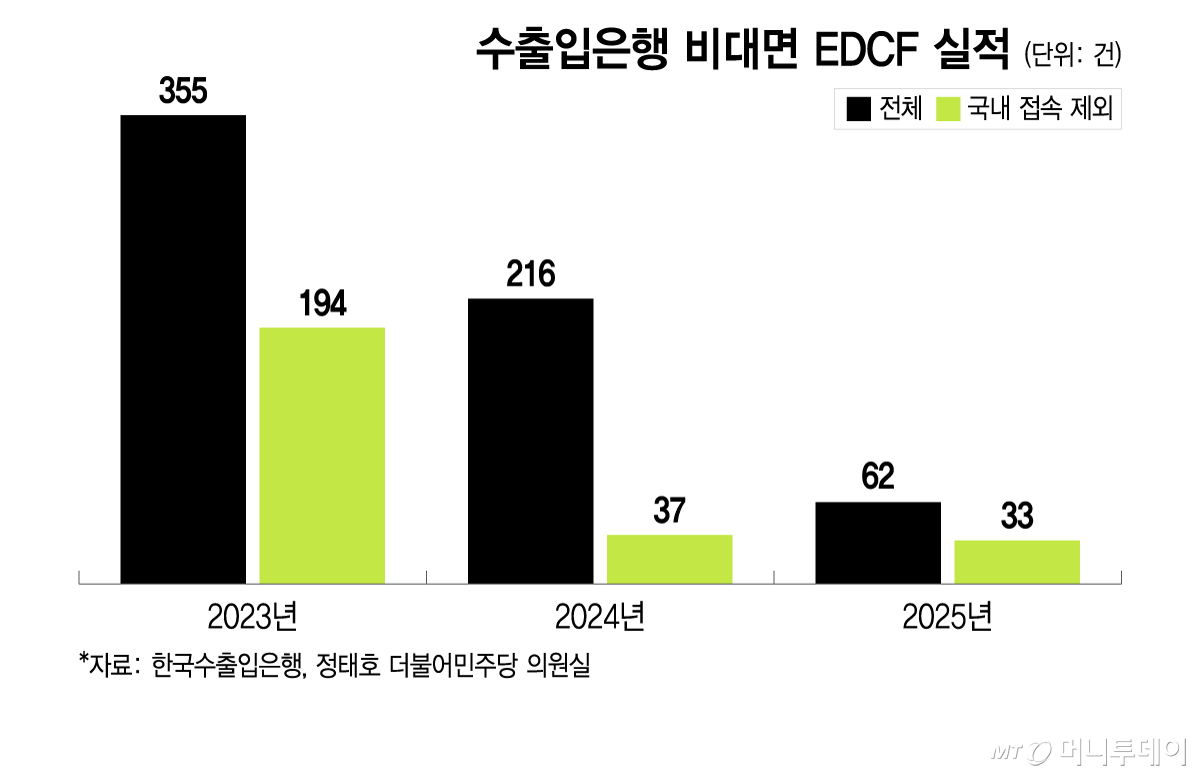
Consequently, although the non-face-to-face system began operations in 2023, its utilization was minimal. Looking at usage by country, the number of system logins was 355 in the first year of implementation, 2023, but dropped sharply to 216 in 2024 and further to 25 in 2025. If only pure overseas access is counted, excluding domestic connections, utilization figures are even lower: just 194 cases in 2023, 37 in 2024, and 33 in 2025.
Unlike expectations, the reason for the low utilization has been attributed to a failure in demand forecasting. From 2023, when the system was effectively launched in full operation, the pandemic situation ended and non-face-to-face demand disappeared. Additionally, problems were identified because the system was designed primarily around execution applications and repayment plan inquiries, lacking key functions such as project development. This has led to criticism that its utility in inter-country collaboration was limited.
In this regard, Export-Import Bank of Korea stated its policy to reactivate the system if similar situations to the pandemic reoccur in the future. An Export-Import Bank of Korea official said, "After the pandemic ended and face-to-face work became possible, effectiveness declined, creating a burden for maintenance and repair, leading to business termination," adding, "If a crisis situation occurs again in the future, it can be utilized once more."
Jeong (Rep.) stated, "The problem was that the system construction did not take place during the period when non-face-to-work demand was highest," and emphasized, "It is necessary to review whether actual demand and on-site feasibility were sufficiently examined during the project promotion process." He further stressed, "As a public institutional investor, it is necessary to carefully design future projects by fully reflecting user demand and on-site opinions."

 in FINANCE
