

![[Seoul=NEWSIS] Reporter Cho Seong-bong = President Lee Jae-myung speaks at the 2026 Youth Day Commemorative Open Mic event held at Cheong Wa Dae on the 19th. 2026.09.19. suncho21@newsis.com /Photo=Cho Seong-bong](https://thumb.mt.co.kr/cdn-cgi/image/f=avif/21/2026/09/2026092308283088187_1.jpg)
Approval ratings for President Lee Jae-myung's administration are the lowest among all age groups, particularly among youth. This reflects significant challenges faced by young people compared to older generations in areas such as employment, asset accumulation, marriage, and home ownership. The Financial Services Commission has more than doubled next year’s youth policy budget from 870 billion won this year to 2.1 trillion won. Policies aimed at building a financial ladder for youth across various domains—including asset formation, employment, entrepreneurship, and housing—will be fully implemented according to each stage of youth development.
The Financial Services Commission is prioritizing the "Our Interest Independence Fund" as its flagship initiative to establish a financial ladder for youth. This program holds significance in that both the government and parents jointly contribute toward initial assets when young people enter society. From birth until age 18, the government provides an annual fixed payment of 1.2 million won or matches contributions with up to 1 million won. Assuming an annual return rate of 6%, investing 2 million won annually over 19 years could accumulate a lump sum of approximately 70 million won.
Specifically, low-income households receive a fixed government subsidy of 1.2 million won per year. In contrast, middle-income households (50–10% income bracket) receive matching support of up to 1 million won proportional to parental contributions. While low-income families are guaranteed benefits, the policy is criticized for offering no advantages to children in middle-income households if their parents do not contribute.
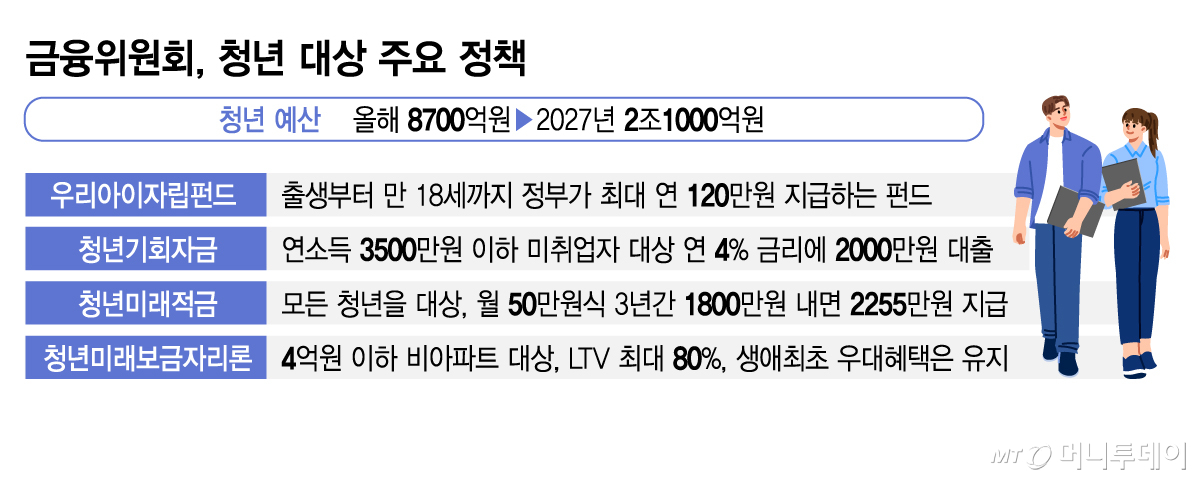
Unemployed youth will be eligible for a "Youth Opportunity Fund" loan with an annual interest rate of 4%, capped at 20 million won total. Socially vulnerable groups and high school graduates who are unemployed will receive an additional interest subsidy of 1.6 percentage points. Over their lifetime, individuals can access up to 20 million won in total, with a maximum of 5 million won per transaction annually, totaling 75 million won available each year. Notably, youth preparing for employment can enjoy the exceptional benefit of interest exemption during an initial grace period of up to eight years.
The "Youth Future Savings Account" has already gained significant popularity. Following the first round, the government will accept applications for a second round starting next month on the 7th. This policy aims to support early asset formation for youth before and after entering society. Unlike the first round, the second round expands eligibility to all youth and increases the government's contribution rate for preferential-type accounts from 12% to 15%. Particularly, the government contribution rate for employees of small and medium-sized enterprises (SMEs) in local regions will be significantly raised to 25%.
By saving 500,000 won monthly, participants can receive government contributions and, over three years, repay a principal of 18 million won while receiving up to approximately 25 million won. Youth enrolled in the general type can accumulate an additional lump sum of up to about 21 million won, while youth employed by local SMEs can secure a lump sum of up to 25 million won or more.
Policies to address youth housing issues are also being implemented. The "Youth Future Housing Loan" enables young people to purchase non-apartment properties at interest rates comparable to monthly rent. Youth purchasing non-apartment homes priced at 400 million won or less can obtain loans with loan-to-value (LTV) ratios ranging from 70% to 80%. Interest rates are fixed at levels equivalent to monthly rent to minimize interest burdens. A key advantage is that the preferential LTV benefit for first-time homebuyers remains intact, meaning loan limits will not decrease even if they later upgrade to an apartment. However, it should be carefully noted that selling a purchased officetel or villa after a certain period of residence may prove difficult due to limited buyer interest.

 in FINANCE

