

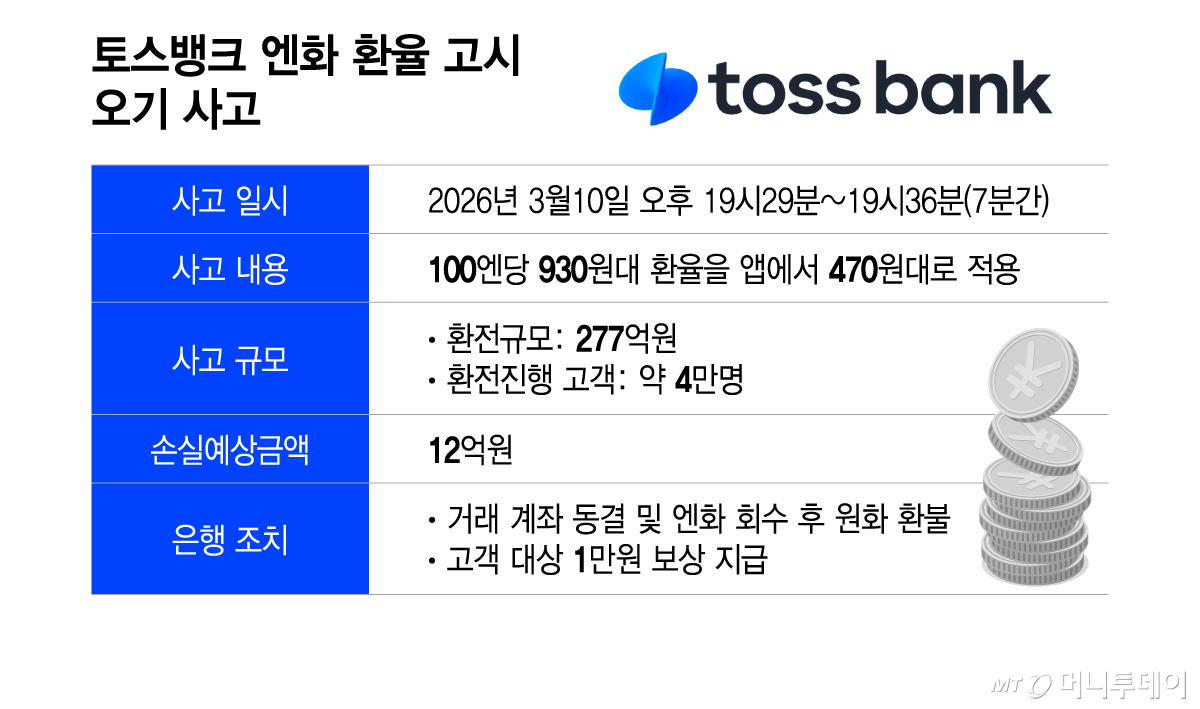
Financial authorities have begun a legal review of whether the Toss Bank yen exchange rate posting error should be classified as an "error" under the Electronic Financial Transactions Act. At the time, after mistakenly posting the yen exchange rate at half its actual level, resulting in 28 billion won worth of currency exchange transactions, Toss Bank designated the incident as an "error" and took recovery measures without customer consent. While opinions have emerged arguing that it cannot be considered an error because users were already aware of the posted price, the financial authorities' decision is expected to significantly impact future consumer complaint handling and assessments of the appropriateness of post-incident measures.
According to financial industry sources on the 4th, the Financial Supervisory Service requested a legal interpretation from its superior institutional investor, the Financial Services Commission, on whether the Toss Bank yen exchange incident constitutes an error under the Electronic Financial Transactions Act.
In March, Toss Bank mistakenly applied the yen exchange rate at 472 won per 100 yen, half of the actual rate of 932 won per 100 yen. During the approximately seven minutes that the incorrect rate was displayed, 28 billion won worth of currency exchanges were executed. Toss Bank subsequently recovered the exchanged yen and refunded the won amounts used for purchases.
At the time, citing the Electronic Financial Transactions Act and its terms of service, Toss Bank uniformly canceled transactions and initiated recovery measures. Article 8, Paragraph 3 of the Electronic Financial Transactions Act stipulates that when a financial institution recognizes an error in an electronic financial transaction, it must process it immediately and notify the user of the result. Based on this provision, Toss Bank did not separately obtain customer consent during the process of recovering yen and refunding won.
However, the Financial Supervisory Service believes that legal review is necessary to determine whether this incident can be considered an error. The Electronic Financial Transactions Act defines an error as "a case where an electronic financial transaction is not performed in accordance with a contract or the user's transaction instruction without the intent or negligence of the user." In Toss Bank's case, interpretations suggest it was not an error because customers directly placed currency exchange orders after seeing the displayed rate, and the transactions were normally executed, meaning there was no discrepancy between the users' transaction instructions and their execution. It is also known that similar arguments have been raised in numerous consumer complaints filed with the Financial Supervisory Service.
The outcome of future consumer complaint handling may be influenced by whether the incident is deemed an error. If the Financial Services Commission determines that this incident was not an error, Toss Bank may need to follow procedures for canceling transactions based on the correction of errors under the Electronic Financial Transactions Act. Given the lack of precedent, the Financial Supervisory Service separately requested a legal interpretation from its superior institutional investor, the Financial Services Commission.
Civil law is also subject to review. Article 109 of the Civil Code states that a legal act may be canceled if there is a mistake in an important part of its content. However, simultaneously, if the mistake arose due to gross negligence by the declarant, i.e., the financial institution, the transaction cannot be canceled. Thus, whether the bank side had gross negligence in the process of the error occurring could become a point of contention. Along with this, the return of unjust enrichment is also under review.
The Financial Supervisory Service plans to accelerate additional inspections and sanction procedures as soon as it completes its legal review, including the interpretation of errors under the Electronic Financial Transactions Act.

 in FINANCE
