

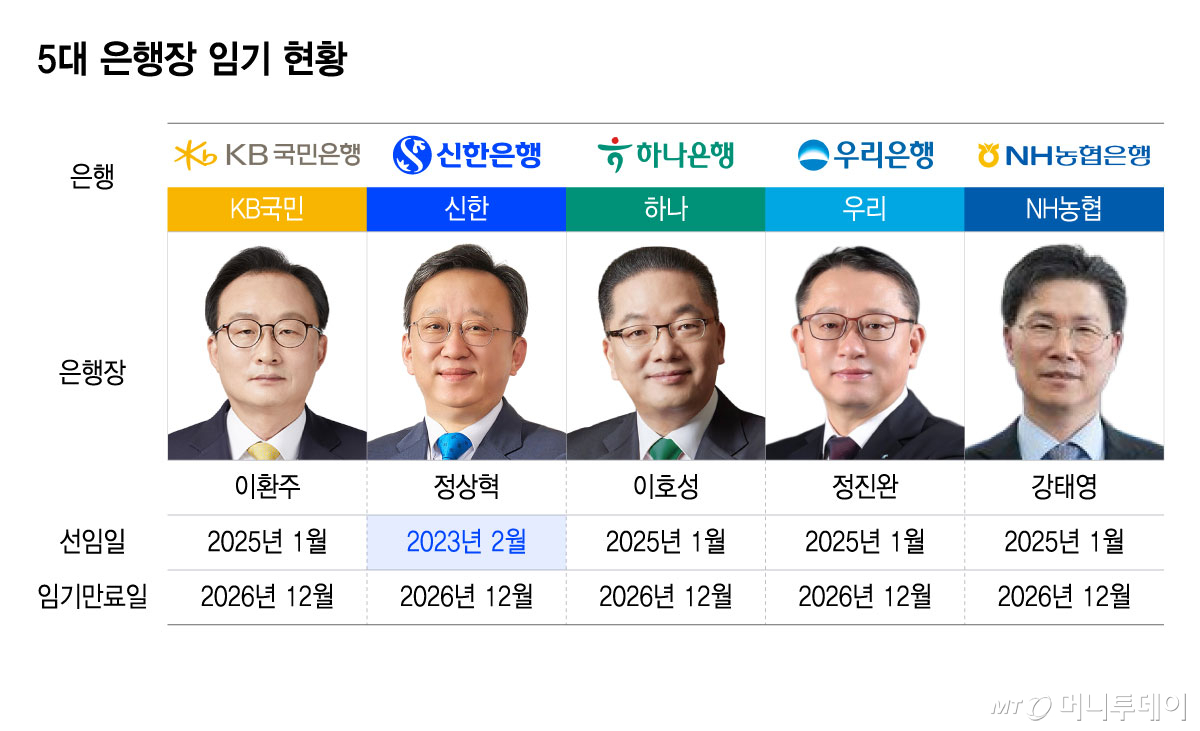
As the terms of office for the CEOs of the five major banks—KB Kookmin, Shinhan, Hana, Woori, and NH NongHyup—all expire at the end of this year, tension is rising in the financial sector. Initially, the possibility of some CEOs being reappointed was discussed based on stable performance, but the atmosphere has shifted as the financial regulator recently emphasized transparency and independence in the CEO selection process. Various predictions are emerging within the industry, ranging from the expectation that a significant number of CEOs will be replaced to the possibility that all five major bank CEOs will be swapped out.
According to financial industry sources on the 2nd, the terms of office for Lee Hwan-ju, CEO of KB Kookmin Bank; Chung Sang-hyuk, CEO of Shinhan Bank; Lee Ho-seong, CEO of Hana Bank; Jeong Jin-wan, CEO of Woori Bank; and Kang Tae-young, CEO of NH NongHyup Bank, all end on December 31. Four of the five, excluding Chung Sang-hyuk, who took office in 2023 and was reappointed once, assumed their positions in January last year and are approaching the end of their initial two-year terms. Recently, major financial holding companies have successively activated committees such as subsidiary CEO candidate recommendation committees, entering into procedures to select the next bank CEOs.
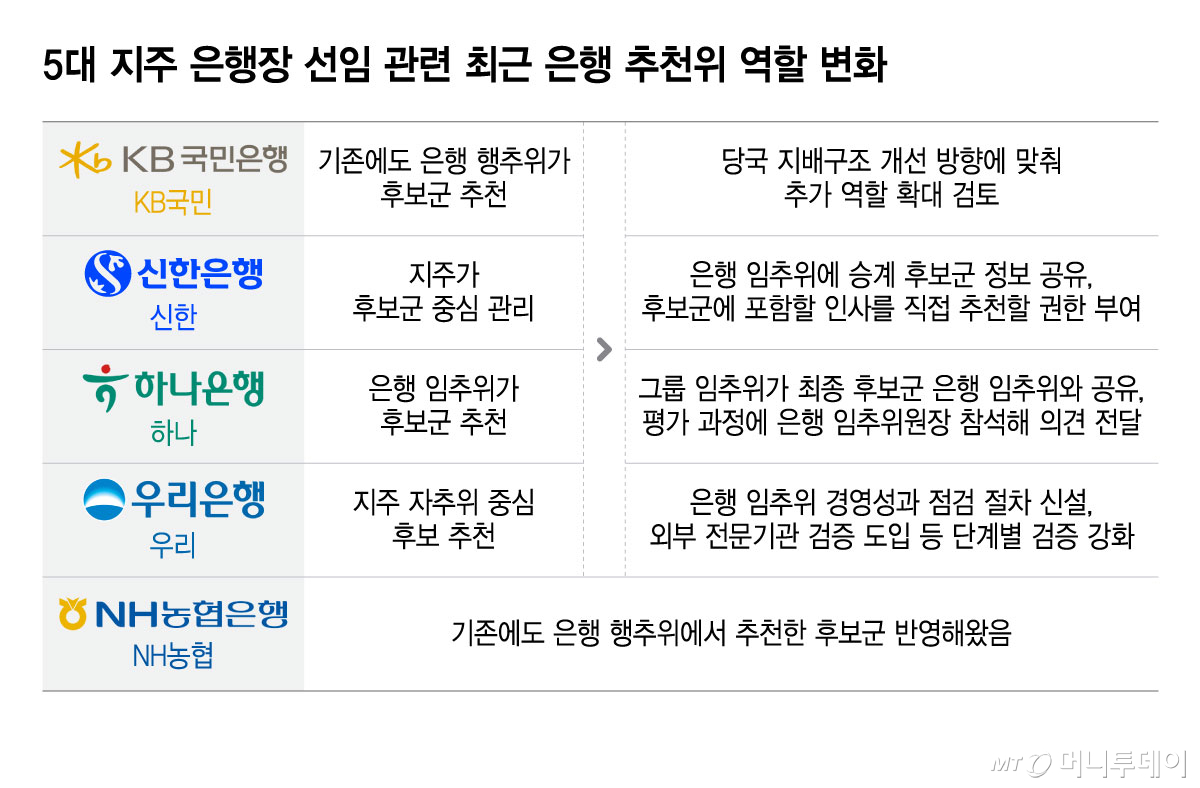
The biggest variable in this year's personnel changes is cited as the financial regulator’s demand for improved corporate governance. Lee Chan-jin, Chairman of the Financial Supervisory Service, held a meeting with the chairs of financial holding companies on the 23rd of last month and stated that "the appointment of subsidiary CEOs should be based on competence, not specific factions or personal relationships." Following this, financial holding companies have moved to strengthen the role of bank boards of directors by granting candidate recommendation rights to the bank executive candidate recommendation committees (Executive Recommendation Committees) or soliciting opinions during the process of narrowing down candidates.
However, assessments within the financial sector suggest that such institutional changes are not enough to reverse the direction of actual bank CEO appointments. This is because even if participation in the bank Executive Recommendation Committee expands, the structure does not require the holding company to necessarily elect the candidates recommended by the bank directors. In particular, the Executive Recommendation Committee, composed of external bank directors, can only recommend candidates such as bank vice presidents, but it is not mandatory for the CEO to be selected from among current vice presidents. There are also points noting that since Ji Ju (Chairman) must place CEOs considering the group-wide business strategy and synergies between affiliates, granting excessive personnel authority to the bank board of directors could conflict with the intent of the financial holding company system.
Information asymmetry regarding candidates is also cited as a limitation. Even if external directors are provided with evaluation materials and candidate pool information, it is difficult for them to deeply understand each individual compared to those who have directly Ji Kyeo-bon (Chairman) the performance and leadership of candidates within the group for decades. A financial industry official said, "In reality, the person who has experienced and observed the largest number of candidates is the chairman," adding that "weight inevitably falls on the chairman's opinion regarding the candidates."
Ultimately, it is analyzed that the practical effect of this institutional improvement lies not in replacing Ji Ju (Chairman)'s personnel authority, but in strengthening the formal and procedural transparency of the bank CEO selection process. However, within the financial sector, attention is focused on the fact that Chairman Lee directly mentioned "factions" and "personal relationships," rather than the institutional changes themselves. Given that it is difficult for the influence of Ji Ju (Chairman) to decrease significantly in the short term despite the strengthening of Executive Recommendation Committee authority, whether reappointing current CEOs or appointing new ones, from the perspective of Seon Chul-ha-deun (Chairman), they are inevitably conscious of the justification and procedural legitimacy of the personnel selection compared to before.
The calculations for each bank are also complex. For Kookmin Bank, the possibility of a generational shift is being discussed as Lee Jae-geun, the next chairman candidate for KB Financial, has been selected. The point of interest is whether the trend of change shown in the process of choosing this candidate over Yang Jong-hui (Chairman)'s reappointment will extend to the personnel decision regarding CEO Lee Hwan-ju.
For Hana Bank, the "reappointment convention" is a variable. Since Ham Young-ju, Ha Na-geum-yung (Chairman), served as the integrated Hana Bank CEO, former CEOs Jeong Seong-gyu, Park Sung-ho, and Lee Seung-yeol were all not reappointed. Given that even former CEO Lee Seung-yeol, who achieved the status of "leading bank," was not reappointed, there is an atmosphere that it is difficult to predict reappointment based on performance alone. In the case of NongHyup Bank as well, there has never been a single instance of a CEO being reappointed, so attention is focused on whether this convention will continue.
For Woori Bank, the atmosphere is relatively high in expectations for reappointment. Within Woori Financial, expectations are emerging that if Lim Jong-ryong (Chairman) is reappointed and CEO Jeong Jin-wan is also reappointed, it could enhance governance stability. In particular, there is a view that more time is needed to fully conduct management, as CEO Jeong has restrained the expansion of bank business operations to some extent for purposes such as managing the group's capital ratio after taking office. A Woori Bank official said, "Internally, I understand there is little disagreement on the point that CEO Jeong should continue."

 in FINANCE

