

[For more diverse company information on the startups mentioned in this article, please visit the Unicorn Factory big data platform 'Data Lab'.]
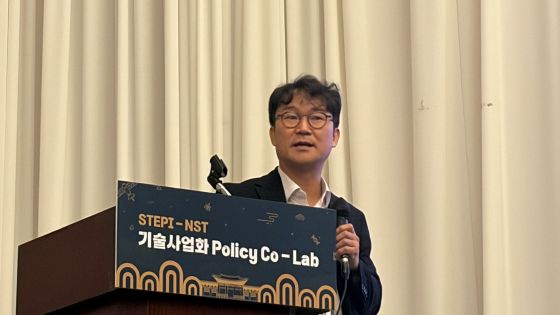
"Support focused solely on patents and incubation spaces is insufficient to guarantee the survival and growth of startup companies."
Lee Yong-kwan, CEO of Blue Point Partners, made these remarks as a speaker at the special session 'STEPI (Science and Technology Policy Institute)-NST (National Research Council of Science & Technology) Technology Commercialization Policy Co-Lab' held on the 27th at Gyeongju Lahan Select in Gyeongsangbuk-do.
Lee identified that the reason why excellent technologies from universities and government-funded research institutes fail to reach the market is not due to a lack of technology, but rather a shortage of market execution capabilities and expert networks.
Technology Is Not the Bottleneck; Success or Failure in Commercialization Depends on 'Market Responsiveness'
Citing research materials analyzing growth obstacles for university spin-off companies, he stated, "The top-ranked obstacles were market, capital, and operational factors such as marketing and sales capabilities, cash flow, and responses to uncertainty. The technology itself was not perceived as a bottleneck."
Similar results emerged regarding factors determining corporate survival. According to a study analyzing 870 university spin-offs in the UK, survival rates were higher when institutional investors participated as shareholders or when board members had startup and management experience. Additionally, survival rates improved when technology transfer offices (TTOs) accumulated commercialization experience rather than administrative experience. In contrast, physical infrastructure such as incubation spaces or science parks showed no clear correlation with corporate survival, and the number of patents failed to serve as a key variable explaining survival.
Lee also shared his own startup experience. He noted, "When I started my business previously, I filed nearly 30 personal patents, but only three or four actually contributed directly to the business." He emphasized, "A patent is good only if it follows a strategy for how it will function in the market."
Lee also pointed out the difference in perspective between academia, which focuses on the 'novelty' of technology, and industry, which looks at 'market fit,' expressing dissatisfaction with the Technology Readiness Level (TRL) framework. He stated, "The turning point for commercialization is the transition from TRL 4 to 5, but researchers often arbitrarily set market-like environments. A structure that ensures continuous communication with the market must be established."
"Promising technologies should move quickly; unpromising ones must stop fast"
Another core point emphasized by Lee is 'judgment speed.' He introduced a study analyzing the National Science Foundation (NSF) customer validation program 'I-Corps,' stating, "The median time to reach a decision to discontinue a project (No-Go) was 1,590 days under general technology commercialization support, but only 777 days in I-Corps—half that amount." He further emphasized, "Just as it is important to quickly identify promising technologies, it is equally crucial to stop unpromising ones swiftly so that public resources are not tied up for too long."
His diagnosis is that the importance of such judgments grows even greater in rapidly changing market environments. Lee stated, "An AI service company that recorded 10 billion won in sales last year saw its first-half sales this year drop to just 150 million won. In the past, a halving of sales was common, but now it can plummet to one-tenth or even one-hundredth of the original amount in an instant."
He also shared his experience that rather than forcing researchers with strong technical skills but low market acceptance to change, "if there are no signs of change, it is more efficient to step back and dedicate that time to startup teams that are more passionate and have higher market acceptance."
Agenda-Centered Community
The distinctive approach of Blue Point Partners becomes even clearer in how they nurture selected teams. The first methodology of Blue Point is an 'agenda-centered program.' Lee defined the core of accelerators as 'peer learning,' stating, "In deep tech, communities must be meticulously designed by topic (agenda)."
A representative example is the energy and climate community 'Clima Salon.' Over three years, it held 11 sessions with a cumulative participation of 930 people. The composition was evenly distributed: 32% companies, 29% startups, 24% investment firms, and 10% academic researchers. They meet quarterly to exchange ideas on technology, markets, and capital. In addition, Blue Point has operated agenda-based programs in areas such as AI, quantum, nuclear energy/fusion, and defense industries.
Venture Studio... Managing Deal Flows with AI
The second methodology is the venture studio, or company building. Lee stated, "It is far more efficient to work together from before a startup is founded rather than providing support after it has been established," noting that there are now over 2,000 venture studios worldwide.
Citing relevant statistics, he explained that the average internal rate of return (IRR) for startups produced by venture studios was 53%, significantly surpassing the 21.3% for general startups. Additionally, the time from founding to Series A funding was 25.2 months, half the 56th months required for general startups.
Lee also introduced 'Lattice,' a proprietary system developed to improve operational efficiency. In a situation where only one or two out of every 100 investment review requests (over 3,000 annually) result in actual investment, AI learns Blue Point's evaluation criteria to perform initial assessments, assign reviewers, and automatically organize the database.
Lattice detects and alerts on anomalies such as CEO departures or concerns about capital impairment based on quarterly reports from portfolio companies. It also responds when follow-on investors request company matching based on specific conditions.
Lee stated, "Ultimately, the key is to connect researchers from universities and government-funded research institutes with organizations that support them, along with capital and large corporations possessing market expertise, around a central agenda from the outset." He added, "By integrating AI and data, we will create even more sophisticated and dense programs."
Meanwhile, 'PTC Korea 2026' was co-hosted by the National Research Council of Science & Technology (NST) and the Korean Association for Research Transfer (KARIT), with KARIT and the Joint TLO Marketing Office serving as organizers.
[MoneyToday startup media platform Unicorn Factory]

 in FUTURE
