

[For more diverse corporate information on startups, visit Unicorn Factory's Big Data Platform Data Lab.]

Spear Street Technology, which operates 'Instinct,' an AI assistant service based in San Francisco, U.S., has secured a 2.5 billion won (approximately 340 billion won) Series B investment round. The company's corporate valuation is estimated at $2.5 billion (approximately 3.4 trillion won).
Noah Shinn, the 23rd-year-old founder leading the company, previously served as a research scientist at the AI agent startup 'Sierra.' Just four months after incorporating in April, his team has created what is currently Silicon Valley's hottest product.
"It feels like magic," with just one text message to prepare for a wedding
This Series B round was jointly led by Index Ventures and Benchmark. Spear Street Technology had received a corporate valuation of 50 billion won (approximately 700 billion won) in its Series A funding earlier this month, raising $75 million (approximately 100 billion won). In just a few weeks, the company has increased its corporate valuation fivefold.
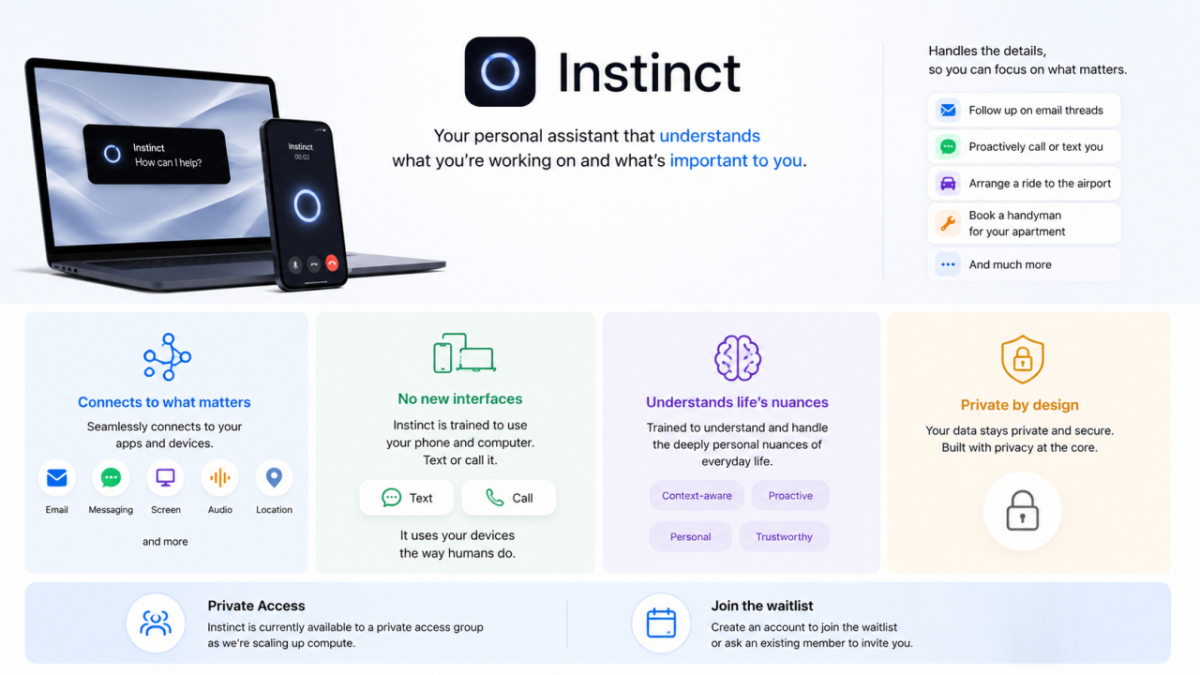
Even more remarkable is that the product has not yet been officially released. Currently, it is only accessible to those who receive an invitation. There is no dedicated app; users simply send instructions via text message or WhatsApp.
Instinct is a personal AI agent that connects not only email, messaging apps, and calendars but also device audio, location, and screen functions. Specifically, it handles various tasks such as booking flights and restaurants, organizing inboxes, grocery shopping, and canceling subscriptions.
According to founder Shinn, some users have even prepared for weddings through Instinct. Early testers responded explosively. Evaluations like "It feels like magic" and "The most exciting release since OpenClo" spread rapidly on X (formerly Twitter), generating buzz among VCs and entrepreneurs.
Sarah Guo, founder of AI-focused investment firm Conviction, stated, "It successfully executed everything from Michelin restaurant reservations to marathon sign-ups, camping bookings, and general purchases." Fintech investor Sil Monoo described it as "OpenClo for ordinary people."
For OpenClo, an open-source AI agent, installation and operation were cumbersome, creating a high barrier for users without development experience. Instinct addressed this by offering a consumer-friendly approach that connects WhatsApp, iMessage, and email accounts with just one click.
Alongside the hype, concerns have also been raised. According to Instinct's terms of service, the operator can store, modify, and utilize user data for AI training. Additionally, it collects screen captures and keyboard inputs, raising issues regarding potential privacy violations.
An industry insider remarked, "The controversy surrounding Instinct could mark a turning point where the core of personal AI agent competition shifts from performance to 'trust.' Designing terms of service that allow users to use the service with peace of mind and strengthening security will become key competitive advantages for AI agent startups."
Founders who sold Fitbit to Google launch new product targeting elderly families

James Park and Eric Friedman, co-founders of 'Fitbit,' which pioneered the wearable device market, have launched a new startup called 'Luffu.' Recently, they unveiled 'Luffu Link,' a wearable health device designed for the elderly.
This product is a wristband with built-in LTE. It continuously monitors activity levels, sleep, resting heart rate, heart rate variability (HRV), and breathing rate. It shares location via GPS and allows users to request help from designated caregivers by pressing a button, even without a smartphone nearby.
Its most distinctive feature is the absence of a screen. Founder Park explained, "Link was designed as a silent guardian that protects health on your wrist all day long. We drew design inspiration from jewelry made to avoid looking like an emergency pendant."
The product's target audience is not the elderly wearing the device but their families. A separate app organizes data and shares it with family members, sending alerts when unusual patterns are detected, such as significantly reduced activity levels.
Founder Park stated, "While we believe technology can reduce caregiving burdens, existing tools were too fragmented. Link does what general trackers do, but its core value lies in how the data is used."
When a button is pressed, Link immediately records the wearer's symptoms and mood. The Luffu app organizes this information so it can be viewed by all family members. It also notifies them of the wearer's location, including whether they entered or exited specific areas. Pressing the button twice allows the wearer to check in with family without making a call or sending a text.
Equipped with LTE, users can request help even when no smartphone is nearby. If the wearer says, "I fell and hurt my wrist; can someone come?", the system sends their location, battery level, heart rate, and recent activity data to family members along with a voice message.
The founders who sold Fitbit to Google entered the 'family caregiving' business due to their personal experiences caring for their parents. Founder Park noted, "Becoming a caregiver, or the 'CEO of the family,' requires immense time. The individual being cared for should be able to continue daily life without feeling monitored."
DeepSeek secures 10 trillion won in funding with a corporate valuation of 103 trillion won… aiming for listing by 2027
Chinese AI startup DeepSeek is nearing the closure of a new funding round that recognizes a pre-investment corporate valuation of 500 billion yuan (approximately $7.4 billion or 103 trillion won). The fundraising amount is 50 billion yuan (approximately 10 trillion won), serving as a de facto pre-IPO round for its planned listing on the STAR Market (ChiNext) of the Shanghai Stock Exchange.
This round includes previous investors Monolith VC and Suxiang Capital, along with battery giant CATL. New investors currently in negotiations include CPE, Legend Capital, and semiconductor-focused private equity firm Stony Creek Capital.
In June, DeepSeek secured 50 billion yuan (approximately $7.4 billion) through its first external fundraising since inception, receiving a corporate valuation of over 50 billion dollars (approximately 70 trillion won). Its valuation has increased by more than 40% in just two months.
DeepSeek was widely known as a company that did not require external funding. For years, it self-funded through profits from Highflyer, a quantitative hedge fund led by founder Liang Wenfeng. Founder Liang previously stated, "Money has never been an issue for us; the challenge is the export ban on advanced chips."
Nevertheless, talent retention has been cited as the primary reason for seeking funding. Competing startups have been poaching DeepSeek researchers with stock options and high corporate valuations, creating a need to enhance compensation competitiveness.
DeepSeek plans to apply for listing by the end of this year, aiming for a market debut as early as the second quarter of next year. Unlike Moonshot AI (creator of Kimi) or Z.ai, which are targeting Hong Kong listings, DeepSeek has chosen mainland Shanghai, a move interpreted as a strategy to position itself as China's "national representative AI company."
While Hong Kong offers better access for international investors, from the perspective of Chinese regulators, it is considered an "overseas listing" requiring approval from the Securities Regulatory Commission. Companies classified as national representatives or those replacing technologies subject to U.S. export controls are expected to list on domestic exchanges.
An industry insider remarked, "Chinese AI companies that find it difficult to access U.S. capital markets are increasingly seeking funding directly on their domestic stock exchanges. If DeepSeek succeeds in its listing after disrupting the global AI market with low-cost models, this trend could strengthen further."
[MoneyToday Startup Media Platform 'Unicorn Factory']

 in FUTURE


