

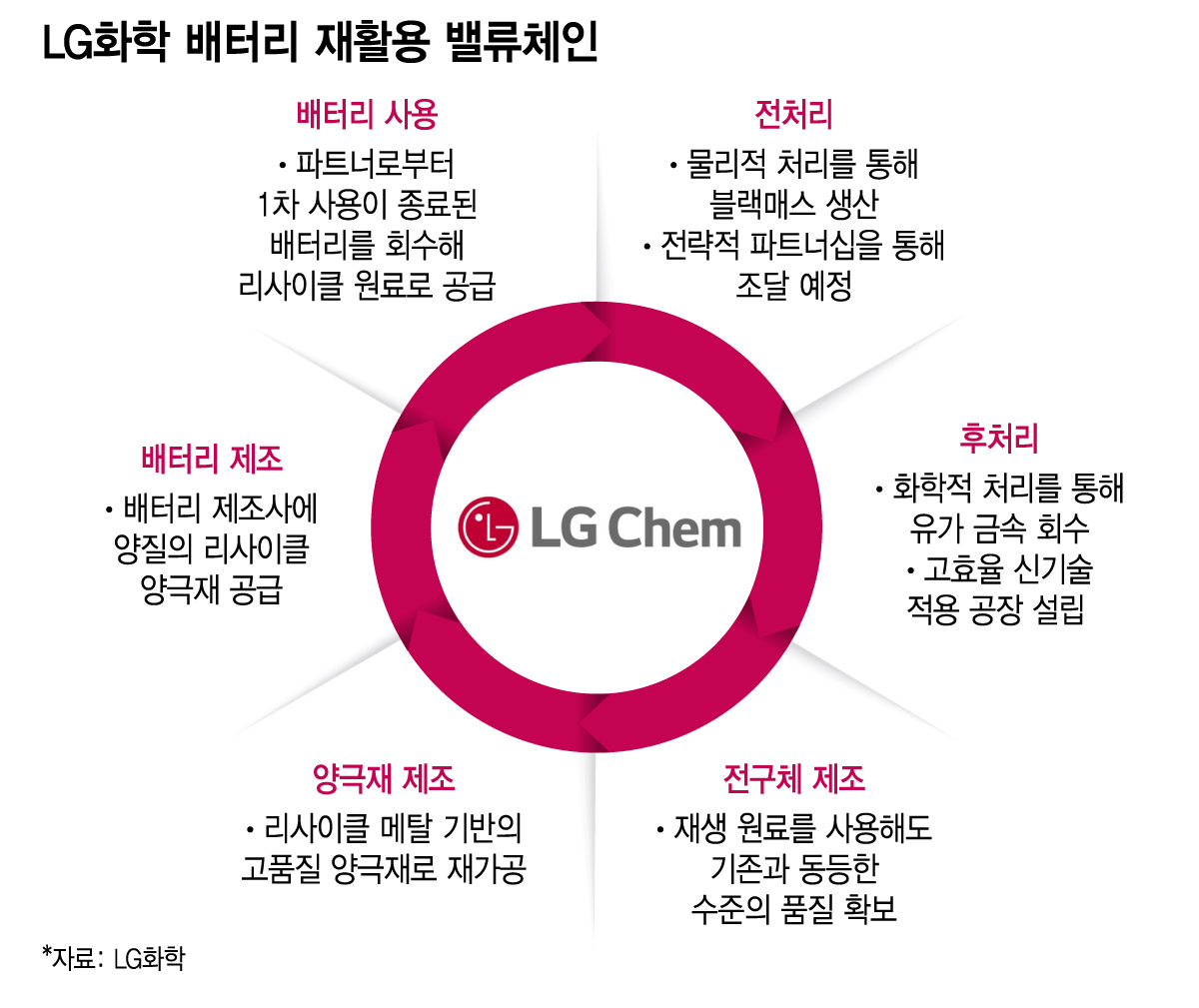
LG Chem is accelerating the commercialization of its battery recycling business. With the expectation that large volumes of waste batteries will flood the market as electric vehicle battery replacement cycles begin in earnest, the company is moving to secure a foothold in the market.
According to industry sources on the 29th, LG Chem completed construction and launched operations of a pilot facility for recycling waste batteries at its Cheongju plant in North Chungcheong Province during the first half of this year. The facility was finalized at the end of last year following technical development and laboratory experiments throughout the previous year, and verification work for commercialization is currently underway. LG Chem aims to establish a waste battery recycling system in Yangsan around 2028 after operating the pilot facility and consulting with clients.
Until now, LG Chem has been advancing its technology for producing cathode materials through waste battery recycling. The process involves receiving black mass, an intermediate product from physical shredding and crushing pre-treatment processes, and then recovering metals usable for cathode production through post-processing. The recovered metals are then used in the production of precursors and cathode materials.
LG Chem plans to secure price competitiveness based on higher process efficiency compared to competitors in the post-processing stage. Additionally, the company intends to reduce impurity levels in recycled lithium-ion battery metals and manage quality uniformly.
It is understood that LG Chem is also jointly pursuing cooperation with numerous battery cell manufacturers and automakers who are its cathode material customers. In particular, since its subsidiary LG Energy Solution is already operating production facilities at the Ochang plant in Cheongju, there are expectations of high potential for synergy.
According to the Korea Economic Daily, the number of electric vehicles with expired battery life worldwide is projected to surge from 170,000 units in 2023 to 42.27 million by 2040. Consequently, the global waste battery market is expected to grow at an annual rate of 17%, reaching $208.9 billion by 2040 from a scale of $10.8 billion in 2023.
The trend of domestic companies investing in waste battery recycling is growing. The POSCO Group has established a joint venture, POSCOHY Clean Metal, with GS Energy and others to pursue waste battery recycling operations. It established a factory in Gwangyang, South Jeolla Province, in 2023 and processes approximately 12,000 tons of black mass annually on average.
Ecopro is expanding its waste battery recycling business through its subsidiary Ecopro CNG. L&F has signed a memorandum of understanding with battery recycling company CIS Chemical for cooperation in lithium-ion battery recycling. L&F's subsidiary JHC supplies black mass through pre-treatment of waste batteries, while CIS Chemical recovers key raw materials through post-processing and utilizes them again in L&F's cathode material production.
Recently, intensifying global conflicts over supply chains for critical minerals used in electric vehicle batteries have further highlighted the importance of waste battery recycling. Industry observers believe that securing stable raw material procurement through waste battery recycling will not only establish a stable structure but also lead to cost reductions.
An industry official stated, "Waste battery recycling is a business that determines access to critical minerals and cost competitiveness," adding, "Companies that first secure lithium-ion battery recycling technology and a stable supply chain are highly likely to maintain competitiveness in the future battery materials market."

 in INDUSTRY
