

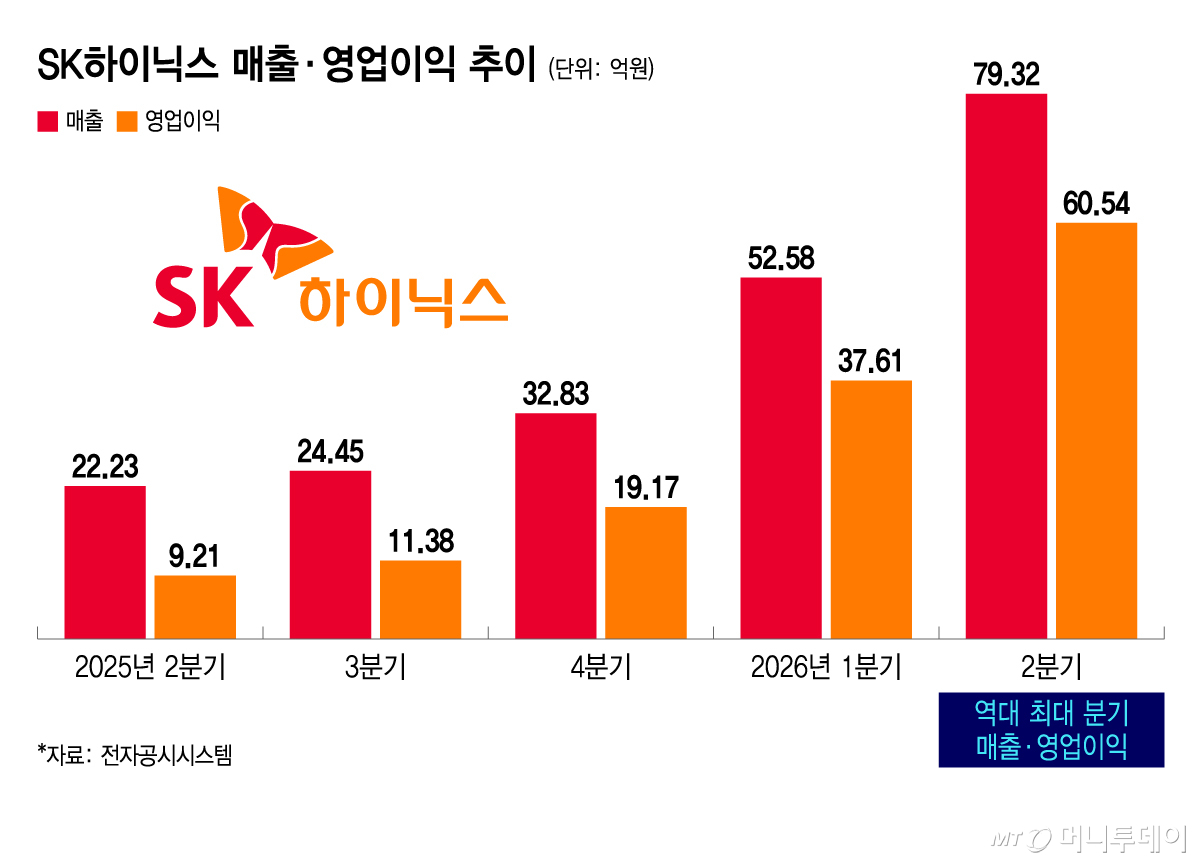
SK Hynix continued its record-breaking performance in the second quarter of this year as well. With an all-time high operating profit exceeding 60 trillion won, it dispelled concerns from some quarters about a "peak-out" in semiconductor profitability driven by AI (artificial intelligence).
On the 29th, SK Hynix announced through a public disclosure that its consolidated revenue for the second quarter reached 79.3187 trillion won, while operating profit hit 60.5426 trillion won. Year-on-year, revenue surged by 257% and operating profit jumped by 557%, compared to the previous quarter, revenue rose by 51% and operating profit increased by 61%. This marks five consecutive quarters of record-breaking results. The cumulative operating profit for the first half alone reached 98.1529 trillion won, nearing 100 trillion won.
Notably, with a sharp rise in memory semiconductor prices, the operating profit margin climbed by approximately 5 percentage points (p) from the previous quarter to reach 76%. This is higher than key customer NVIDIA (65.6%) and TSMC, the absolute powerhouse in foundry (contract manufacturing) at 60.3%, and comparable to Micron, the third-largest player in the memory industry at 80.4%. Given that Samsung Electronics is also expected to see a memory division operating profit margin in the range of 75% to 80%, it is being evaluated that an era of "memory supremacy" has begun.
Thanks to these strong results, SK Hynix's financial structure has become more robust. With cash assets totaling 88 trillion won and borrowings limited to just 18.6 trillion won, net cash stands at 69.4 trillion won. Net cash doubled within three months.
However, the figures fell short of the operating profit forecast expected by securities firms (approximately 64 trillion won). Recent forecasts have been around 60 trillion to 62 trillion won, which aligns with this level.
SK Hynix expressed confidence that performance in the second half will be even better. The key drivers are high-value-added products such as HBM (high-bandwidth memory), DRAM for AI servers, and eSSD (enterprise SSD). The company has already signed long-term supply agreements (LTA) with over 10 major global customers, including leading big tech firms, based on five-year terms.
During the management briefing held today, SK Hynix dismissed peak-out concerns by citing these market conditions. "The increased willingness of customers to establish long-term contracts proves that demand for memory in the AI ecosystem will continue to grow," the company stated with confidence. This reflects the reality on the ground, where demand is exceeding expectations, as recently highlighted by SK Group Chairman Choi Tae-won, who described the explosive demand for AI semiconductors using the term "abyss of chaos."
Accordingly, new investments to expand production capacity are expected to accelerate. On this day, SK Hynix emphasized that "in a situation of severe supply shortage like now, supplying memory products needed by the AI ecosystem is the manufacturer's obligation."

 in INDUSTRY
