

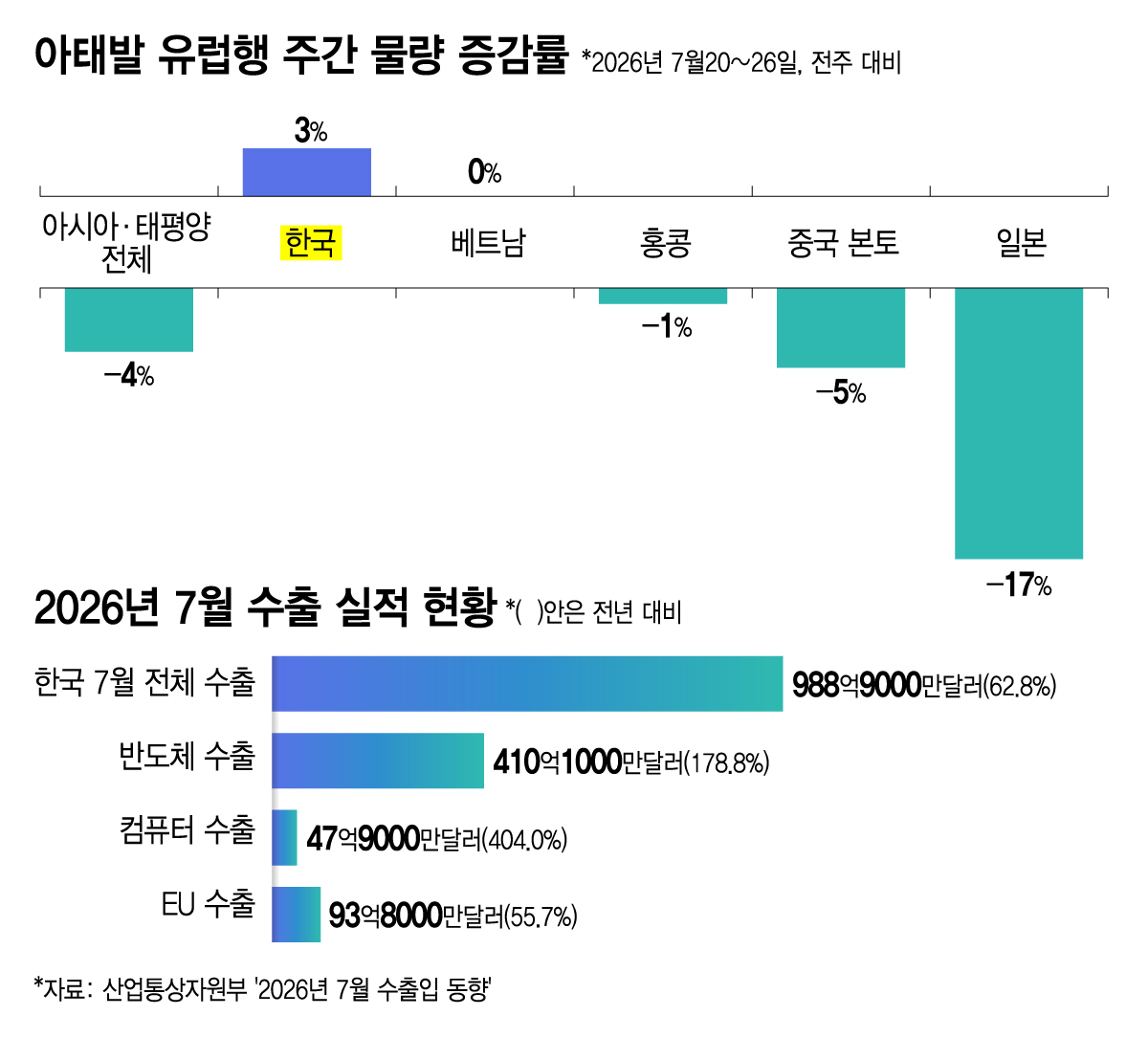
In the European-bound air cargo market where e-commerce (online shopping) shipments from China have weakened, only shipments originating from Korea increased. Analysts suggest that as investments in artificial intelligence (AI) expand, high-value technological cargo such as semiconductors, servers, and data center equipment is filling the void left by low-priced Chinese e-commerce goods. Korean Air's cargo revenue on European routes also rose 40% in the second quarter, reflecting this trend in actual performance.
According to WorldACD, an international air cargo market research firm, on the 7th, Asian and Pacific-bound shipments to Europe from the 20th to 26 fell 4% compared to Jeonju. Among major departure countries, only shipments from Korea increased by 3%. In contrast, shipments from Japan to Europe dropped 17%. Shipments from mainland China decreased by 5%, while those from Hong Kong fell by 1%. Compared to the same period last year, shipments from mainland China and Hong Kong declined by 10% and 23%, respectively.
The decline in shipments from China and Hong Kong is attributed to the European Union's (EU) tightening of regulations on low-value imports. Starting from the 1st, the EU abolished the tariff exemption for low-value imports under 150 euros and began imposing a temporary duty of 3 euros per item. This reduced the price competitiveness of low-priced goods that Chinese e-commerce companies had been shipping to Europe via air freight.
The increase in shipments from Korea coincides with export growth driven by the "AI supercycle." Last month, South Korea's semiconductor exports reached $41.01 billion, a 178.8% increase compared to the same period last year. Computer exports, including enterprise solid-state drives (SSDs), surged 404% to $4.79 billion. Exports to the EU rose 55.7% to $9.38 billion, marking a record monthly high.
The sharp rise in computer exports is seen as evidence supporting the increase in air cargo from Korea. AI-related products such as semiconductors and servers have high value relative to their volume, and timely delivery is critical, making them highly dependent on air transport.
Korean Air has seen these changes lead to improved profitability in its cargo business. Korean Air's second-quarter cargo revenue reached 1.5419 trillion won, a 46.1% increase compared to the same period last year. This also represents a 41.4% rise compared to first-quarter cargo revenue of 1.0906 trillion won.
While total cargo volume in the second quarter increased only 3% compared to the same period last year, cargo yield rose 41.8%. The increase in revenue was driven not by volume growth but by a higher proportion of high-value cargo and rising freight rates. Cargo revenue on European routes also increased 40% compared to the same period last year.
Korean Air explained that AI semiconductors, server racks, and data center infrastructure equipment have become key growth drivers for its cargo business, replacing Chinese e-commerce shipments. Demand for large and heavy special cargo such as transformers for data centers is also rising. Orders for high-bandwidth memory (HBM) and high-performance processors are expected to remain visible for the next two to three years.
Foreign carriers transporting Korean-origin cargo have also reported increased demand for technological goods. Cathay Pacific utilizes both freighter aircraft and lower-deck cargo holds of passenger planes departing from Incheon to carry Korean-origin cargo, connecting it via its Hong Kong hub to long-distance markets such as Europe. Cathay Cargo identifies semiconductors and electronic components from companies like Samsung Electronics as major cargo originating from Korea.
Cathay Pacific's first-half cargo revenue reached HK$13.86 billion, a 23.9% increase compared to the same period last year. The airline stated that increased transportation of high-value technological products driven by expanded AI investments has fueled growth in cargo revenue. Cathay Pacific Group's first-half net profit rose 71% to HK$6.24 billion.
Korean Air is strengthening Vienna Airport's role as a gateway to Central and Eastern Europe. It has extended its cargo operating agreement with Vienna Airport until the end of 2028, operating up to 10 weekly freighter flights to transport electronics and pharmaceuticals to Central and Eastern Europe. Both sides are also promoting joint marketing and advanced logistics services.
AI-related products have a greater impact on airline revenue than on cargo volume. According to the International Air Transport Association (IATA), AI-related products accounted for 53.5% of air cargo value last year, but their share of cargo volume was only 7%.

 in INDUSTRY
