

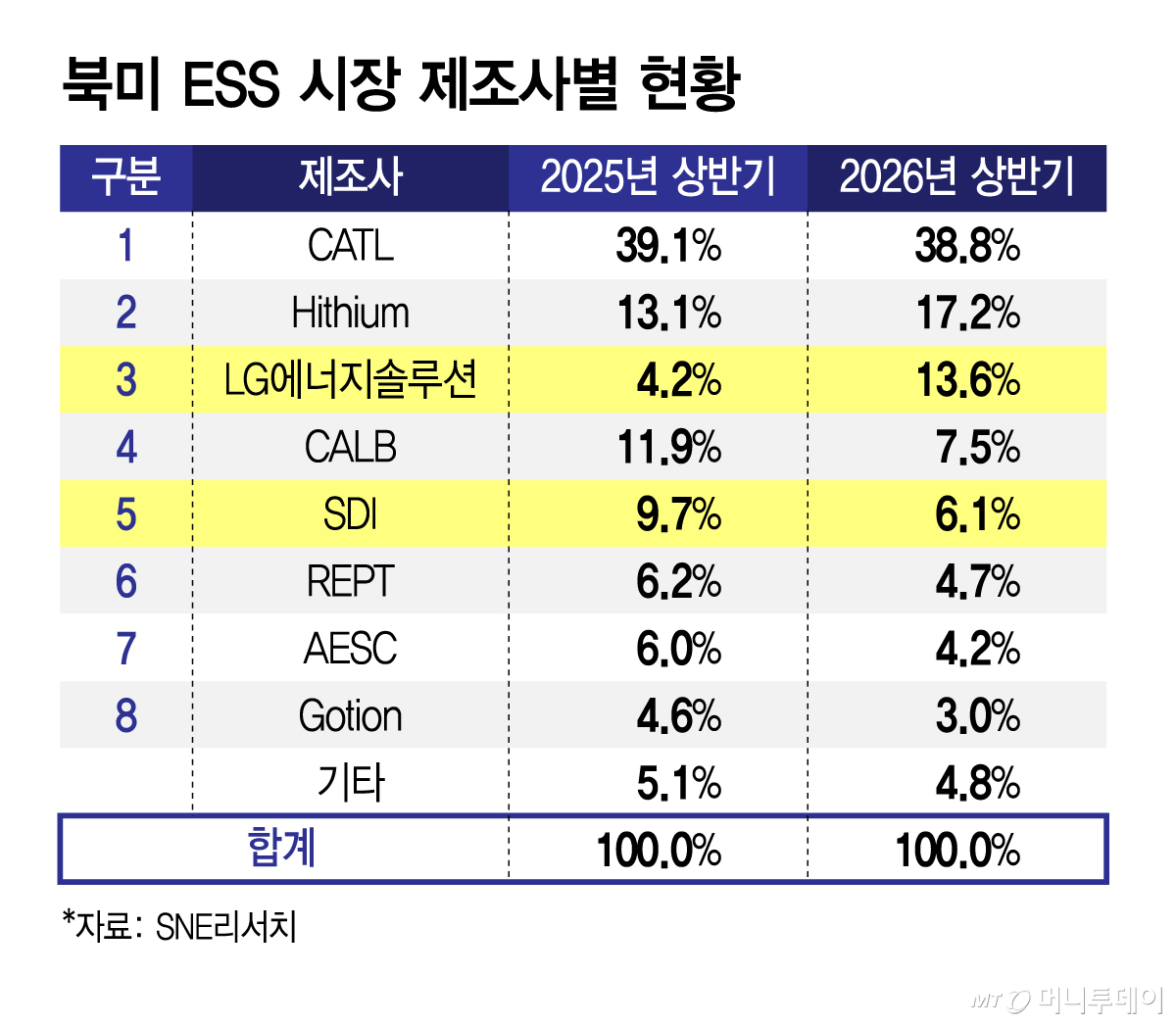
As the United States strengthens its restrictions on Chinese-made ESS (energy storage system) batteries, South Korea's battery industry is reaping the benefits. While LG Energy Solution and Samsung SDI have seen their combined market share rise compared to last year, SK On has also signed supply contracts one after another, expanding its foothold.
According to relevant industry sources on the 1st, LG Energy Solution's market share in the North American ESS market for the first half of this year is estimated at 13.6%, while Samsung SDI's share stands at 6.1%. The combined market share of the two companies reached 19.7%, an increase of about 5 percentage points from 14% during the same period last year. In contrast, Chinese companies accounted for 76% of the market in the first half of this year. Compared to the 90th%+ range held by Chinese firms in 2024, their influence in the North American ESS market is gradually weakening.
Since the inauguration of Donald Trump's second administration, the trend toward decoupling from China has strengthened, creating a favorable environment for South Korea's battery industry. Additionally, President Trump recently signed an executive order to strengthen security regulations on batteries and energy storage systems (BESS). As a result, the position of Chinese-made batteries in the North American ESS market is expected to shrink further.
South Korea's battery industry is responding to these market changes based on local production bases. LG Energy Solution has established five major ESS manufacturing hubs in North America: its Holland plant in Michigan, L-H Battery Company's Ohio facility, Ultium Cells' Tennessee and Lansing (Michigan) plants, and NextStar Energy's Ontario plant in Canada. The company plans to secure more than 50GWh (gigawatt-hours) of production capacity by the end of this year.
Samsung SDI is also accelerating its conversion of existing production facilities for ESS use. It will convert part of the electric vehicle production line at its Indiana plant, a joint venture with global automaker Stellantis called Starplus Energy (SPE), to begin producing LFP (lithium iron phosphate) batteries for ESS starting in the fourth quarter of this year. The facility has been producing NCA-based ESS batteries since the fourth quarter of last year.
SK On is converting part of its electric vehicle battery production line at its Georgia plant into an LFP battery production line for ESS and plans to begin operations in Yangsan in the second half of the year. Following a 1GWh-scale ESS supply contract signed last year with renewable energy company Flatiron Energy Development (hereinafter Flatiron), the company also signed a supply agreement yesterday with US ESS firm Neovolta Power for a total of 9GWh of LFP batteries for ESS from 2027 to 2031.

 in INDUSTRY
