

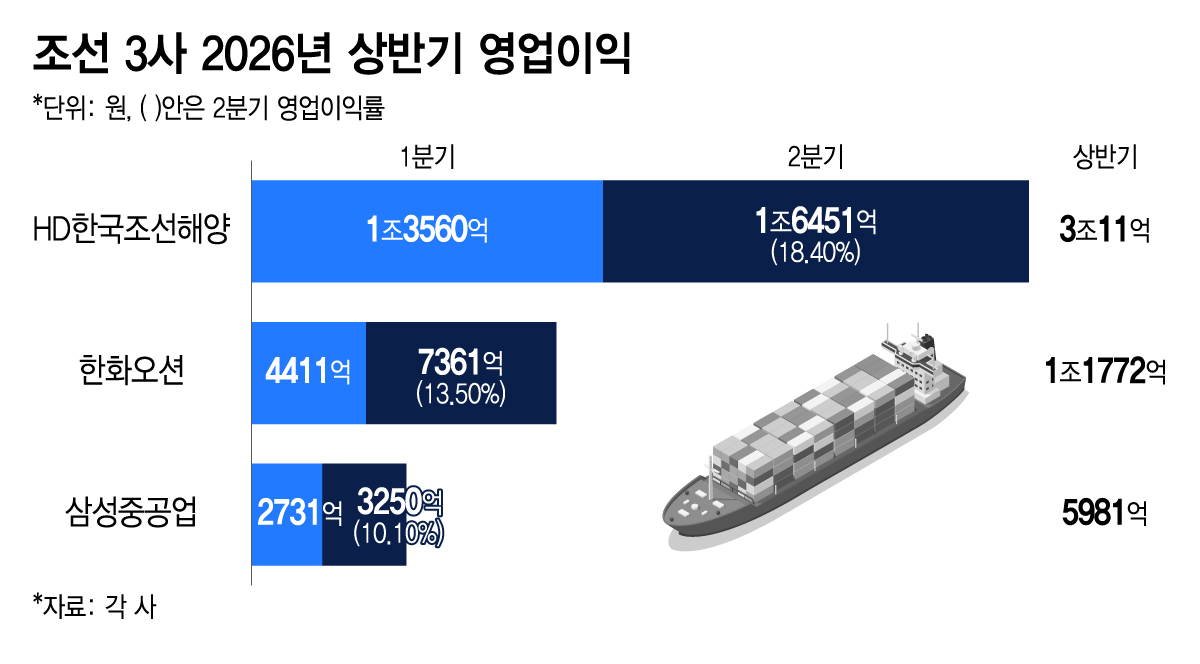
The combined operating profit of the three major domestic shipbuilding companies for the first half of this year exceeded 4 trillion won. This significant improvement in profitability resulted from a strategic focus on high-value-added vessels such as liquefied natural gas (LNG) carriers and productivity enhancements. In the second quarter, all three companies achieved double-digit operating profit margins consecutively.
According to industry sources on the 29th, the combined operating profit of HD Hyundai Heavy Industries, Hanwha Ocean, and Samsung Heavy Industries for the first half totaled 4.7764 trillion won. This strong performance was driven by a second-quarter operating profit of 2.7062 trillion won, following a first-quarter combined total of 2.702 trillion won. Notably, the second-quarter operating profit margins were 18.4% for HD Hyundai Heavy Industries, 13.5% for Hanwha Ocean, and 10.1% for Samsung Heavy Industries, with all three exceeding 10%.
Firstly, the full reflection of revenues from high-profit projects drove profitability improvements. In fact, it was revealed that vessels ordered since 2024 accounted for more than half of second-quarter sales. Productivity gains and cost reduction effects achieved through AI-driven transformation (AX), along with favorable exchange rates, also supported these strong results.
In the first half of this year, performance was particularly notable not only in commercial vessels but also in the offshore plant sector. Samsung Heavy Industries secured the "Coral Norte" floating liquefied natural gas production facility (FLNG) project in Mozambique, a 3.6356 trillion won initiative led by Italian energy company ENI. The company also signed an FLNG contract with U.S. energy firm Delfin Midstream valued at 2.9 billion dollars (approximately 4.3862 trillion won). For Hanwha Ocean, revenues of 1.5 trillion won from the P-79 floating production storage and offloading (FPSO) facility for Brazil's state-owned energy company Petrobras were reflected in its financial results under Indian accounting standards.
In the special vessel sector, there was disappointment over missing out on Canada's submarine project (CPSP), yet all three shipbuilders continue to expand into overseas markets. A Hanwha Ocean representative explained, "We are discussing new warship construction projects and various opportunities related to the U.S. Navy in the Middle East, Africa, South America, and Europe." HD Hyundai Heavy Industries is also pursuing orders for patrol and escort ships in the Philippines and submarine projects in Peru during the second half of the year.
Securing workloads has already exceeded expectations. HD Hyundai Heavy Industries secured a total of 142 vessels worth 16.39 billion dollars this year, representing 70.3% of its annual order target (23.31 billion dollars). Samsung Heavy Industries also surpassed an accumulated order value of 10 billion dollars this year, achieving 72% of its annual target (13.9 billion dollars). Although Hanwha Ocean has not disclosed its annual order target, it recorded cumulative orders of 4.35 billion dollars in the first half, marking an increase of over 35% compared to the previous year.
The shipbuilding industry anticipates that positive trends will continue into the second half of the year. This expectation is based on projected expansion in LNG carrier orders centered on major U.S. LNG projects and steady demand for replacing aging vessels. However, the order gap with China remains a challenge. In the first half of this year (January to June), China secured a total of 31 million CGT (1,131 vessels), capturing a 72% market share, while South Korea accounted for only 7.97 million CGT (195 vessels), representing 19%.
Domestic shipbuilders plan to accelerate development of floating data centers (FDCs) and eco-friendly ships to secure future growth drivers. A representative from HD Hyundai Heavy Industries stated, "We are engaged in close and detailed discussions with numerous companies regarding FDCs and are working hard to achieve tangible results. We are developing FDCs that can be deployed under various environmental conditions."

 in INDUSTRY
