

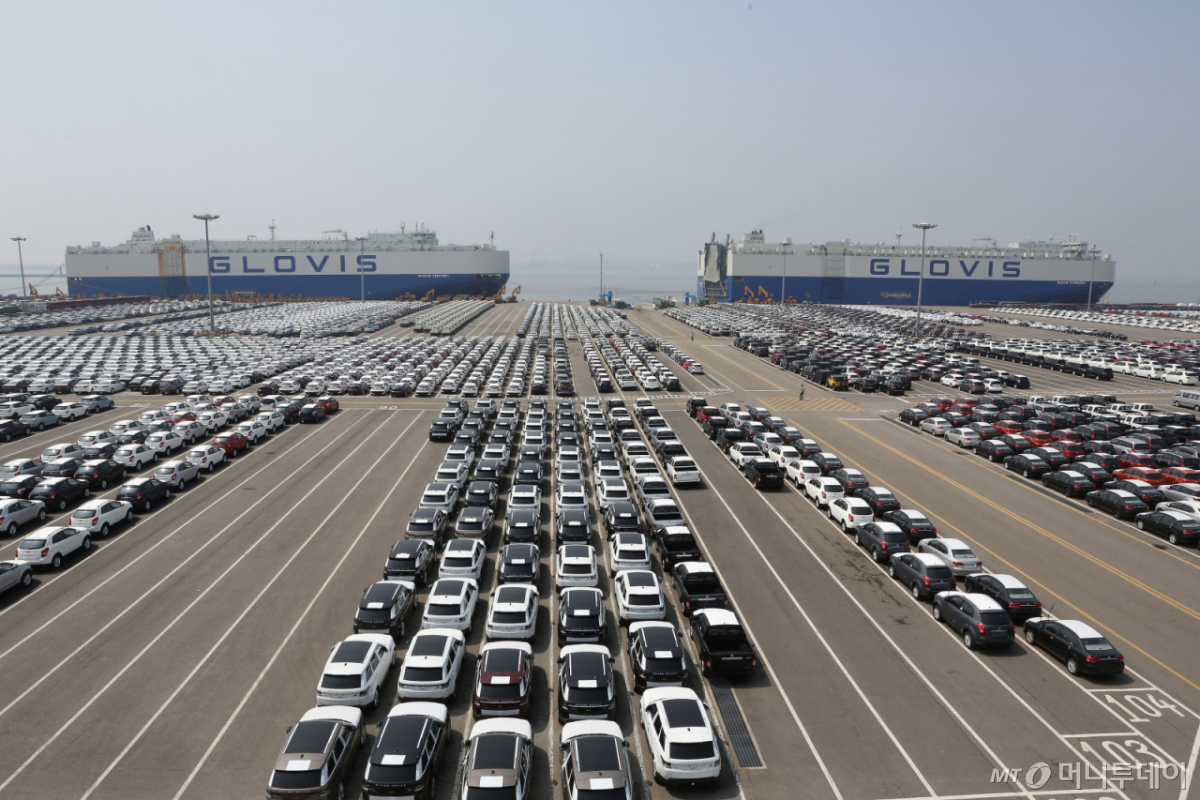
As Chinese automakers' exports surge, shortages of pure car carriers (PCTCs) are intensifying. Although newbuildings are increasing vessel supply, they cannot keep pace with the rapid overseas expansion of Chinese vehicles. With some Chinese firms resorting to alternative transport methods such as container ships due to inability to secure PCTCs, analysts warn that vessel scarcity has reached a level that constrains finished vehicle manufacturers' overseas sales.
According to industry sources on the 14th, China exported over 6.2 million passenger cars from January to August this year, surpassing last year's full-year export volume of approximately 6 million cars in just eight months. Last month alone saw exports reach about 890,000 units, a 67.1% increase compared to the same period last year. This surge is attributed to rapid overseas sales growth centered on electric vehicles and plug-in hybrid vehicles (PHEVs), amid sluggish domestic demand in China.
The core issue lies in vessels failing to match the pace of export growth. Andreas Enger, CEO of global car carrier operator Hogg Auto Lines, recently stated during an earnings announcement that approximately 100 additional PCTCs would be needed solely to transport this year's increase in Chinese vehicle exports. He further noted that all available vessel capacity for this year has already been booked, with strong booking demand extending through 2027. Industry estimates indicate a gap of about 74 vessels (equivalent to 7,000 CEU passenger car units) between Chinese demand and PCTC supply.
Vehicles unable to secure space on dedicated carriers are being shifted to general cargo ships. According to the shipping industry, approximately 1 million to 1.5 million vehicles were transported via alternative methods such as containers in the first half of this year alone. Consequently, charter rates for PCTCs have surged. According to shipping broker Clarkson, the annual charter rate for a 6,500 CEU-class PCTC reached $80,000 per day last month, an 88% increase from year-end last year—the highest level since November 2024.
Vessel shortages are directly influencing sales strategies of Chinese finished vehicle manufacturers. BYD's management recently indicated at an investor meeting that while their overseas sales target for this year is 1.9 million to 2 million units and over 2.5 million units next year, vessel scarcity has constrained this year's overseas shipment volume. They explained that if transport capacity had been sufficient, overseas sales would have grown further. BYD's overseas shipments last month totaled 189,466 units, a 134.5% year-on-year increase. Currently operating eight PCTCs, BYD has also begun securing its own dedicated fleet.
Hyundai Glovis and other firms are also expected to benefit. In Hyundai Glovis's finished vehicle ocean transport segment last year, non-affiliate cargo accounted for 53% of revenue, already exceeding half. As Chinese automakers' overseas sales surge, opportunities for Hyundai Glovis to secure additional non-affiliate cargo are increasing. Indeed, Hyundai Glovis's second-quarter shipping revenue this year rose 20.9% year-on-year to 1.6441 trillion won, driven by expansion of non-affiliate cargo including from Chinese local OEMs.
Hyundai Glovis plans to expand its PCTC fleet capacity from approximately 98 vessels at the end of the second quarter this year to about 110 vessels (in 6,500 CEU equivalent terms) by year-end and around 120 vessels by the end of 2027. In the medium to long term, the company aims to increase its PCTC fleet to 128 vessels by 2030 and expand annual finished vehicle ocean transport volume from the current 3.4 million units to 5 million units.

 in INDUSTRY
