

The labor union of Micron Technology (hereinafter Micron) in Taiwan has demanded that 15% of operating profit be used as the source for performance bonuses, warning of the possibility of a general strike. This marks the beginning of "operating profit-linked" performance bonus demands overseas, following domestic memory semiconductor companies such as Samsung Electronics and SK Hynix. As profits surge due to the semiconductor boom, the industry's cost burden related to performance distribution is also increasing.
According to the semiconductor industry on the 16th, the Micron Taiwan union held a press conference on the 15th (local time) and demanded that the company use 15% of operating profit as the source for performance bonuses. Previously, Micron's headquarters announced its "2026 Fiscal Year Performance Compensation Plan" on the 11th (local time). For Taiwan employees who joined before August 29, 2025, the plan includes a special appreciation payment of 1 million New Taiwan dollars (approximately 43 million won), an annual performance bonus reaching up to 500% of the basic target, and additional stock compensation. Based on production workers, the total compensation amounts to 35 to 68 months' wages.
The union side argues that a long-term profit-sharing system linked to performance is necessary rather than one-time compensation. In particular, they cited the performance bonus systems of domestic memory companies and claimed that wage gaps have widened compared to employees at Korean companies. The Micron Taiwan union plans to declare a breakdown in negotiations if the company does not provide a clear solution during labor-management negotiations on the 18th and 21st, and will proceed with a vote on whether to support a general strike.
In the domestic memory semiconductor (hereinafter memory) industry, a structure that distributes a certain percentage of operating profit as performance bonuses is spreading. SK Hynix was the first to lead this trend. Last year, SK Hynix labor and management agreed to abolish the upper limit on payments from operating profit and utilize 10% of operating profit as the source for performance bonuses. Based on this year's annual operating profit forecast of 264 trillion 925.7 billion won, a simple calculation shows that the per-person performance bonus amounts to approximately 733 million won. Samsung Electronics labor and management also agreed through this year's wage and collective bargaining agreement to establish a special management performance bonus utilizing 10.5% of DS (Device Solutions) division operating profit as the source.
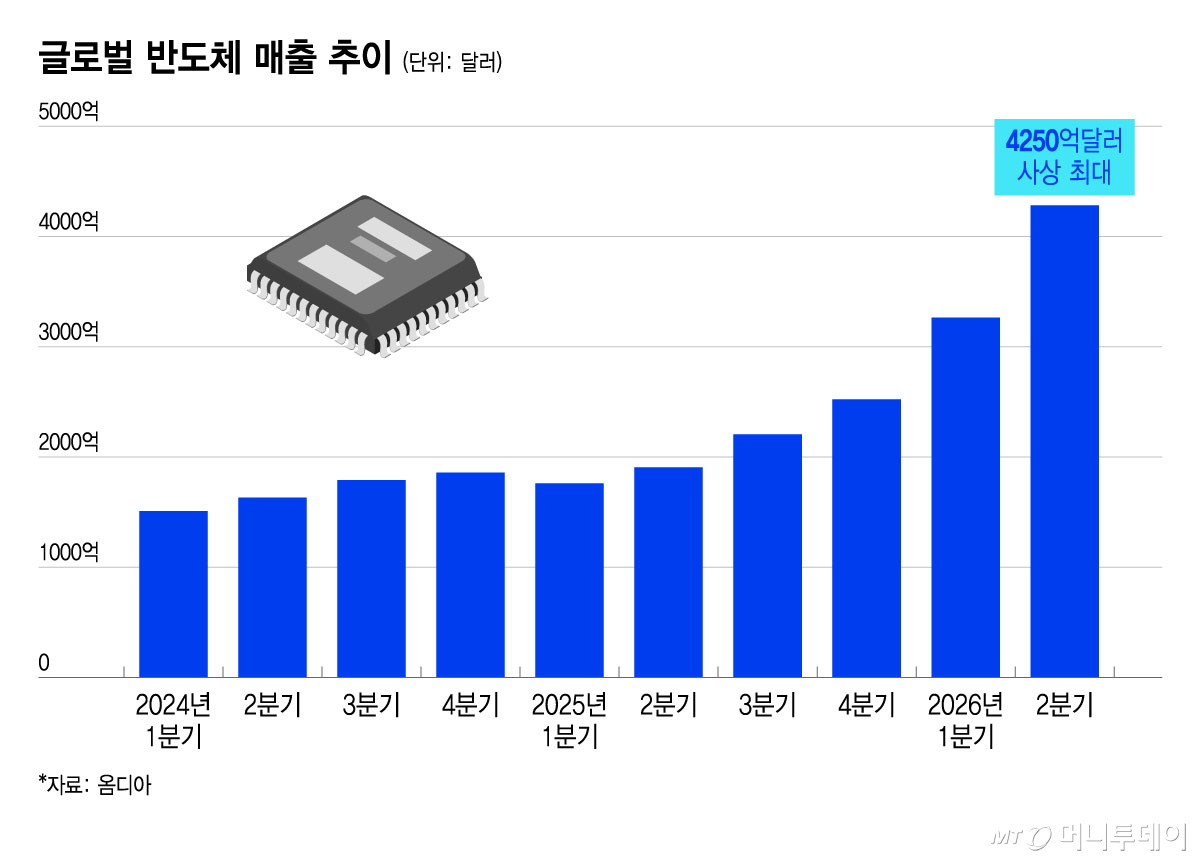
An unprecedented semiconductor boom is fueling demands for performance distribution. According to market research firm Omdia, global semiconductor sales in the second quarter of this year reached 425 billion dollars (approximately 581 trillion won), a record high. In particular, the share of memory sales accounted for 54% of total semiconductor sales, surpassing 50% for the first time. The non-memory semiconductor market also grew by more than 10% compared to the previous quarter. Considering that the usual growth rate is around 3%, this is an exceptional level. When performance bonus controversies erupted at TSMC, the world's number one foundry (semiconductor contract manufacturer), Chairman C.C. Wei personally stepped in to de-escalate the situation by announcing that he would increase the total amount of performance bonuses by more than 30% compared to last year.
The problem is that as the boom continues, there is a high possibility that demands for performance distribution will not remain limited to one-time payments. If paying a certain percentage of operating profit as performance bonuses becomes an industry standard, compensation costs will rise along with performance. Furthermore, as competition among the three memory companies expands beyond advanced processes and equipment investment to securing key talent, the gap in performance bonuses compared to competitors has become a difficult-to-ignore variable.
Professor Lee Jong-hwan of the Department of System Semiconductor Engineering at Sangmyung University stated, "Competition between memory companies is expanding into a compensation race for securing talent beyond advanced processes or equipment investment." He emphasized that as the scale of performance bonuses grows, the room for future investment in R&D (research and development) or production lines decreases, so a balance is needed between performance distribution and investment.

 in INDUSTRY

