

①Unreasonable sanctions harm companies and waste administrative power.
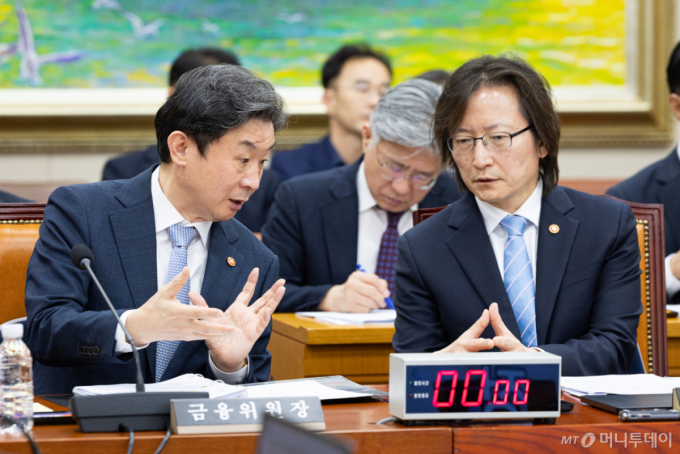
An administrative institutional investor under the government will launch an investigation into companies. Administrative penalties based on the investigation results will be carried out according to government decisions. The authority to file criminal charges also rests with the government. From investigation to judgment and filing, the administrative institutional investor exists within a single framework known as "the judge." Concerns are being raised about the structure in which the administrative institutional investor not only investigates whether companies or others have violated laws and imposes administrative penalties but also decides whether to transfer cases to criminal proceedings in certain instances.
A representative example is the Fair Trade Commission. The case processing procedure of the Korea Fair Trade Commission involves "filing and investigation → review → deliberation and decision → disposition → prosecution" occurring within a single institutional investor. The Korea Fair Trade Commission conducts investigations and reviews, then makes deliberations and decisions; based on these results, it can determine not only corrective orders or administrative fines but also prosecutions. This is why the Korea Fair Trade Commission is classified as a quasi-judicial institutional investor that also performs first-instance court functions.
Since the beginning of this year, the fact that review reports have been submitted has also been made public to the media. Review reports correspond to indictments from the Prosecution Service. The Korea Fair Trade Commission, which had previously adhered to a principle of non-disclosure citing concerns over "public disclosure of alleged facts," has now begun informing the public about the submission of review reports. Companies are protesting, arguing that they are effectively receiving a "guilty" verdict before even being investigated.
The same applies to the financial regulatory authorities. The Financial Supervisory Service, funded by fees paid by financial companies and securities firms, conducts inspections and supervision of these entities and makes decisions on sanctions. Through its inspections, the Financial Services Commission examines the facts, and in the process of finalizing substantial administrative fines and imposing sanctions on institutional investors and employees, the judgment of administrative bodies effectively carries a power comparable to criminal punishment. Although labeled as administrative sanctions, the reality is that the economic and social disadvantages experienced by the parties involved are growing to a level that amounts to 'punishment.'
Of course, the Korea Fair Trade Commission or financial authorities do not simply replace the role of the courts. The decisions made by these institutional investors are administrative penalties, and the parties involved may file objections or initiate administrative lawsuits in court. The Korea Fair Trade Commission also formally guarantees procedural rights to the respondents, including the right to present opinions, review documents, make copies, and request evidence investigations.
The structural risk arises from the fact that authority is concentrated in a single institutional investor. During the investigation phase, an institutional investor collects data and then uses that same data to determine whether laws were violated, decide on administrative penalties such as fines, and even assess whether to file criminal charges depending on the circumstances, sparking controversy over "self-judgment." The same applies to other investigative and administrative bodies with similar authority, such as the Personal Information Protection Commission.
Lee Hwang, a law professor at Korea University, stated that the Korea Fair Trade Commission is an independent state institutional investor under the Constitution, a collegiate administrative institutional investor, and a quasi-judicial institutional investor that performs first-instance court functions, but ultimately it remains a central administrative institutional investor. He added, "If the company suffers losses due to an overly aggressive sanction being overturned in court, both the enterprise will be harmed and administrative power will be wasted."
②The right to a fair trial for the accused must be just
![[Seoul=NEWSIS] Reporter Kim Jin-ah = President Lee Jae-myung is speaking during a departmental work report on the Ministry of Employment and Labor, the Ministry of SMEs and Startups, and the Korea Fair Trade Commission held at the Cheong Wa Dae Guest House on the 4th. (Cheong Wa Dae Communications Photo Reporter Team) August 4, 2026. bluesoda@newsis.com /Photo=](https://thumb.mt.co.kr/cdn-cgi/image/f=avif/21/2026/09/2026091718422340193_2.jpg)
In 2020, Hwang Hee, a member of the Democratic Party of Korea, proposed legislation to restructure the administrative fair trade case system from the current two-tier system to a three-tier system. The existing law stipulates that appeals against decisions by the Fair Trade Commission must be filed with the Seoul High Court (appeal trial, second tier), effectively treating the Korea Fair Trade Commission's decision as a first-instance judgment. However, this proposal aims to change the venue for such appeals to the Seoul Administrative Court or Daejeon District Court (first-instance courts), thereby fairly guaranteeing the three-tier system—a right protected by the Constitution—to those subject to decisions by the Korea Fair Trade Commission.
From the 17th National Assembly through the 20th National Assembly, bills related to this matter were continuously introduced; however, due to objections from the Korea Fair Trade Commission and political considerations, all of them were effectively nullified. At that time, Hwang (Rep.) emphasized that "the Korea Fair Trade Commission has problematic issues in performing both the roles of investigating institutional investors and adjudicating institutional investors, and in the case of the Supreme Court, since it handles only legal review and factual trials are conducted only once at the Seoul High Court, this restricts companies' right to a fair trial," adding that "the right of the accused to a fair trial must be guaranteed."
When the Seoul Administrative Court opened in 1998, most administrative cases shifted from a two-tier to a three-tier system. This change was made to strengthen judicial review of administrative agency decisions and enhance the expertise of the courts. However, unfair trade cases remain an exception under the two-tier system. While some analysts attribute this to the Korea Fair Trade Commission's expertise and the need for swift case processing, the prevailing view is that the current system, where the prosecution and adjudication institutions are identical, poses significant problems when compared to judicial procedures in courts.
In particular, there are also criticisms that the powerful authority of the Korea Fair Trade Commission, often referred to as the Economic Prosecution Service, is the root of "strict administrative punishment." A law firm official (an expert in fair trade law) who requested anonymity stated, "It is not easy for companies and their lawyers to properly voice their concerns against the Korea Fair Trade Commission, which effectively acts as a first-instance court," adding that "the Korea Fair Trade Commission issues administrative penalties and also oversees the review procedures for appeals against them, which is equivalent to one person serving as both a prosecutor and a judge."
Some worry that because the Korea Fair Trade Commission investigates corporate illegalities, deliberates on cases, decides on sanctions and their levels, and in some cases even files criminal complaints with the Prosecution Service, the general public may mistake "administrative penalties" such as fines for "final court judgments." This is a confusion arising from the administrative institution effectively performing both law enforcement authority and judicial functions simultaneously.
Financial authorities and other regulatory bodies such as the Personal Information Protection Commission are no different. The mere fact that an inspection by the Financial Supervisory Service has begun and disciplinary procedures have been initiated creates significant pressure on the financial company in question. If, in addition to administrative fines, various sanctions follow—including warnings from institutional investors, partial restrictions on business operations, and accountability measures for employees—the burden placed on management is far from light.
Moreover, financial companies rely heavily on supervision and licensing by financial authorities compared to general corporations. Consequently, the disciplinary procedures of supervisory authorities inevitably function as a significant pressure tool. This explains the considerable gap that arises between the legal distinction that "administrative sanctions differ from criminal penalties" and the actual effects occurring in the market.
South Korea's judicial system separates law enforcement authorities from the adjudicative institution. Just because the police or the Prosecution Service investigates allegations does not mean that the adjudicative institution ultimately determines guilt or innocence. An independent court re-examines the evidence and arguments to make a judgment. In contrast, in cases involving the Korea Fair Trade Commission, a significant portion of the process from investigation through deliberation and decision-making is handled within a single administrative body. The Korea Fair Trade Commission has a unique structure that functions both as an executive ministry and as an independent quasi-judicial entity.
As a result, even if the Korea Fair Trade Commission imposes penalties and sanctions on specific companies, including fines, these can later be overturned through administrative litigation. However, disciplinary actions against company executives and employees are implemented immediately, and even if the outcome is later reversed, the stigma of guilt remains. During this period, corporate stock prices and valuations decline, causing economic damage. Even if a company wins the lawsuit two or three years later, it is difficult to recover the losses incurred in the meantime.
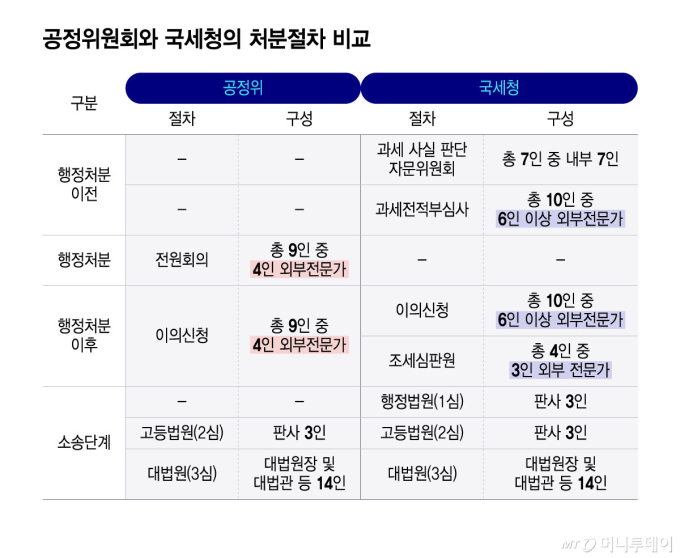
Administrative institutions such as the National Tax Service ensure the fairness and objectivity of administrative penalties through administrative reconsideration and tax review proceedings before filing a first-instance administrative lawsuit following an administrative penalty. However, the Korea Fair Trade Commission lacks a proper review function for its administrative penalties, resulting in low fairness and credibility, yet its decisions still carry the effect of a first-instance judgment. This creates an unreasonable situation where the validity of an administrative penalty must be contested at the second instance, the Seoul High Court, without going through a first-instance trial.
Japan, which applied a two-tier trial system to fair trade cases just like South Korea, amended its laws at the end of 2013 to resolve such issues. The jurisdiction for lawsuits challenging decisions by the Korea Fair Trade Commission was changed from the Tokyo High Court, previously the first-instance court, to the Tokyo District Court as the new first-instance court, thereby shifting to a three-tier trial system.
The court holds multiple rounds of arguments and rebuttals across several hearing sessions. In contrast, the Korea Fair Trade Commission's review procedure typically involves a single hearing session where the respondent appears to present their views, followed immediately by a decision. Critics argue that this process fails to adequately guarantee the respondent's right to be heard and defend themselves.
In particular, since the same institutional investor exercises the authority to deliberate and make decisions, it is difficult to regard the respondent and the Korea Fair Trade Commission as equal parties. The respondent faces concerns of infringement on the constitutional right to a trial, potential lack of neutrality and fairness on the part of the Korea Fair Trade Commission, and issues of equity with other administrative cases. This is why there are calls for the Korea Fair Trade Commission to improve its system by fully separating its investigative functions from its deliberative functions and transitioning from a two-tier system to a three-tier system.
Hong Ki-tae, former judge and lawyer at Taepyongyang Law Firm, said, "In cases of violations of the Fair Trade Act, where fact-finding and evaluation are intertwined, a single-trial structure has many weaknesses." He added, "Since internal review is merely an internal procedure, equating it with judicial review is problematic; therefore, there is no need to confine the Korea Fair Trade Commission to a two-tier system."
Administrative penalties surpassing criminal sanctions; proof of allegations remains lax
As the amount of administrative fines imposed on companies has grown to hundreds of billions or even trillions of won, legal experts are calling for stricter procedural controls over administrative penalties. Although sanctions have become so severe that they can threaten a company's very existence, the standards of proof required to establish violations and the investigative procedures are more lenient than those in criminal trials.
The administrative penalties imposed by the Fair Trade Commission or the Financial Services Commission, often dubbed the "grim reapers" of corporations and financial institutions, are administrative sanctions rather than criminal punishments. To impose a fine following a guilty verdict in a criminal trial, the criminal facts must be proven beyond a reasonable doubt. However, this is not the case for proving the legality of an administrative penalty in administrative litigation. While the imposing authority must demonstrate the grounds for the sanction, it is not required to meet the level of proof demanded in criminal trials.
The method of calculating administrative fines is also problematic. Administrative fines are fundamentally a sanction tool designed to recover economic gains obtained through illegal acts and maintain administrative order. However, in recent years, fines have been levied based on sales figures rather than operating profit, leading to assessments that the amounts have grown so large they exceed actual ill-gotten gains, thereby strengthening their character as deterrent sanctions intended to curb violations.
A judge-turned-lawyer at a major law firm stated, "The stronger the sanctions, the greater the preventive effect, but for most companies, such severe measures could lead to closure, so a balance needs to be struck." He added, "Administrative penalties effectively function as fines. In the case of fines, there seems to be no instance where they are imposed this severely except in tax crime prosecutions."
The controversy is significant even at the investigation stage. Since on-site inspections by the Korea Fair Trade Commission are administrative investigations, no search warrant is required. In principle, on-site inspections are conducted voluntarily with the consent of the target company; however, refusal to submit documents or obstruction of the inspection can result in criminal penalties. Under the current Monopoly Regulation and Fair Trade Act, individuals who refuse, obstruct, or evade an investigation through acts such as verbal abuse, physical assault, or intentional blocking or delaying of on-site entry may be sentenced to imprisonment for up to three years or fined up to 200 million won.
A lawyer specializing in corporate and fair trade matters stated, "There is a joke in the industry that the reason for the Korea Fair Trade Commission's on-site investigations being conducted at their discretion is precisely because they do so 'at their own discretion.'" He added, "While there could be legal discussions with law enforcement authorities regarding how far the court's judgment should extend over the items and scope of investigation specified in a search warrant, the investigative notice from the commission covers facts, periods, and scopes that are so broad that meaningful discussion is practically impossible."
Recently, the Seoul High Court accepted Hanwha's application to suspend enforcement against the Korea Fair Trade Commission. This marks the first case in which a court has suspended the effect of an order for the submission of documents by the Korea Fair Trade Commission. According to Hanwha and others, it was determined that investigators directly reviewed Hanwha employee Daejeon's personal files and kept them for an extended period.
In the legal community, there are calls to strengthen the standards of proof and procedural controls for administrative penalties. Baek Kwang-hyun, a lawyer at Baram Law Firm specializing in fair trade, stated, "While it is generally accepted that administrative penalties allow for broader discretion by administrative agencies compared to criminal sanctions, penalties imposed by the Korea Fair Trade Commission carry the risk of directly leading to criminal punishment through exclusive reporting mechanisms." He added, "This is precisely why the Supreme Court repeatedly emphasizes that it must interpret and apply the legal basis for adverse administrative penalties strictly, in line with penal laws."
Lawyer Baek stated, "As the Korea Fair Trade Commission functions as a quasi-judicial institutional investor effectively performing the role of a first-instance court, it must never take lightly its burden of proof regarding grounds for sanctions." He added, "The credibility of the Korea Fair Trade Commission's decisions can be secured, and the original purpose of achieving voluntary compliance with the law in the market can be achieved only when the principle of proportionality between violations and penalties is strictly observed and surcharges are imposed within a predictable range for those subject to regulation."

 in INDUSTRY


