

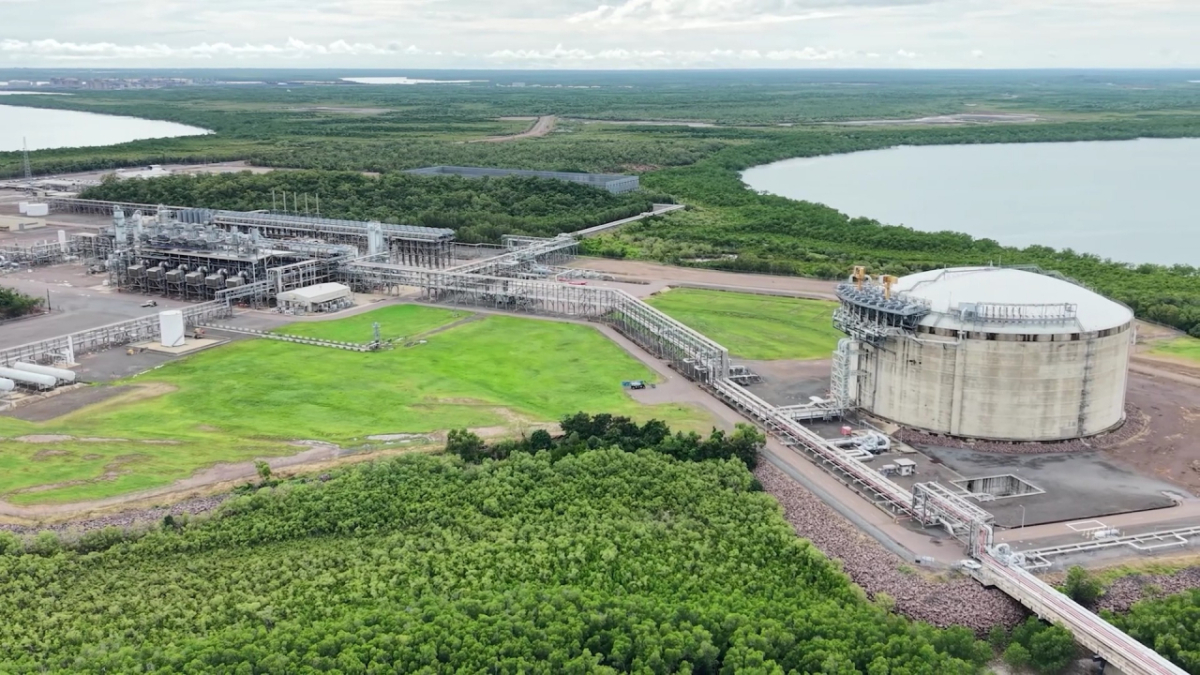
Darwin, the capital of Australia’s Northern Territory, on the 30th. After traveling about 40 minutes southwest along the coast from the city center, a dense mangrove forest spread out before us. At the end of a path cutting through that forest, an LNG (liquefied natural gas) plant with large and small silver pipes intertwined, along with massive cylindrical storage tanks, came into view. This is the Darwin LNG Terminal (DLNG), in which SK Innovation E&S holds a 25% stake.
This site is a key hub where natural gas produced at the Barossa gas field, located about 380 kilometers to the north in the middle of the sea, flows in via pipeline and is converted into LNG. Kim Hyeon-jun, a technical committee member of SK Innovation E&S’s LNG Business Division, whom we met on site, said, “After liquefaction, the LNG is stored in large-scale LNG storage tanks with a capacity of 180,000 cubic meters. Once a ship docks at the jetty, which is our offshore wharf facility, it is loaded.”
This year, after dedicating 14 years to the “Barossa Project,” SK Innovation E&S secured a long-term LNG import volume of approximately 1.3 million tons annually. This accounts for about 3% of South Korea’s annual LNG imports, allowing for stable supply of a total of 26 million tons of LNG over the next 20 years. It is the first case in which a domestic private company participated from the early stages of overseas resource development and successfully reached production. Because it is an overseas gas field in which the company participated from the development stage, it is possible to import a certain volume at stable prices even if LNG procurement costs rise due to factors such as the Iran war.
The “Barossa effect” does not end with LNG. In fact, about 300,000 barrels of ultra-light crude oil produced at the Barossa gas field arrived at Incheon Port last August. This is the first case in which a domestic private company directly imported ultra-light crude oil secured through overseas resource development. The volume was supplied to SKIncheon Petrochemical’s refining facilities and utilized for the production of petroleum products and petrochemical feedstocks.
Efforts by SK Innovation E&S, such as its “Barossa Project,” to diversify supply lines inevitably draw attention. This is because the situation in which resource supply through the Strait of Hormuz, through which about 20% of the world’s crude oil and LNG supply passes, has become difficult due to the Iran war, continues.
Kang Yoon-gwon, Gyeong Yeong-gi-hoek (Head) at SK Innovation E&S, emphasized, “The Barossa gas field and Darwin LNG Terminal have the advantage of enhanced resilience against various variables, such as rapidly changing market conditions like the Middle East conflict.” He added, “Ultimately, this translates into supply stability. We can proactively respond to changes in the market and supply-demand situations by utilizing flexible volumes.”
Domestic companies’ efforts to diversify resource supply lines are not limited to the “Barossa Project.” SK Earthon, an energy resource development subsidiary of SK Innovation, continues its efforts to secure oil and gas in China, Vietnam, Malaysia, and Indonesia. POSCO International has operated a Myanmar gas field since 2013 and expanded its base by acquiring Australian gas company Senex in 2022. It is also pursuing participation in the U.S. Alaska LNG Project, an area of interest for U.S. President Donald Trump.
A key element in the resource acquisition battle is, as always, “technology.” In the case of gas alone, it must be reduced in volume by turning it into an extremely low-temperature liquid to enable long-distance maritime transport. Upon entering the Darwin LNG Terminal plant, cylindrical liquefaction facilities labeled “COLD BOX” lined up came into view. The core of the liquefaction process involves preliminary treatment to remove carbon dioxide (CO₂), moisture, mercury, and other impurities from the gas coming from Barossa, followed by cooling the natural gas to minus 162 degrees Celsius.
We could observe gaseous natural gas transforming into liquid LNG through a three-stage cooling process using propane, ethylene, and methane as refrigerants. In this process, the volume is reduced to about one-six-hundredth of its gaseous state. Kim Hyeon-jun noted, “Each company uses different refrigerants and liquefaction methods. The efficiency of the liquefaction facility is determined by which refrigerant is used and how cheaply and quickly it can cool down to minus 162 degrees Celsius.”
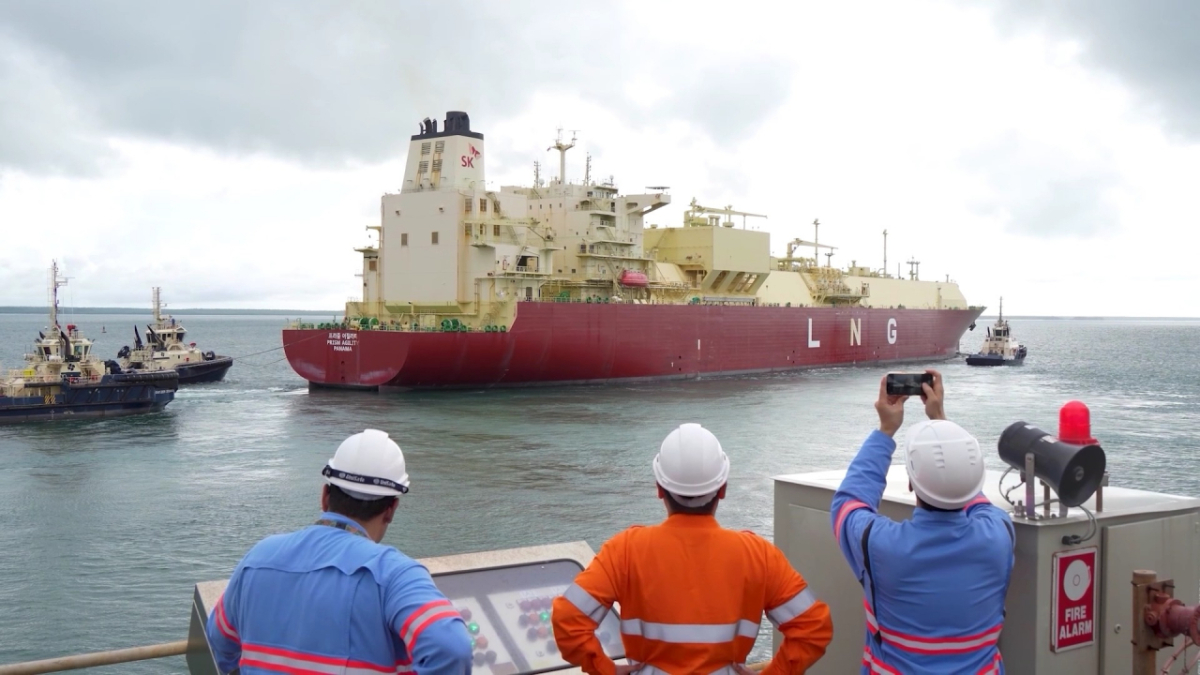
SK Innovation E&S has persistently pursued gas field development in Australian waters since 2012. It was a journey completing the entire process from gas field development to LNG production, shipping, and domestic import. And last February, it was able to unload its first volume at the Boryeong LNG Terminal in Chungnam Province via its own LNG carrier, “Prism Agility.” Kim Hyeon-jun said, “It is not an easy task for a private company to devote 14 years to a single project.”

 in INDUSTRY

