

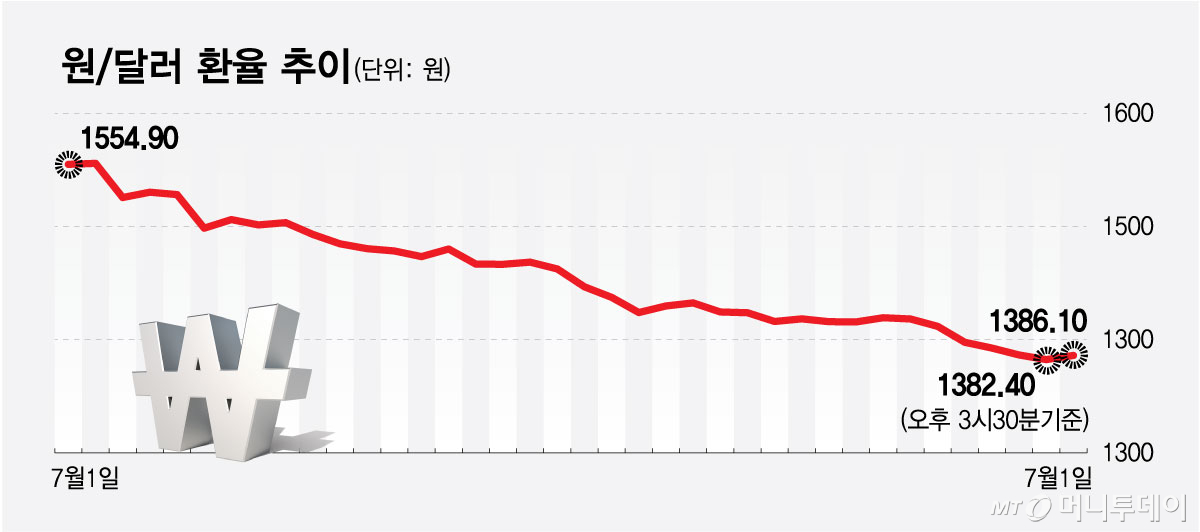
As the won/dollar exchange rate returns to the 1,380 won range for the first time in a year, interest grows in stocks that benefit during periods of a strong won. While it is generally expected that industries focused on domestic demand will fare well, some stocks have shifted from being domestic-focused to export-oriented over the past few years, prompting investors to exercise caution when making investment decisions.
On the 25th, in Seoul's foreign exchange market, the won/dollar exchange rate closed at 1,386.1 won as of 3:30 p.m., up 3.7 won from the previous trading day.
The won/dollar exchange rate had risen to as high as 1,555.80 won in early July but has since fallen below the 1,400 won mark due to a weakening of foreign investors' net selling pressure in the stock market, inflows of funds from SK Hynix's American Depositary Receipts (ADRs), and increased domestic currency conversion demand by export companies. This marks the first time since late September last year that the closing price of the won/dollar exchange rate has entered the 1,300 won range, and the entry into the 1,380 won range comes after more than a year.
Moon Da-um, a researcher at Hanwha Investment & Securities, stated, "For the foreseeable future, the won/dollar exchange rate is expected to face limited upward pressure centered around the 1,400 won mark." He added, "Recent U.S. employment, consumption, and inflation data have been released in ways that ease concerns about additional interest rate hikes by the Federal Reserve, supporting the downward trend in the exchange rate."
Consequently, securities firms anticipate that benefits will primarily flow to domestic-focused and consumer stocks due to reduced import costs and increased demand for overseas travel. The analysis suggests this could be a positive development for industries with high dollar-denominated payment shares, such as food, aviation, and utilities.
In particular, the securities industry believes that food stocks, which are representative domestic-focused businesses, will see improved earnings as the cost of imported raw materials such as grains, meat, and sugar declines. In fact, the Korea Exchange's Food & Tobacco Index rose by approximately 6%, from a closing price of 4,682.44 on July 2 when the won/dollar exchange rate was in the mid-1,500 won range, to the late 4,900s on this day. During the same period, the KOSPI index fell by approximately 12%, from 7,648.09 to 6,742.74.
Sim Eun-ju, a researcher at Hana Securities, said, "It was a week with many inquiries regarding the sensitivity of the (food) sector to exchange rates after the won/dollar exchange rate plummeted from 1,480 won a month ago." She added, "Most small and medium-sized stocks are expected to benefit from the decline in the exchange rate."
However, experts point out that since the 2020s, large-cap stocks related to food and tobacco have shifted their character from domestic-focused to export-oriented due to the global spread of so-called "K-culture," making this a key investment point.
Specifically, KT&G, once a representative domestic-focused stock in Korea, recorded annual sales of 6.5796 trillion won last year, with overseas revenue from its core businesses surpassing domestic revenue for the first time. Similarly, Samyang Foods reported consolidated sales of 770.3 billion won for the second quarter of this year, of which overseas sales amounted to 645.8 billion won.
The securities industry opinion is that these large-cap stocks in food and tobacco, which grew based on domestic consumption, have now become de facto export-oriented businesses driven by overseas markets. Consequently, the criteria for classifying them as exchange rate beneficiary stocks are also changing, prompting warnings to investors to exercise caution.
Researcher Sim stated, "KT&G and Samyang Foods are now in a favorable position with a rising won/dollar exchange rate, while CJ CheilJedang has become neutral." She added, "Based on estimates, the impact of a 10-won fluctuation in the won/dollar exchange rate on profits is projected to be 5 billion won for KT&G and 2 billion won for Samyang Foods."
A securities industry official emphasized, "When discussing benefits from a strong won, it has become an era where one must look beyond simply labeling stocks as 'domestic-focused' and instead consider both the proportion of overseas revenue and sensitivity to exchange rates."

 in STOCK
